AC Joint Sprains
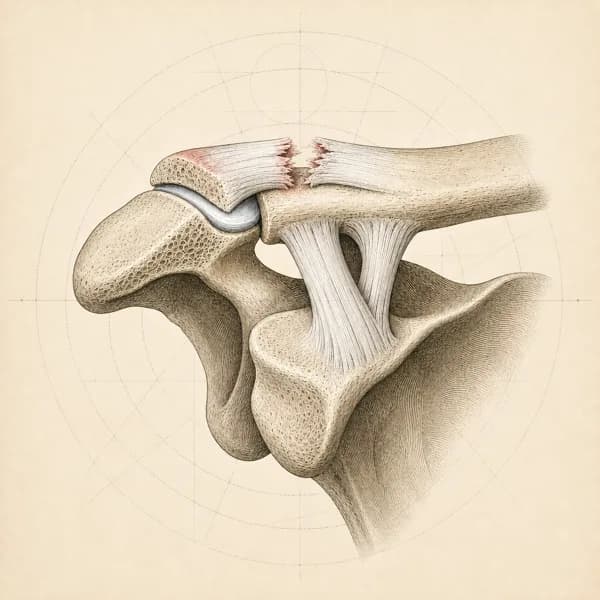
The acromioclavicular (AC) joint sits at the top of the shoulder, where the collarbone meets the shoulder blade. A fall or blow can sprain its supporting ligaments or separate the joint, sometimes leaving a bump. Arthritis can also affect this joint, causing pain with overhead reaching or bringing the arm across the body.
Key points
- What usually helps
- Rehab matched to the grade of the injury. Higher grades need a surgical opinion.
- What you can do now
- Keep the sling short term. Start gentle shoulder blade holds.
- How long it takes
- Depends on the grade and on what you are returning to; heavy lifting and contact sport come back last.
- When to see a doctor first
- Some signs need emergency care. Check the list before you start treatment.
Symptoms
Does this sound like you?
- Pain at the top of the shoulder
- A visible bump in more severe cases
- Pain with overhead activities
- Tender to press over the AC joint, where the collarbone meets the point of the shoulder
- Pain reaching across the body
Often alongside it
- Neck pain
- Difficulty sleeping on that side
- Weakness with pushing
- Clicking sensations
- Moving differently to work around the pain
Starts suddenly after an injury, or gradually with arthritis. The same movements hurt each time.
Before using this comparison, check when these symptoms need a doctor first.
When to see a doctor first
Go to emergency
Numbness, tingling, weakness, or a pale or cold arm or hand after the injury
Go to emergency now
Pain near the breastbone end of the collarbone with trouble swallowing or breathing after an injury
Go to emergency now
Shoulder or arm pain with chest pain, shortness of breath or sweating
Call 911
A hot, red, swollen joint, or fever
Go to emergency now
Get seen today
After a fall onto the shoulder: severe pain, a bone pushing up against the skin, a step that looks large or a clavicle pushed backward, or pain over the middle of the collarbone
Same-day medical assessment and X-ray to rule out a fracture or a high-grade separation that may need a surgical opinion
Treatment
How it is treated
Main approach. Lower-grade AC joint sprains (grades I and II) are managed with rehabilitation matched to the injury. For grade III separations, trials have found rehabilitation gives results similar to surgery for many people, while higher grades (IV to VI) usually need a surgical opinion.
Alongside it. Shoulder blade exercises and temporary changes to pressing and carrying can ease the load on the joint while it settles.
Managing it over time. Rebuilding shoulder strength before returning to contact sport, and padding where the sport allows it, may help protect the joint.
A typical rehabilitation progression
Three phases, from settling symptoms to returning to full activity.
Recovery from AC joint sprains is usually staged: calm the symptoms first, then rebuild the strength and capacity of the area, then return to your full activities. The phases below show how that can progress.
Phase 1Protect and Preserve
Take load off the injured ligaments while keeping the shoulder and shoulder blade muscles from weakening (deconditioning). A sling is used short term, often 1 to 2 weeks for higher-grade injuries, then phased out as pain allows. An international consensus (Beitzel and colleagues, ISAKOS, 2014) and current non-surgical programs emphasise switching on the shoulder blade and cuff muscles early rather than keeping the arm still for a long time, which tends to stiffen the joint and delay recovery. How long each phase lasts depends on the grade of the injury and on what you are returning to.
Example exercises
- Elbow, wrist and hand movement drills to stop them stiffening while you use the sling
- Shoulder blade setting drills (gently drawing the shoulder blade back and down) and gentle shoulder blade squeeze holds, below shoulder height
- Pendulum swings once tolerated, letting the shoulder hang relaxed and avoiding a pulling force across the AC joint
- Neck and upper back movement work, to ease the load on a neck that is working harder to protect the shoulder
- Static shoulder holds (isometrics) in pain-free middle positions once the early tenderness has settled
Possible progression milestones
Pain at rest below 3 out of 10, able to sleep in a tolerable position, tenderness over the joint reducing, and the arm able to be raised for you without pain (passive elevation) to 90 degrees in grade I or II, or to 60 degrees in grade III.
Phase 2Restore Scapular Control and Cuff Capacity
Once the ligaments have started to firm up, the joint tolerates load built up below and then at shoulder height. A 2013 consensus on the shoulder blade (Kibler and colleagues, the scapular summit) describes this as restoring shoulder blade position and movement before adding heavier cuff and pressing work. Avoid forceful stretches across the body and dips early on, because they squeeze the healing AC joint directly.
Example exercises
- Y, T and W arm lifts and rows lying face down, for the muscles that steady the shoulder blade, progressed from static holds to slow repetitions through movement
- Turning the arm outward and inward against a band or light dumbbell, elbow at your side
- Punches for the serratus anterior (the muscle that holds the shoulder blade against the ribs) and wall slides, to help the shoulder blade turn upward as you raise the arm
- Rows at chest height against resistance, drawing the shoulder blades back without shrugging
- A wall push-up progression with the hands fixed on the wall (closed-chain work), and a half-kneeling press with a light dumbbell, avoiding loading across the body
Possible progression milestones
Raising the arm fully yourself without painful catching, outward rotation strength approaching 70% of the other side, and no sharp AC joint pain when bringing the arm across the body or pressing straight forward at light loads.
Phase 3Return to Pressing, Contact, and Overhead Sport
Rebuild the loads your sport or job demands. This is where lifters and overhead athletes can get stuck, because the previous phase settles the pain but the joint has not yet been challenged under heavy load or contact. Return-to-sport guidance in research on AC joint injuries ties progress to milestones rather than fixed weeks: equal strength on both sides, shoulder blade control, and tolerating direct pressure on the joint.
Example exercises
- Bench press progression: floor press (pressing while lying on the floor, which limits the range) and close-grip variations before full-range wide-grip
- Overhead press progressions, from a landmine press to dumbbell and barbell presses
- Loaded carries (farmer, suitcase and racked kettlebell carries: weights in both hands, a weight in one hand, or a kettlebell held at shoulder height) to train the shoulder and shoulder blade to stay steady on the move
- Pull-up, chin-up and weighted row progressions, to load the muscles of the back fully
- Drills for contact sport (tackling shields, falling onto crash pads) and the overhead movements of your sport, with the amount built up in planned steps
Possible progression milestones
Strength within roughly 10% of the other side on pressing and rowing, pain-free bench press at pre-injury loads with a narrower grip, tolerating direct pressure on the AC joint (a strap pressing on it, contact), and confidence in the shoulder in unplanned or reactive movements.
What you can do now
- Keep the sling short term. After an injury, a sling is used short term, often 1 to 2 weeks for higher-grade injuries, and then phased out as pain allows. While you use it, keep moving your elbow, wrist and hand so they do not stiffen.After a fall, a bone pushing up against the skin, a large step, or numbness, tingling or a pale or cold hand needs medical care first: see the warning signs on this page for how urgently.
- Start gentle shoulder blade holds. Keeping the arm still for a long time tends to stiffen the joint and delay recovery. Phase 1 starts with gently drawing the shoulder blade back and down and holding it, below shoulder height.
- Take pressing out for now. Pressing squeezes the AC joint with high force, especially with a wide grip and the elbows flared. Early on, keep pressing out of your program completely, and avoid dips and forceful stretches across the body.Bring pressing back in order: landmine and floor press, then close-grip bench with the elbows tucked, then full-range bench with a narrower grip, with the wide grip last.
- Sleep off the sore side. The joint sits just under the skin with very little padding, so lying on it squeezes it. Most people do better on the other side, hugging a pillow under the sore arm, or on their back with a small pillow behind the sore shoulder to stop the arm drifting across the body.Night pain usually settles within 3 to 6 weeks, as long as the joint is not being irritated again and again during the day.
- Keep direct pressure off the joint. Pressure from a bag strap or contact presses straight on the injured joint. Tolerating that pressure is one of the last milestones in rehab, so keep it off the joint for now.
What I use in clinic
- Progressive loading. Strength work built up in step with healing to restore stability. Outcomes are good for most grade I to III injuries.
- Shoulder blade (scapular) strengthening. May help the shoulder share load and ease stress on the AC joint.
Recovery
How long it takes
Depends on the grade of the injury and on what you are returning to. Light daily activity usually comes back well before heavy lifting, overhead sport or contact sport, and higher-grade injuries take longer. Return to each is guided by strength and shoulder blade control rather than the calendar.
Many people return to full use of the shoulder. Some develop arthritis in the joint years later.
What changes the timeline
- How severe the injury is (its grade)
- What you need the shoulder to do
- Age
- Keeping up the rehab exercises
How I track it. I track how much the pain gets in the way of the tasks that matter to you, how well you move when I test those tasks in clinic, and how confident you feel in daily activities
Similar conditions
Conditions that can feel similar
- Rotator Cuff Tendinopathy or Tear
- Pain is felt on the outer upper arm (over the deltoid), with a painful arc as the arm lifts (60 to 120 degrees). Turning the arm outward or lifting it out to the side against resistance brings it on, and the AC joint itself is not tender to press. An AC joint problem gives pinpoint tenderness at the top of the shoulder and pain when reaching across the body (cross-body adduction).
- Subacromial Pain Syndrome
- A painful arc lifting the arm overhead, pain when the arm is raised or turned in set positions (Neer and Hawkins-Kennedy tests), and pain spreading into the outer arm. Moving the arm across the body for you is typically not what brings it on most, which sets it apart from an AC joint problem.
- Distal Clavicular Osteolysis
- Comes on gradually in weightlifters and CrossFit athletes, with pain over the AC joint during loaded pressing. Scans show typical changes: small cysts in the bone just under the joint surface and the end of the collarbone wearing away (resorption). It differs from a fresh separation because it follows repeated loading rather than a single injury.
- AC Joint Osteoarthritis
- Long-standing pain at the top of the shoulder in older people, grinding (crepitus) when reaching across the body, and a narrowed joint with bone spurs (osteophytes) at the AC joint on X-ray. Unlike a fresh injury, there is no fall or blow, and it comes on gradually.
- Sternoclavicular Joint Pathology
- Pain at the inner end of the collarbone, where it meets the breastbone (sternoclavicular joint), rather than at the outer top of the shoulder. The inner collarbone is tender, and reaching forward or bringing the arm across the chest brings it on. Easy to miss if the examiner does not press along the inner end of the collarbone.
- Cervical Referred Pain (C4 Dermatome)
- Pain at the top of the shoulder without tenderness over the AC joint. Moving the neck, or tilting the head and pressing down on it (Spurling test), brings it on, and reaching across the body does not.
Questions
What patients ask me most
What grade is my AC joint injury?
The Rockwood system grades AC separations from I to VI. Grade I is a sprain with no visible deformity. Grade II shows the end of the collarbone sitting slightly higher, but not above the top edge of the acromion (the bony point of the shoulder). In Grade III both the AC ligaments and the strong ligaments holding the collarbone down (coracoclavicular ligaments) are fully torn, with a clear step on examination. Grades IV to VI are rare, high-force injuries where the collarbone is pushed backward, far upward or downward, and they usually go straight to a surgical consultation. The ISAKOS 2014 consensus (Beitzel et al., Arthroscopy) split Grade III into stable IIIA and unstable IIIB, based on how well the shoulder blade is working and whether the collarbone overlaps the acromion on a cross-body X-ray. This helps decide between surgery and non-surgical care in the grey zone.
Do I need surgery for a Grade III separation?
For most people, no. Tang et al.'s meta-analysis (Medicine, 2018) comparing surgery and non-surgical care for Rockwood Type III AC dislocations found no statistical difference in clinical outcomes, and non-surgical care led to lower rates of bone forming in the ligaments (coracoclavicular ligament ossification) and bone loss at the end of the collarbone (lateral clavicle osteolysis). The 2019 Cochrane review of higher-grade AC injuries similarly found, with low-certainty evidence, that surgery did not clearly improve shoulder function, return to activities, or quality of life at one year. I reserve surgical referral for overhead athletes, manual labourers with high demands, or people whose shoulder blade control and function are still poor after 3 to 6 months of structured rehab, or an unstable pattern on a cross-body X-ray.
How long until I can go back to work or sport?
It depends on the grade and on what you are returning to. Light daily activity and desk work usually come back first. Heavy lifting at work, pressing in the gym, overhead sport and contact sport take longer, and higher-grade injuries take longer still. In two studies of college and military academy athletes, low-grade (Grade I and II) sprains cost an average of about 10 to 11 days of sport or training (Pallis et al., 2012; Dragoo et al., 2012). Higher-grade injuries took longer, and some of those athletes had surgery. These figures come from young athletes and may not match a manual job or a recreational player. Within each grade, the timeline depends on whether strength and shoulder blade control have been restored, and on whether your sport involves direct contact or heavy overhead load.
Will the bump ever go away?
Probably not completely. In Grade II and Grade III separations, the visible step where the end of the collarbone sits higher than the acromion often remains, even when the shoulder works well. Once pain settles and the cuff and shoulder blade muscles are strong, many people regain full use of the shoulder with the bump still visible. Ongoing pain or a feeling of instability deserves reassessment. Surgery can correct the cosmetic deformity but does not reliably improve function compared to rehab, which is why it is usually not recommended on cosmetic grounds alone.
Is it safe to bench press again?
Eventually yes, with modifications. The AC joint is squeezed and pushed forward and back with high force during pressing, especially with a wide grip and elbows flared, which is why bench press is one of the most commonly reported aggravators in recreational lifters. Early on I keep pressing out of the program completely. As things settle I reintroduce landmine press and floor press, then close-grip bench with the elbows tucked, then full-range bench with a narrower grip. The wide-grip competition-style bench is the last movement to come back. People who rush the wide grip tend to re-flare the joint.
Why does sleeping on that side hurt?
The AC joint is just under the skin at the top of your shoulder with very little soft tissue padding, so lying on it directly compresses an already irritated joint. Most people do better on the other side with a pillow hugged under the sore arm, or on their back with a small pillow behind the sore shoulder to stop the arm drifting across the body. Night pain usually settles within 3 to 6 weeks if the joint is not being repeatedly re-irritated during the day.
Can AC joint arthritis develop later?
It can. Arthritis after an injury (post-traumatic arthritis) or bone loss at the end of the collarbone (distal clavicular osteolysis) can develop years later, particularly in people who press heavily or do a lot of overhead work. It is not known whether rehabilitation changes that long-term risk, but building shoulder strength and returning to heavy pressing gradually can help the joint cope with the demands you put on it. If pain at the top of the shoulder comes back, it is worth having it reassessed.
Does a cortisone injection help?
It can help with wear-related AC arthritis or long-standing pain after an injury, where an injection into the joint can give meaningful short-term relief and allow loading work to progress. For a fresh, high-grade separation, an injection is not the main option, since the pain comes from torn ligaments, not joint inflammation. Injection is worth considering sparingly for long-standing pain when symptoms are blocking rehab, not as a first response. Injection itself is something I coordinate with a sports medicine physician. They perform the procedure, and I plan the loading work around it.
The science
The Science of AC Joint Sprains
AC joint injuries involve damage to ligaments connecting the clavicle to the . These range from sprains to complete separations. The joint is superficial and vulnerable to direct trauma.
Contributing factors
The AC joint is where the collarbone meets the top of the shoulder blade. Ligaments around the joint, and two strong ligaments running down to the shoulder blade (the coracoclavicular ligaments), hold it together. A fall onto the point of the shoulder is the usual cause of a sprain or separation: milder injuries stretch or tear the joint's own ligaments, and higher-grade injuries also tear the coracoclavicular ligaments, which is when a clear step appears at the top of the shoulder.
Pressing and carrying load the joint, and wide-grip bench press, dips and reaching across the body are common aggravators once it is sore. That is why I change those first and bring them back gradually.
AC joint changes become common with age and may follow an injury. They are often painless, and ordinary shoulder movement does not mean the joint is wearing away with each repetition. Some people who lift heavily develop pain from the end of the collarbone (distal clavicular osteolysis), which is listed under conditions that can feel similar.
Research
What the studies show
Surgery did not clearly improve results at one year for higher-grade AC separations
A 2019 Cochrane review of six trials (357 mainly young adults) found low-certainty evidence that surgery, compared with a sling and rehabilitation, may not improve shoulder function, return to former activities, or quality of life at one year, and that recovery was earlier without surgery.
The evidence is low certainty. Injury grade, how far the collarbone is displaced, skin or nerve concerns, the demands of your sport or work, and ongoing instability still affect whether a surgical opinion is worthwhile.
Tamaoki MJ, Lenza M, Matsunaga FT, et al. Surgical versus conservative interventions for treating acromioclavicular dislocation of the shoulder in adults. Cochrane Database Syst Rev. 2019;10(10):CD007429. PMID: 31604007.
X-ray grading (Rockwood) alone has limits for choosing treatment
A 2023 review of 35 studies found no treatment established as the standard for AC joint injuries, and not enough high-quality evidence to settle the choice. It called for a grading system that also captures how the shoulder moves, not only how the joint looks on X-ray.
Treatment decisions should take account of what you need the shoulder to do and your goals, rather than relying only on the grade seen on X-ray.
de Groot C, Verstift DE, Heisen J, et al. Management of acromioclavicular injuries: current concepts. Orthop Res Rev. 2023;15:1-12. PMID: 36814992.
Related Conditions
Conditions I commonly see alongside, or confused with, this one.
Getting back to it
Physiotherapy for AC joint sprains, built around the activity you want back.