MCL/LCL Sprains
The MCL (medial collateral ligament) supports the inner side of the knee; the LCL (lateral collateral ligament) supports the outer side. They resist sideways movement. A sprain can cause pain, swelling or instability. LCL injuries and injuries involving several ligaments may need a different plan from an isolated MCL sprain.
Key points
- What usually helps
- Early movement within any brace limits, and strength built up step by step.
- What you can do now
- Wear a prescribed brace as advised. Keep the knee moving within your limits.
- How long it takes
- MCL as a rough guide: grade I 2 to 4 weeks, grade II 4 to 8, grade III 8 to 12. The LCL can take longer.
- When to see a doctor first
- Some signs need emergency care. Check the list before you start treatment.
Symptoms
Does this sound like you?
- Pain on the inner side (MCL) or outer side (LCL) of the knee
- Swelling over the ligament
- A feeling that the knee is unstable
- Pain when the knee is pushed inward or outward
- Difficulty with sudden changes of direction (cutting)
Often alongside it
- Knee stiffness
- Difficulty fully straightening the knee
- Hip or ankle problems from moving differently to protect the knee
- Weakness in the front thigh muscle (quadriceps)
- A change in the way you walk
It starts with a sudden injury from a specific force on the knee. Pain and swelling stay over the ligament.Book an assessment for MCL/LCL sprains
When to see a doctor first
Go to emergency
The knee felt like it shifted out of place, or it is loose in more than one direction after the injury
Possible injury to more than one ligament or a knee dislocation. Go to emergency now, especially if the foot is cold, pale or numb
Get seen today
You cannot take four steps on the leg, or there is sharp tenderness on the bone (kneecap, top of the shin or top of the outer shin bone) after a fall or blow
Possible fracture. Same-day medical assessment for an X-ray
Foot drop, or numbness on the top of the foot or outer shin after an outer-knee (LCL) injury
Possible injury to the nerve on the outer knee. Same-day medical assessment
Calf swelling, warmth or tenderness, especially while you are using a brace or walking less
Same-day medical assessment to rule out a blood clot (DVT)
Check with your doctor
Large swelling within a few hours of the injury, or the knee locks and will not straighten
Possible cruciate ligament, meniscus or bone injury. See your family doctor or a sports medicine physician within a few days
Treatment
How it is treated
Main approach. Many Grade I and II sprains of the MCL or LCL alone return to sport with structured non-surgical care: moving the knee early, within any brace or weight-bearing limits, and building strength step by step. The research behind specific rehab programs is of low certainty.
Alongside it. A hinged brace that still lets the knee bend (functional bracing) can steady the knee while it heals and help prevent stiffness.
Managing it over time. Training that practises landing, cutting and knee control (neuromuscular training) is linked with fewer knee injuries in sports with pivoting, and can stay in your routine after you return to sport.
A typical rehabilitation progression
Three phases, from settling symptoms to returning to full activity.
Recovery from MCL and LCL sprains is usually staged: calm the symptoms first, then rebuild the strength and capacity of the area, then return to your full activities. The phases below show how that can progress.
Phase 1Protected Healing (Weeks 0 to 3)
Control swelling, protect the ligament from being pushed inward or outward again ( or stress), get the knee bending and straightening within comfortable limits, and keep the front thigh muscle (quadriceps) working. The 2017 clinical guideline on knee ligament sprains (Logerstedt and colleagues) supports early, protected movement over keeping the knee still for these side ligament injuries, because long rest weakens both the ligament and the muscles around it.
Example exercises
- Quad sets (tightening the thigh muscle with the leg straight) and straight leg raises in all four directions (forward, backward and to each side), to keep the thigh muscle from losing bulk without pushing the knee inward or outward
- Bending and straightening the knee on your own or with help, within a pain-free range, moving further as the protective muscle tension (guarding) settles
- Stationary bike once the knee bends to about 100 degrees, with a high seat and low resistance
- Hinged knee brace for Grade II and III injuries during walking and light daily activity
- Holds without movement (isometrics) for the muscles on the side of the hip and the hip's outward rotators, standing or lying on your side, to start building control at the hip
Possible progression milestones
Little or no swelling in the joint, knee movement nearly equal to the other side, walking without a limp in the brace, the thigh muscle contracting with no sag on a , and pain-free light exercises with the foot on the ground (closed-chain).
Phase 2Strength and Single-Leg Control (Weeks 3 to 8)
Rebuild strength on both legs and on one leg, bring back side-to-side loading under control, and restore confidence when the knee is pushed inward or outward. This is the phase where I see the most avoidable setbacks, because people feel good and skip the slow work that protects the ligament.
Example exercises
- Leg press, split squats and Romanian deadlifts, built up step by step toward the injured leg having more than 80 percent of the other leg's strength
- Step-ups and step-downs, checked in a mirror or on video to catch the knee dropping inward
- Side steps with a band around the legs, single-leg hip thrusts, and short-lever Copenhagen holds for the inner thigh (a side plank with the top leg supported), with the support at the knee rather than the ankle so the healing is not stressed
- Single-leg balance, first on firm ground and then on unsteady surfaces, adding head and trunk movements
- Pool running and gradual jog-walk intervals on land, once straight-line running causes no swelling afterward
Possible progression milestones
Front and back thigh strength around 85 to 90 percent of the other leg, a pain-free single-leg squat with the knee staying in line, and joint swelling that does not flare within 24 hours of training.
Phase 3Return to Cutting and Sport (Weeks 4 to 12+, depending on grade)
Bring back changes of direction, slowing down and contact. Grade I injuries often reach this phase around weeks 4 to 6. Grade III MCL injuries on their own more typically reach it at 8 to 12 weeks. The point of the phase is not time on the calendar; it is showing that the knee handles the specific demands of the sport you are returning to.
Example exercises
- A set of hop tests (single hop for distance, triple hop, crossover hop and timed 6 metre hop), aiming for the injured leg to reach at least 90 percent of the other leg
- Change-of-direction work, built up step by step: 45 degree cuts, 90 degree cuts, then cutting in reaction to a partner or signal
- Jumping and landing drills (), from two-leg to one-leg landings, adding slowing down and bounding sideways
- Sport-specific drills that bring back planned and unplanned inward or outward stress on the knee, under supervision
- Return-to-contact progression for collision sports, starting with controlled drills before full competition
Possible progression milestones
At least 90 percent of the other leg on strength and hop tests, clean changes of direction without the knee dropping inward, no joint swelling after training, and feeling confident in the knee during sport-specific tasks.
What you can do now
- Wear a prescribed brace as advised. For Grade II and III injuries, a hinged brace that limits the knee being pushed inward or outward can let you stay mobile early on without worrying about an awkward step. Wean off it when your clinician or surgeon says it is time, because long-term bracing does not strengthen the ligament.Early movement does not mean taking off a prescribed brace early.
- Keep the knee moving within your limits. Early, protected movement gets better results than keeping the knee still. Bend and straighten it within a comfortable range, and within any brace or weight-bearing limits you have been given.If the knee locks and will not straighten, see your family doctor or a sports medicine physician within a few days.
- Keep training the rest of your body. Upper body training, stationary cycling within a comfortable range, hip and core work, and single-leg balance on the uninjured side can all continue. What changes is the dose and the knee-specific exercises, not the fact of training.
- Build up the knee load gradually. Loading the knee step by step helps the ligament heal and restores its stability. As a rough guide for an MCL sprain on its own, Grade I takes about 2 to 4 weeks, Grade II about 4 to 8 weeks and Grade III about 8 to 12 weeks.An LCL injury, or an injury to more than one ligament, needs its own plan and can take longer.
- Watch for calf swelling or warmth. While you are in a brace or walking less, calf swelling, warmth or tenderness needs a same-day medical assessment to rule out a blood clot.
What I use in clinic
- Moving the Knee Early. This gets better results than keeping the knee still (immobilization).
- Progressive Strengthening. Building strength step by step restores the knee's stability.
Recovery
How long it takes
As a rough guide for isolated MCL sprains: Grade I about 2 to 4 weeks, Grade II about 4 to 8 weeks, Grade III about 8 to 12 weeks. Recovery varies, and LCL and combined ligament injuries can take longer.
MCL sprains have good potential to heal with appropriate management. The LCL heals less predictably, and a complete LCL tear often needs a surgical opinion.
What changes the timeline
- How severe the sprain is (its grade)
- Other injuries in the knee at the same time
- What your sport asks of the knee
- The quality of the rehabilitation
How I track it. I track how much the pain gets in the way of the tasks that matter to you, how well you move when I test those tasks in clinic, and how confident you feel in daily activities
Similar conditions
Conditions that can feel similar
- Medial Meniscus Tear
- Tenderness along the joint line rather than along the length of the MCL, catching or locking, and pain on twisting and bending tests (McMurray or Thessaly tests). It often follows a twist with the foot planted, rather than a straight blow that pushes the knee inward (valgus).
- ACL Tear with Associated MCL Injury
- A large swelling inside the joint within hours, a pop at the time of injury, the shin bone moving too far forward or the knee shifting on testing (positive Lachman and pivot shift tests), and a sense of the knee giving way. An MCL sprain on its own typically gives more localized swelling over the ligament, and the Lachman test is stable.
- Posterolateral Corner Injury
- The outer side of the knee opens up when the knee is pushed outward (varus instability), and the shin turns outward further than normal with the knee bent 30 degrees (dial test). The injury is often the knee bending backward too far (hyperextension) or a blow to its outer back corner. It is easy to miss when attention stays on the obvious pain on the outer side, and it commonly happens together with cruciate ligament injuries.
- Pes Anserine Bursitis or Tendinopathy
- Pain two to three finger-widths below the inner joint line, where a group of tendons attaches (the pes anserine), rather than over the MCL itself. It comes on gradually with overuse rather than from a distinct injury, and the knee does not open up when pushed inward on testing.
- Iliotibial Band Syndrome
- Pain on the outside of the knee, at the bony bump at the end of the thigh bone (the epicondyle), that can be confused with LCL pain. It is brought on by repeated bending and straightening, such as running, rather than by pushing the knee outward, and the knee is not loose on testing.
- Tibial Plateau or Proximal Fibula Fracture
- A high-energy injury, tenderness over bone rather than ligament, and often being unable to take weight on the leg. Tenderness at the top of the thin outer shin bone (the proximal fibula) after the knee is forced outward (a varus injury) should in particular raise concern that a piece of bone has pulled away with the LCL or the outer back corner of the knee (an avulsion). It needs imaging.
Questions
What patients ask me most
What is the difference between an MCL and an LCL injury?
The MCL is on the inner side of the knee and is usually sprained when the knee is pushed inward, by a blow to the outside of the knee or a planted-foot twist. The LCL is on the outer side and is usually sprained when the knee is pushed outward or hyperextended. MCL sprains are far more common and usually heal well without surgery, even when complete. LCL injuries are less common, are more often part of a wider injury to the outer corner of the knee, and a complete LCL tear usually needs a surgical opinion.
Do I need surgery for a torn MCL?
Usually not. MCL tears on their own, including complete Grade III injuries, heal well with structured rehabilitation in the large majority of cases. This is one of the few knee ligaments with a strong natural ability to heal. Older work by Indelicato on how these injuries heal without surgery, and more recent systematic reviews, consistently support treatment without surgery as the default. Surgery is considered when the MCL is torn together with an ACL, PCL or posterolateral corner injury, when the ligament has pulled off the shin bone and that does not heal (a tibial-sided avulsion), or when the knee stays loose when pushed inward (persistent valgus laxity) after a full rehabilitation trial.
Is LCL injury treated the same way as MCL?
No, and this is where I try to be honest with patients. The MCL is a broad ligament with good blood supply and heals predictably. The LCL is a smaller cord-like structure that heals less well, and it is rarely injured on its own. Grade I and II LCL sprains can be managed without surgery, but a Grade III LCL tear, especially with any injury to the outer back corner of the knee (the posterolateral corner), often needs a surgical opinion early. Missing a posterolateral corner injury and rehabbing it as a simple sprain is a known way to end up with a knee that stays unstable.
How long until I can run and return to sport?
Grade I sprains tend to return to running in 2 to 3 weeks and sport by 4 weeks. Grade II is typically 4 to 8 weeks, with sport-specific cutting work starting once single-leg strength and control approach the other side. Grade III isolated MCL injuries often take 8 to 12 weeks for return to sport when the rest of the knee is stable. These are ranges, not promises. I use criteria like pain-free single-leg squat, symmetrical hop performance, and confidence on cutting drills rather than a pure calendar date.
Do I need to wear a knee brace?
A hinged knee brace that limits the knee being pushed inward or outward is reasonable during the early healing phase for Grade II and III injuries, and I often use one to let patients stay mobile without worrying about an awkward step. It is not a lifetime commitment. The goal is to wean off the brace as strength and control return, on your clinician's or surgeon's advice. Long-term bracing does not strengthen the ligament, and weaning at the right time helps you build confidence in the knee.
Will I always be unstable after an MCL tear?
Many people regain a knee that is stable in everyday use, but some keep a small amount of looseness (laxity) on testing that never fully disappears. What often matters more is whether the knee feels stable when you change direction, twist or slow down. That depends on front thigh (quadriceps) strength, hip control and balance and control retraining, as well as on the ligament itself. Many people who work through progressive strengthening and return-to-sport testing end up with a knee they trust, even if the ligament itself heals slightly longer than the other side.
Do I need an MRI?
For a clear MCL sprain on its own, where the knee was pushed inward, the tenderness is only on the inner side, and the other ligament tests show a stable knee (varus stress, Lachman and posterior drawer tests), imaging is not mandatory to start rehabilitation. I cannot order imaging myself, so I flag it to your family doctor or a sports medicine physician and refer you when imaging would change the plan: when how it happened or the exam suggests a combined injury, when the LCL or posterolateral corner is in question, when there is joint-line tenderness suggesting a meniscus tear, or when you are not progressing as expected.
Can I still exercise during recovery?
Yes, and I strongly prefer that you do. Early, protected loading and work on how far the knee bends and straightens produce better outcomes than keeping the knee still, which is supported by the MCL rehabilitation literature. Upper body training, stationary cycling within a comfortable range, hip and core work, and single-leg balance on the uninjured side can all continue. What changes is the dose and the knee-specific exercises, not the fact of training.
Will this cause arthritis later?
MCL injuries on their own that heal well do not have a strong link to later osteoarthritis. The risk rises when the MCL injury is part of an injury to several ligaments, when there is a meniscus tear as well, or when the knee is left loose and loaded differently. That is part of why I do not treat a grade III MCL as a trivial injury, even when it heals without surgery. The quality of the rehabilitation affects how the joint is loaded for years afterward.
The science
The Science of MCL/LCL Sprains
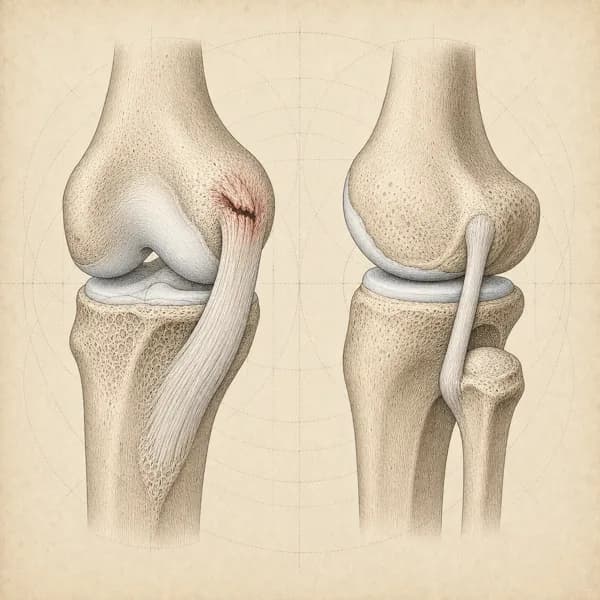
The MCL (medial collateral ligament) runs down the inner side of the knee, and the LCL () runs down the outer side. Together they stop the knee bending sideways: the MCL resists the knee being pushed inward, and the LCL resists it being pushed outward.
They are usually injured in different ways. The MCL is one of the most commonly injured parts of the knee (Phisitkul et al., Iowa Orthopaedic Journal, 2006). It is typically sprained by a blow to the outside of the knee or a twist with the foot planted that makes the knee buckle inward, which is common in hockey, soccer, football and skiing. The LCL is injured less often, usually by a force to the inner side of the knee, a hyperextension or a twist, and it is often hurt together with the structures at the back and outer corner of the knee (the posterolateral corner) or a (Grawe et al., Journal of the American Academy of Orthopaedic Surgeons, 2018).
They also feel different. An MCL sprain hurts along the inner knee, with tenderness over the ligament and swelling that is usually mild and local. An LCL sprain hurts on the outer knee, near the top of the fibula. With either, a higher-grade sprain can make the knee feel loose when it is pushed sideways or when you change direction.
Both are graded I (stretched), II (partly torn) or III (fully torn), but they heal differently. The MCL has a good blood supply and heals well without surgery in most cases, including many complete isolated tears (Indelicato, Journal of Bone and Joint Surgery, 1983). As a guide, isolated MCL sprains take about 2 to 4 weeks to return to sport at grade I, 4 to 8 weeks at grade II and 8 to 12 weeks at grade III. The LCL heals less reliably. Grade II LCL sprains generally do well with rehabilitation, but grade III LCL injuries had poorer long-term results without surgery in follow-up research (Kannus, American Journal of Sports Medicine, 1989), so they usually need a surgical opinion early.
In clinic I test both sides of the knee and the cruciate ligaments, because an outer-knee sprain that turns out to involve the posterolateral corner needs a different plan.
Contributing factors
The (MCL) serves as the primary restraint against forces that push the knee into a knock-kneed position. This ligament has substantial tensile strength. The superficial MCL provides 57% of the restraining valgus moment at 5 degrees of knee flexion and increases to 78% at 25 degrees, showing that the ligament's contribution varies with knee angle. This angle-dependence explains why MCL injuries often occur with the knee in slight flexion rather than full extension.
MCL injuries occur far more frequently than LCL injuries due to the relative exposure to valgus-producing forces. When a football player gets struck on the lateral (outside) aspect of their knee, the impact creates a valgus force that stresses the MCL on the medial side. This mechanism accounts for the majority of MCL injuries in contact sports. The force required varies based on knee position, muscle activation, and impact direction, and a sufficiently large lateral blow can cause MCL failure when protective muscle activation is insufficient.
The lateral collateral ligament (LCL) resists forces that push the knee into a bow-legged position. This ligament has significantly lower tensile strength than the MCL. At 30 degrees of knee flexion, the LCL serves as the primary stabilizer against varus stress, bearing the majority of restraining forces. Pure varus-directed contact is relatively uncommon compared to valgus forces, explaining the lower incidence of isolated LCL injuries. When LCL injuries do occur, they often involve more complex mechanisms including hyperextension or rotational components.
The collateral ligaments work in concert with the and joint capsule to provide knee stability. When your MCL is intact, it prevents the medial joint space from gapping open during valgus stress. If the MCL tears completely, the tibia can translate laterally relative to the femur, creating joint . Research using instrumented knee testing shows that isolated MCL tears allow increased medial joint opening at 30 degrees flexion, while combined MCL and posterior oblique ligament tears produce still greater opening, demonstrating the importance of secondary restraints in maintaining stability.
Athletic movements involving cutting and pivoting create dynamic valgus loads on the MCL. When you plant your foot and cut to change direction, your body's momentum creates an external rotation and valgus moment at the knee. If your quadriceps, hamstrings, and hip muscles don't activate quickly enough to control this motion, excessive valgus stress loads the MCL. Studies using motion capture in soccer players show that poorly controlled cutting maneuvers generate increased knee valgus angles, creating MCL forces approaching injury thresholds. Athletes with weak hip demonstrate greater dynamic valgus during cutting, increasing MCL injury risk.
Ski injuries create unique mechanisms for both MCL and LCL damage. The MCL "phantom foot" injury occurs when a skier catches their inside edge and falls backward with the knee twisted inward, creating combined valgus and external rotation forces. The ski boot acts as a long lever arm, amplifying forces transmitted to the knee. Biomechanical analysis of ski falls shows that the rigid boot substantially increases valgus moments compared to athletic shoes, explaining why MCL tears are among the most common knee injuries in recreational skiing.
Previous MCL injuries alter knee even after clinical healing. After an MCL sprain, the ligament often heals with increased length (), reducing its ability to restrain valgus forces. Some athletes develop chronic medial knee laxity after MCL injuries, demonstrating greater joint opening compared to the uninjured side during valgus stress testing. This residual laxity increases the risk of future MCL injuries and can contribute to premature medial compartment knee due to altered loading patterns.
Contact sports create the highest risk for MCL injuries through direct trauma mechanisms. In football, rugby, hockey, and soccer, lateral knee contact during tackling or blocking generates high-magnitude valgus forces. Tackle impacts can generate high peak forces capable of exceeding the MCL's failure threshold. The combination of high force magnitude, rapid loading rate, and inability to generate protective muscle contraction before impact makes these injuries particularly common and often severe in contact athletes.
Research
What the studies show
Rehab without surgery looks promising for MCL injuries on their own, but the evidence is very uncertain
A 2024 review by Svantesson and colleagues (BMJ Open Sport & Exercise Medicine) concluded that rehab without surgery for MCL injuries looks promising. It cautioned that the evidence is of very low certainty, that the studies varied a lot, and that grade I and grade II injuries were generally treated the same way.
Supports physiotherapy-led rehab as the usual first approach for an MCL sprain on its own, with realistic expectations about how strong the evidence is.
Svantesson J, Piussi R, Weissglas E, et al. (2024). Shedding light on the non-operative treatment of the forgotten side of the knee: rehabilitation of medial collateral ligament injuries-a systematic review. BMJ Open Sport Exerc Med. PMID: 38933372.
Guides on knee pain
Longer explanations of symptoms and scan-report wording.
- Pain Right Below the KneecapA single tender spot below the kneecap that flares with jumping, stairs, or deep squats. Most commonly patellar tendinopathy in active adults, and growth-plate conditions in young athletes.
- Suprapatellar Effusion (Fluid on the Knee)Extra fluid inside the knee joint, seen in the pouch above the kneecap. What the size words on a report mean, the usual causes by how quickly the swelling came on, and when to see a doctor first.
- Joint Space Narrowing in the KneeThe gap between the bones looks thinner than expected on an X-ray. What medial, tricompartmental and the severity words mean, how it relates to pain, and what the guidelines recommend.
Related Conditions
Conditions I commonly see alongside, or confused with, this one.
Getting back to it
Physiotherapy for MCL/LCL sprains, built around the activity you want back.