Hammer Toe Deformities
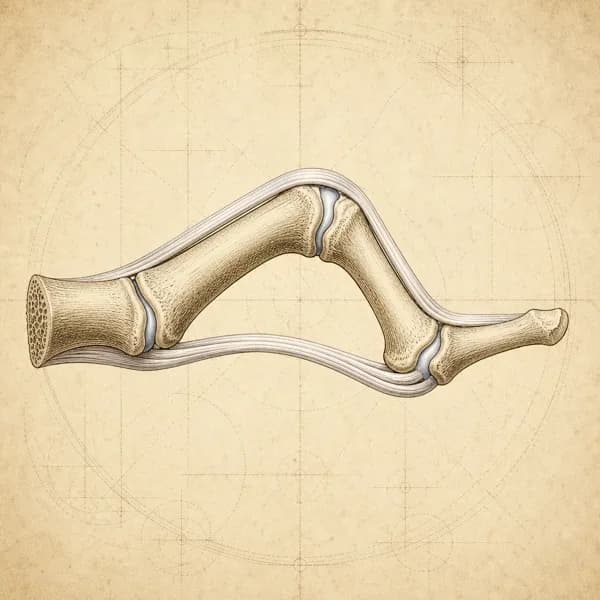
A hammer toe is a smaller toe that lifts at its base and bends down at its middle joint, most often the second toe. Early on it can still be straightened by hand, but over time it can stiffen into a fixed position. Pain usually comes from pressure and rubbing, such as a corn on top of the bent joint.
Key points
- What usually helps
- Roomy shoes, cushioning the bent joint, and gentle daily stretching of a toe that can still straighten.
- What you can do now
- Wear shoes with a wide, deep toe box. Cushion the bent joint.
- When to see a doctor first
- Some signs need emergency care. Check the list before you start treatment.
Symptoms
Does this sound like you?
- A smaller toe that bends upward at the base and down at the middle joint, so it looks buckled
- Rubbing, a corn, or a callus on top of the bent middle joint of the toe
- Soreness under the ball of the foot beneath the base of that toe
- Shoes feeling tight or painful over the toe
Often alongside it
- A callus or sore spot on the tip of the toe
- The toe can be straightened by hand early on, but becomes stiffer over time
- Often seen alongside a bunion or a long second toe
Usually develops gradually. Care depends on whether the toe is still flexible and whether the skin is being damaged. Broken skin, especially with diabetes or reduced feeling in the feet, needs prompt attention from your family doctor or foot care provider.Book an assessment for hammer toe deformities
When to see a doctor first
Go to emergency
A toe that turns pale, blue, or black, or feels cold
Go to emergency now to check the circulation
Get seen today
An open sore, blister, or ulcer on the toe, especially if you have diabetes or reduced feeling in your feet
See your family doctor or a foot care provider the same day; do not wait for a physiotherapy appointment
Redness, heat, swelling, pus, or fever
Same-day medical assessment for a possible infection
Check with your doctor
Numbness or burning in the toes or feet
See your family doctor before starting physiotherapy, to check for a nerve condition such as diabetic neuropathy
A toe that suddenly starts to drift, lift, or cross over its neighbour
See your family doctor for an orthopaedic opinion on a possible plantar plate tear
Treatment
How it is treated
A typical rehabilitation progression
Three phases, from settling symptoms to returning to full activity.
Recovery from hammer toe deformities is usually staged: calm the symptoms first, then rebuild the strength and capacity of the area, then return to your full activities. The phases below show how that can progress.
Phase 1Take Pressure Off the Toe and Wake Up the Small Foot Muscles (Weeks 1 to 4)
Early work is about giving the and the affected toe a break. That means consistently wearing shoes with a wider, deeper toe box, taking pressure off the top of the bent middle joint of the toe (the PIP joint) with silicone sleeves or padding if a corn or callus is present, and gently starting to use the small muscles inside the foot for comfort and toe control. Nothing in this phase should bring on sharp toe pain or break the skin.
Example exercises
- Daily wear of a shoe with a wide, deep, foot-shaped toe box and a heel under roughly 2 cm
- A silicone toe sleeve or gel cap over a painful bump on top of the middle toe joint, if shoe pressure is a factor
- Short-foot exercise, gently shortening the arch by pulling the ball of the foot toward the heel without curling the toes, 3 sets of 10 with 10-second holds
- Gently straightening the toe with your hand and easing the middle toe joint through its movement, holding the straighter position for 10 seconds, 10 repetitions per session, only within a comfortable range
- Toe splay holds, actively spreading the toes apart, 3 sets of 10 with 5-second holds, seated to start
Possible progression milestones
Comfortable daily walking in wider shoes, no broken skin over the toe, and doing the short-foot and toe-spreading work every day without cramping or pain.
Phase 2Build Control of the Small Foot Muscles and Smaller Toes (Weeks 4 to 10)
Once the toe is less irritable, the work shifts to rebuilding strength and coordination in the small muscles inside the foot and in the muscles that balance the long and short muscles that bend the toe (the toe flexors). Gentle foot exercises may support comfort and control in a flexible toe and help share the load on the forefoot. They have not been shown to stop the toe getting worse or to straighten a toe that has become fixed. Keep adjusting your shoes and padding during this phase.
Example exercises
- Short-foot holds progressed from seated to standing on two feet, then to standing on one leg, 3 sets of 10 to 15
- Towel scrunches with the toes and picking up marbles or other small objects, 2 sets of 15 to 20 repetitions per foot
- Toe splay holds progressed to standing, 3 sets of 10 with 5-second holds
- Calf raise variations (rising onto your toes) with the heel moving cleanly in line with the second toe, 3 sets of 12 to 15, to keep the forefoot lined up as you push off
- Standing on one leg on firm ground with the foot neither rolled in nor out (a neutral foot posture), 3 sets of 30 to 45 seconds, progressing to a foam pad as tolerated
Possible progression milestones
Possible milestones, adapted to the person rather than treated as fixed cut-offs: a visible short-foot hold without the toes curling (clawing), steady balance on one leg on foam with the forefoot staying stable, and less day-to-day pain or pressure at the affected toe.
Phase 3Keep the Gains and Protect the Forefoot Long Term (From Month 3)
For a toe that is still flexible, the long-term plan is protecting the gains with suitable shoes worn consistently, some ongoing strengthening and attention to the rest of the forefoot. For a toe that has become fixed, this phase is about steady function with pain kept to a level you can manage, and clear conversations about when a surgeon's review is worthwhile. The work is less about any single exercise and more about a routine you can keep up.
Example exercises
- Strengthening the small foot muscles twice a week to keep the gains, rather than daily
- Periodic shoe reviews every 6 to 12 months, because sock thickness, shoe wear, and foot shape all change over time
- Building up walking or other low-impact activity gradually, with a sensible limit each week, rather than sudden jumps
- Keeping up calf and single-leg exercises with moderate resistance to support control of the forefoot
- Checking pain, function and any change in the toe's shape every 3 to 6 months, with a surgical opinion considered if symptoms are getting worse despite good non-surgical care
Possible progression milestones
Comfortable daily walking in suitable shoes, a toe position that is stable or slowly improving if the toe is flexible, and a clear understanding of the point at which a surgical opinion would help.
What you can do now
- Wear shoes with a wide, deep toe box. Look for a roughly foot-shaped toe box that is wide and deep, a heel under about 2 cm and a sole that bends through the forefoot. Walk around in shoes on a solid floor before buying, rather than trusting the size label alone.A corn, callus or blister on top of the toe from a shoe means the shoe is too shallow or too tight.
- Cushion the bent joint. A silicone sleeve or gel cap over a painful middle toe joint, or a silicone crest under the toes, can reduce pressure and pain during the day. They are useful add-ons alongside shoe changes and foot exercises rather than a cure, and for a stiff, fixed toe they are mainly for comfort.An open sore, blister or ulcer on the toe, especially if you have diabetes or reduced feeling in your feet, needs your family doctor or a foot care provider the same day; do not wait for a physiotherapy appointment.
- Straighten a flexible toe gently each day. If the toe can still be straightened by hand, ease it straighter and hold for 10 seconds, 10 repetitions per session, only within a comfortable range. This is gentle movement work for the middle joint while the toe is still flexible, not a way to straighten a toe that has become fixed.Stop if it brings on sharp toe pain or breaks the skin. A toe that suddenly starts to drift, lift or cross over its neighbour needs your family doctor, as the warning signs on this page explain.
- Wake up the small foot muscles. Sitting down, do short-foot holds (gently pull the ball of the foot toward the heel without curling the toes), 3 sets of 10 with 10-second holds, and toe-spreading holds, 3 sets of 10 with 5-second holds. These exercise the small muscles inside the foot for comfort and toe control.Ease off if the foot cramps or the exercises hurt.
Similar conditions
Conditions that can feel similar
- Claw Toe Deformity
- The toe bends down at both its middle and end joints, and up at the base joint where it meets the foot (the MTP joint). A true hammer toe bends down mainly at the middle joint (the PIP joint). Claw toe is often linked with nerve conditions or diseases that affect the whole body, and tends to affect several toes, on both feet.
- Mallet Toe Deformity
- The toe bends down only at its end joint (the DIP joint), and the middle joint is normal, unlike a hammer toe, which bends mainly at the middle joint. It most often affects the second toe and often comes from pressure from a longer neighbouring toe or a tight toe box.
- Morton's Neuroma
- Burning, electric or shock-like pain in the forefoot with numbness into neighbouring toes, rather than pain over the raised knuckle on top of a bent toe. Taking the shoe off and rubbing the forefoot relieves the symptoms. A bent toe may be present too, but it is not the main cause of the pain.
- Metatarsophalangeal Joint Synovitis or Plantar Plate Injury
- Pain and swelling sit at the joint where the toe meets the foot (the MTP joint), rather than over the knuckle on top of the toe. Pushing the base of the toe upward often shows too much movement or brings on pain (drawer test), and the toe may be drifting sideways or lifting up. An injury to the tough plate of tissue under the joint (the plantar plate) most commonly involves the second toe and can progress until the toe crosses over its neighbour (crossover toe).
- Hallux Valgus with Secondary Lesser Toe Deformity
- The main problem is at the big toe joint. The big toe angles toward the other toes, crowds them, and can lead to hammer toe changes. Treatment then often focuses on the big toe and its long foot bone (the first ray) rather than the smaller toe on its own.
Questions
What patients ask me most
What actually is a hammer toe?
A hammer toe is a change in the shape of one of the smaller toes, most often the second, where the middle joint of the toe (the proximal interphalangeal or PIP joint) stays bent, either fixed or partly fixed. The tip of the toe points down, the middle knuckle points up, and the joint at the base of the toe (the MTP joint) often sits bent slightly upward. Early on the toe is flexible and can be straightened by hand. Over time the joint capsule and tendons tighten and the deformity becomes rigid.
Why does this happen?
Several things combine. A long second toe crammed into a tight or pointed shoe toe box is a common mechanical driver. A bunion (hallux valgus) at the big toe can push the smaller toes out of position. A long-standing imbalance between the long and short muscles that bend the toe, weak small muscles inside the foot, and raised-heel shoes that concentrate load on the forefoot all contribute. In many cases the deformity develops slowly over years before pain or a visible callus brings the person in.
Can physiotherapy reverse a hammer toe?
That depends on whether the deformity is still flexible or has become rigid. Flexible hammer toes tend to respond reasonably well to a combination of footwear changes, strengthening the small foot muscles, toe splinting or taping, and addressing how the forefoot as a whole has been taking load. Rigid, fixed deformities do not straighten with conservative care. In those cases, the realistic goal of physiotherapy is to reduce pain, offload pressure points, preserve mobility in neighbouring joints, and help the person decide whether and when surgical consultation is appropriate.
What does the evidence actually show for conservative care?
Reviews of lesser toe deformities, such as Shirzad and colleagues (2011), are consistent that the evidence base for conservative management is limited and largely drawn from expert practice rather than large trials. What is reasonable is that footwear with a wide and deep toe box, strengthening of the small muscles inside the foot, and toe splints or silicone sleeves to offload pressure may improve comfort and control in a flexible toe. They are not proven to stop progression or to straighten a fixed deformity. I am honest with patients that the high-quality evidence for any one technique is thin, so the emphasis is on consistent, sensible mechanics rather than any single exercise.
What kind of shoe should I be wearing?
A shoe with a wide, deep, and roughly foot-shaped toe box, a heel under about 2 cm, and flexibility through the forefoot. The aim is to give the toes room to sit in their natural spread rather than being squeezed into a tapered point. If a callus, corn, or blister is developing on the top of the toe from a shoe, the shoe is too shallow or too tight. I suggest patients walk around in shoes on a solid floor before buying, rather than trusting the size label alone.
When should I see a surgeon?
When the deformity is rigid, painful despite reasonable footwear and conservative care, associated with recurrent ulceration or infection (particularly in people with diabetes or peripheral neuropathy), or when it is interfering significantly with walking, work, or quality of life. Surgical options range from soft tissue procedures in more flexible cases to fusing the joint, or removing part of it (resection arthroplasty), in rigid cases. The point of conservative care first is not to avoid surgery at all costs. It is to make sure surgery is actually needed before someone goes through it.
Will toe splints or crests actually help?
They can be useful add-ons rather than a cure on their own. Silicone crests under the toes, gel sleeves over a painful middle toe joint, and taping to gently straighten a flexible toe can reduce pressure and pain during the day. They work well when paired with shoe changes and foot strengthening. For a rigid toe, they are mostly about offloading and comfort rather than changing the shape of the joint.
The science
The Science of Hammer Toe Deformities
A hammer toe develops when the small inside your foot can no longer balance the pull of the longer tendons that run down from the leg. The intrinsics normally bend the toe at the joint where it meets the foot while keeping the smaller joints beyond it straight. When they can no longer do that, the toe buckles: it lifts at the base and bends at the middle joint.
Early on the deformity is flexible and the toe can still be straightened by hand. Over time the joint capsule, the small beneath the joint and the surrounding soft tissue adapt to the shortened position, and the deformity becomes fixed. That distinction matters, because a flexible toe has more room to respond to footwear change, padding and exercise, at least for comfort, than a rigid one.
Symptoms usually come from friction and pressure rather than the deformity itself. The raised middle joint rubs against the top of the shoe and forms a corn, while the toe tip and the ball of the foot beneath the base of the toe take more pressure than they were designed for.
Contributing factors
Footwear is the most common contributor. A narrow toe box squeezes the toes together, and any heel height shifts your weight forward onto the front of the foot, which increases the demand on the toes to grip. Both encourage the buckled position.
Foot structure plays a part too. A second toe that is longer than the big toe, a high arch that concentrates load on the ball of the foot, and a bunion that crowds the neighbouring toes can all raise the risk. So can conditions that weaken the small foot muscles or alter the nerve supply to the foot.
Because the toes are working harder to stabilise you than most people realise, deformity often reflects a foot that has been compensating for a long time. Assessment therefore looks beyond the toe itself to how you load the , what your footwear allows, and whether the deformity is still flexible.
Research
What the studies show
A review lists several causes of smaller toe deformities and describes non-surgical care with padding and appliances
A review of smaller toe deformities (lesser toe deformities) by Shirzad and colleagues (Journal of the American Academy of Orthopaedic Surgeons, 2011) lists poorly fitting shoes, injury, genetics, inflammatory arthritis, and nerve and metabolic conditions as causes. It describes non-surgical care with padding and devices worn on the toes (appliances), with surgery for those who do not respond.
Supports starting with footwear, padding and splinting, and getting a surgical opinion when a rigid, painful toe does not settle.
Shirzad K, Kiesau CD, DeOrio JK, Parekh SG. Lesser toe deformities. J Am Acad Orthop Surg. 2011;19(8):505-514. PMID: 21807918.
Shoes shorter than the foot were linked to deformity of the smaller toes in older people
In a study of 176 people aged 62 to 96 (Menz and Morris, Gerontology, 2005), most wore shoes narrower than their feet. Shoes shorter than the foot were linked with deformity of the smaller toes, and shoes much narrower than the foot with corns, bunions and foot pain.
Supports checking shoe length and width as a first step for hammer toes.
Menz HB, Morris ME. Footwear characteristics and foot problems in older people. Gerontology. 2005;51(5):346-351. PMID: 16110238.
Related Conditions
Conditions I commonly see alongside, or confused with, this one.
Getting back to it
Physiotherapy for hammer toe deformities, built around the activity you want back.