
Scaphoid Fractures
The scaphoid is a small wrist bone at the base of the thumb, often broken in a fall onto an outstretched hand. Swelling can be mild and the first X-ray can look normal. Persistent pain there after a fall needs prompt assessment; protect the wrist and avoid lifting or putting weight through it until assessed.
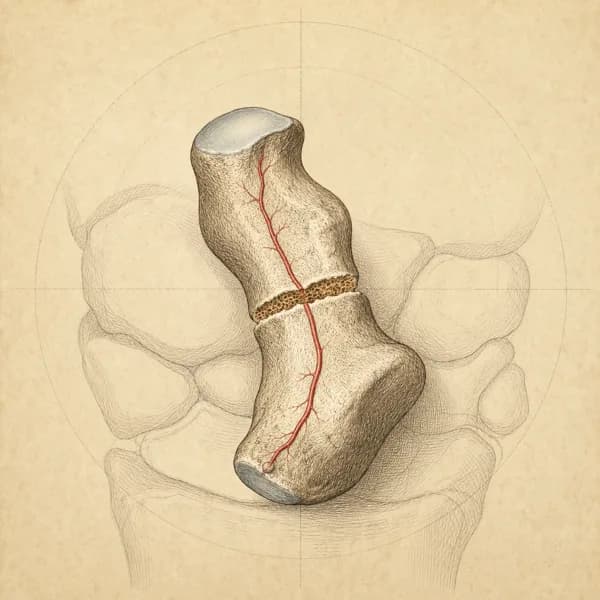
Key points
- What usually helps
- Protection first: a cast or splint, then rehab once healing has been confirmed on imaging.
- What you can do now
- Protect the wrist until it is checked. Follow your cast or splint plan.
- How long it takes
- A fracture across the middle of the bone is typically in a cast for around 6 to 12 weeks.
- When to see a doctor first
- Some signs need emergency care. Check the list before you start treatment.
Symptoms
Does this sound like you?
- Pain on the thumb side of the wrist after a fall onto an outstretched hand
- Tenderness in the hollow at the base of the thumb (the anatomical snuffbox) or over the bony bump on the palm side of the wrist
- Pain when gripping, pinching, or pushing the thumb in toward the wrist
- Mild swelling around the thumb side of the wrist
Often alongside it
- The wrist often still moves, which is why it can be mistaken for a sprain
- Reduced grip strength
- Pain putting weight through the hand, such as pushing up from a chair
- After a cast comes off: stiffness, weaker grip, and less forearm rotation
Usually a fall onto an outstretched hand, often in sport, on ice, or from standing. Pain may seem modest at first and the first X-ray can be normal, so persistent thumb-side wrist pain after a fall needs medical assessment and protection rather than reassurance from a single normal film.Book an assessment for scaphoid fractures
When to see a doctor first
Go to emergency
An obvious change in the shape of the wrist, severe swelling, or being unable to move the wrist or fingers after a fall
Go to emergency now
Numbness, tingling, or fingers that turn pale or cold after the injury or under a cast
Go to emergency now
Get seen today
Tenderness in the hollow at the base of the thumb (the snuffbox), or pain when the thumb is pushed in toward the wrist, after a fall on an outstretched hand
Get a prompt medical assessment and X-ray, the same day or next day, even if it looks like a sprain. Until then, support the wrist in a splint and avoid lifting or putting weight through it. An early X-ray can be normal, so continued suspicion needs follow-up imaging and protection
Check with your doctor
Snuffbox pain that returns or keeps going after the cast comes off
See the doctor managing your fracture before loading the wrist further, to check the bone has healed
Treatment
How it is treated
A typical rehabilitation progression
Three phases, from settling symptoms to returning to full activity.
Recovery from scaphoid fractures is usually staged: calm the symptoms first, then rebuild the strength and capacity of the area, then return to your full activities. The phases below show how that can progress.
Phase 1Restoring Movement While Protecting the Bone (Weeks 0 to 4 after cast removal)
The first block of rehab is about getting comfortable movement back in the wrist, forearm and thumb after weeks in a cast, without putting the healing scaphoid under sliding or squeezing forces (shear or compression) it is not ready for. Nothing in this phase should bring back pain in the hollow at the base of the thumb (the snuffbox), or pain when pressure goes along the thumb toward the wrist (axial loading). If it does, I scale back and check in with the treating physician before progressing.
Example exercises
- Gently bending the wrist forward and back, and tilting it toward the thumb and the little finger (flexion, extension, radial and ulnar deviation), in a pain-free range, 10 slow repetitions, 3 to 4 times daily
- Turning the palm down and up ( and supination) with the elbow tucked at your side, 10 repetitions, 3 times daily, progressing from no weight to holding a light broomstick
- Touching the thumb across to the fingertips and gentle thumb circles (opposition and circumduction), avoiding pressing hard through the thumb tip toward the wrist
- Tendon gliding sequence for the fingers (straight, hook, fist, tabletop, straight fist), 5 repetitions of each position 3 times daily
- Easing swelling (edema) by raising the hand, gentle massage from the fingers toward the elbow (retrograde massage), and a compression sleeve as tolerated
Possible progression milestones
Full or nearly full pain-free wrist movement, no tenderness in the snuffbox with daily tasks, and a comfortable light grip on a soft ball without pain on the thumb side. Confirm clearance from the treating physician to begin loading before moving to phase 2.
Phase 2Rebuilding Grip and Forearm Strength (Weeks 4 to 10)
Once movement is back and the bone has been judged healed, the priority shifts to rebuilding forearm and hand strength, grip endurance and the wrist's sense of position (). The bone has healed, but the muscles around the wrist, and their sense of position, have had weeks off. Progress is gradual, and I watch for any return of pain when the thumb takes load as a signal to back off.
Example exercises
- Grip work with putty or a soft ball, 3 sets of 10 to 15, gradually making it firmer as tolerated
- Strengthening for bending the wrist forward and back with a light dumbbell, moving slowly, 3 sets of 10 to 12
- Strengthening for turning the palm down and up (pronation and supination) with a light hammer held near its head, then gradually further down the handle for more leverage, 3 sets of 10
- Strengthening for tilting the wrist toward the thumb and toward the little finger (radial and ulnar deviation) with a light weight, 3 sets of 10
- Wrist control work (proprioception): rolling a small ball in circles under the palm on a table, then progressing to a wobble board for the hand
Possible progression milestones
Grip strength moving back toward the uninjured side from one test to the next, no pain in the snuffbox or at the base of the thumb with daily tasks or light loading, and comfortable palm-down and palm-up turning and wrist movement against a moderate resistance band.
Phase 3Return to Sport, Work, and Heavier Hand Use (Months 3+)
This phase tests whether the wrist copes with the loads of real life: push-ups, bench pressing, racquet and stick sports, manual trades and contact sports. I add load along the thumb and hand toward the wrist (axial loading) gradually, I keep an eye on any delayed pain the day after harder sessions, and I do not rush people back to activities that risk another fall onto the hand before their confidence and strength are genuinely there.
Example exercises
- Wall push-ups progressing to incline push-ups and then floor push-ups, 3 sets of 8 to 12, with a neutral wrist position
- Carrying moderate dumbbells (suitcase and farmer walks), building grip endurance over time
- Sport-specific reintroduction where relevant, for example racquet work starting with mini-tennis or shadow swings before full hitting
- Exercises for the muscles that steady the wrist while taking weight through the hand, such as on hands and knees (quadruped), a plank from tall kneeling, and a side plank on the hand
- Full-range wrist flexion and extension strengthening with moderate resistance, 3 sets of 8 to 12, 2 to 3 times per week as maintenance
Possible progression milestones
Return to pre-injury activities without snuffbox pain during them or the morning after, grip and forearm turning strength within a small margin of the uninjured side, and confidence catching body weight on the hand in activities like push-ups or controlled falls in sport.
What you can do now
- Protect the wrist until it is checked. After a fall onto an outstretched hand, tenderness in the hollow at the base of the thumb (the snuffbox), or pain when the thumb is pushed in toward the wrist, needs a medical assessment and X-ray the same day or next day, even if it looks like a sprain. Until then, support the wrist in a splint and avoid lifting or putting weight through it.An early X-ray can be normal, so if that pain continues after a clear X-ray, the wrist still needs protection and follow-up imaging. A change in the shape of the wrist, severe swelling, or being unable to move the wrist or fingers after a fall means go to emergency now.
- Follow your cast or splint plan. A fracture across the middle of the scaphoid that has not shifted out of place is typically treated with around 6 to 12 weeks in a cast, with repeat imaging to confirm healing before it comes off. Fractures near the end closest to the forearm often heal more slowly, so keep to the timing set by the surgeon or physician managing your fracture.Numbness, tingling, or fingers that turn pale or cold under the cast mean go to emergency now.
- Let healing, not the calendar, set the pace. After the cast comes off, start with gentle movement of the wrist, forearm and thumb. Hold off on lifting, push-ups and putting weight through the hand until healing of the bone has been confirmed on imaging and your doctor or surgeon has cleared you.If pain in the snuffbox comes back or keeps going after the cast comes off, see the doctor managing your fracture before loading the wrist further.
- Keep the fingers moving and the swelling down. Once the cast is off, run through the finger tendon gliding positions (straight, hook, fist, tabletop, straight fist), 5 of each, 3 times a day. To manage swelling, raise the hand, use gentle massage from the fingers toward the elbow, and wear a compression sleeve if it is comfortable.Nothing here should bring on pain in the snuffbox; if it does, scale back and check in with the doctor managing your fracture.
Recovery
How long it takes
A fracture across the middle of the bone is typically in a cast for around 6 to 12 weeks.
Similar conditions
Conditions that can feel similar
- Wrist Sprain (Scapholunate Ligament Strain)
- Pain on the back of the wrist rather than in the snuffbox, no clear tenderness over the scaphoid's bump on the palm side (the scaphoid tubercle), pain more central in the wrist, and usually less pain when the thumb is pushed in toward the wrist. The Watson scaphoid shift test (the clinician presses on the scaphoid while moving the wrist) does not reliably pick up every injury, so a fall on an outstretched hand with persistent wrist pain still warrants imaging before settling on a sprain.
- Distal Radius Fracture
- Tenderness on the back or palm side of the end of the forearm bone (the distal radius) rather than in the snuffbox, often with a visible deformity or marked swelling. It happens the same way, from a fall on an outstretched hand, which is why imaging should always include dedicated scaphoid views as well as standard wrist views.
- De Quervain's Tenosynovitis
- Thumb-side wrist pain that comes on gradually rather than after an injury, a painful thumb-and-wrist stretch test (Finkelstein's test), tenderness over the tendon tunnel on the thumb side (the first dorsal compartment) rather than deep in the snuffbox, and no history of a significant fall.
- First Carpometacarpal (Thumb Base) Osteoarthritis
- Pain further toward the hand, at the base of the thumb rather than in the snuffbox, pain when the thumb is pressed into its base joint and rotated (CMC grind test), joint changes on X-ray in older people, and no clear fall or injury that started it.
- Radial Styloid Fracture or Contusion
- Tenderness at one spot directly over the bony bump on the thumb side of the wrist (the radial styloid), rather than over the scaphoid or deep in the snuffbox, often with local swelling and bruising. X-rays clarify the difference, and I would not accept a label of a bruised styloid (styloid contusion) unless the scaphoid has been imaged adequately.
- Superficial Radial Nerve Irritation
- Burning or tingling over the back of the hand on the thumb side, rather than deep pain in the snuffbox. Tapping over the nerve on the thumb side of the forearm often sets off tingling (Tinel sign), and the pain does not change much when the thumb is pushed in toward the wrist.
Questions
What patients ask me most
I fell on my hand and my wrist still hurts. How do I know if it is broken or sprained?
You probably cannot tell from the outside, and the clinical exam only takes you so far. Rhemrev and colleagues' 2011 review in the International Journal of Emergency Medicine makes the point that the classic bedside tests (snuffbox tenderness, pain when the thumb is pushed in toward the wrist, and pain when the scaphoid is compressed) are sensitive but not specific: they pick up most fractures but are also positive in many wrists that are not broken. They are good at raising suspicion, but they cannot rule a fracture in or out on their own. If you have snuffbox tenderness or pain when the thumb is pushed in toward the wrist after a fall on an outstretched hand, the wrist should be supported in a splint, kept from lifting and weight-bearing, and assessed promptly for an X-ray, the same day or next day, not watched to see if it settles. I refer you for that through your family doctor or urgent care. An early X-ray can be normal, so continued suspicion needs follow-up imaging and protection.
Why do people worry so much about scaphoid fractures compared with other wrist injuries?
Two reasons. First, the scaphoid has an unusual blood supply that enters at the end nearest the fingers and runs back toward the forearm. A fracture near the end closest to the forearm (the proximal pole) can disrupt blood flow to that piece of bone, which raises the risk of the bone dying (avascular necrosis). Second, fractures fail to heal (non-union) more often than in most other wrist bones, particularly when the fracture has shifted out of place or is near the proximal pole. A missed or undertreated scaphoid fracture can become a long-term wrist problem, so the threshold for imaging should stay low.
What tests will a clinician actually do at the bedside?
I am looking to build a hypothesis rather than tick boxes. Steinmann and colleagues (2006) described three bedside manoeuvres that together raise or lower suspicion: tenderness in the anatomical snuffbox, tenderness over the scaphoid tubercle on the palm side, and pain when the thumb is pushed in along its length toward the wrist (axial compression). None of them is diagnostic on its own, but combined with the story of the fall and the pattern of pain, they tell me how likely a fracture is. If any of them is positive after a fall, I ask you to support the wrist in a splint and refer you for a prompt X-ray, the same day or next day, because the cost of missing a scaphoid fracture is much higher than the cost of an X-ray.
The X-ray was clear but my wrist still hurts. What now?
Early X-rays miss a meaningful share of scaphoid fractures. The practical approach in many settings is to treat as a suspected scaphoid fracture, immobilise, and re-image at around 10 to 14 days, or move to MRI or CT earlier if symptoms are severe or the person cannot tolerate waiting. I would not accept a single clear X-ray as the final word when snuffbox tenderness and thumb-loading pain are still clearly present.
Do I need surgery, or will a cast be enough?
For fractures across the middle (waist) of the scaphoid that have not shifted out of place (undisplaced), the 2020 SWIFFT trial published in The Lancet (Dias et al.) compared cast immobilisation with surgical fixation and found no meaningful difference in patient-rated wrist scores at one year, with more surgery-related serious complications in the surgery group and more cast-related complications in the cast group. For undisplaced fractures, cast management is a reasonable first choice. Fractures that have shifted, fractures near the proximal pole, and fractures that have not healed (non-unions) are a different conversation and generally move toward surgical consultation because the non-union risk is higher.
How long will I be in a cast?
Typical non-operative treatment for an undisplaced scaphoid waist fracture is around 6 to 12 weeks of cast immobilisation, with repeat imaging to confirm healing before the cast comes off. Proximal pole fractures often heal more slowly and may need longer. Exact timing depends on fracture location, imaging findings, and the surgeon or sports medicine physician overseeing care.
What does physiotherapy look like after the cast comes off?
The wrist is usually stiff, the forearm muscles have weakened, and people are understandably cautious about loading the hand. My early work is gentle range of motion for the wrist, forearm, and thumb, gradually rebuilding grip strength, restoring the wrist's sense of position (proprioception), and introducing loading progressions that respect the healing tissue. I do not rush putting weight through the hand and I keep a close eye on any return of snuffbox pain, because that would prompt a conversation with the treating physician before pushing forward.
Will my wrist ever feel normal again?
Most undisplaced fractures that are recognised early and managed appropriately heal and return close to normal function. Stiffness and grip weakness usually resolve with structured rehabilitation. The cases that struggle are often the ones that were missed initially, that went on to non-union, or that involved the proximal pole. That is why I take the initial picture seriously and do not shortcut the diagnosis.
The science
The Science of Scaphoid Fractures
The scaphoid sits between the two rows of carpal bones and acts as a bridge between them, so a large share of the load crossing your wrist passes through it. That position is also what makes it vulnerable: a fall onto an outstretched hand with the wrist extended drives force directly across the bone.
What makes the scaphoid different from most fractures is its blood supply. Vessels enter near the far end of the bone and travel backwards through it, so a fracture through the middle or the near end can interrupt supply to the fragment closest to the forearm. That fragment then has limited ability to heal, which is why these fractures are associated with delayed healing, , and in some cases loss of blood supply to the bone.
Early scaphoid fractures are frequently missed. Swelling is often modest, the wrist can still move, and initial X-rays can appear normal even when a fracture is present. Persistent tenderness in the hollow at the base of the thumb after a fall warrants medical assessment and further imaging, such as repeat X-ray, CT or MRI, rather than reassurance from a single normal film.
Contributing factors
The classic mechanism is a fall onto an outstretched hand, usually with the wrist bent backwards and angled toward the thumb. Sports with a high fall risk at speed account for many of these injuries, as do falls from standing in older adults and slips on ice.
Because the wrist often still moves and grip is only moderately reduced, the injury can be mistaken for a sprain and managed with rest alone. Continuing to load the wrist through a fracture that has not been identified is what allows a healing problem to develop, so the priority in the early stage is accurate diagnosis and appropriate immobilisation rather than early rehabilitation.
Once the fracture has been managed and healing is confirmed, rehabilitation addresses the stiffness, grip weakness and forearm rotation loss that follow a period of immobilisation, and rebuilds tolerance for loading through the wrist.
Related Conditions
Conditions I commonly see alongside, or confused with, this one.
Getting back to it
Physiotherapy for scaphoid fractures, built around the activity you want back.