
Facet Joint Syndrome
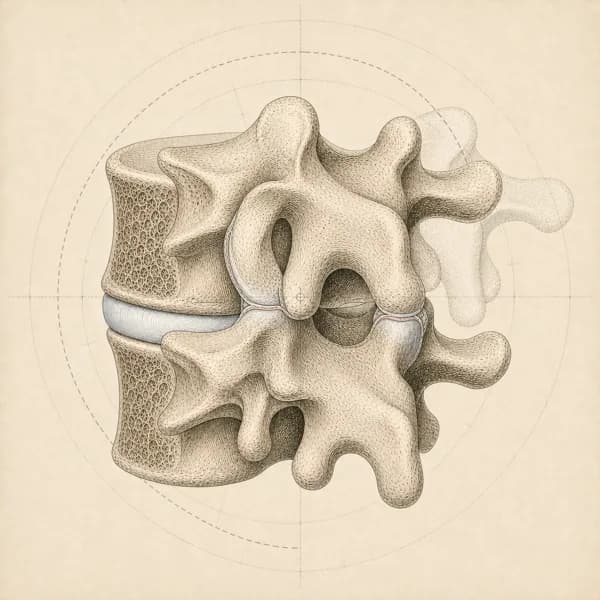
The facet joints are small joints at the back of the spine that help guide movement. They are one possible source of local back pain, sometimes aggravated by arching backward or twisting. That pattern, an examination or arthritis on a scan cannot reliably establish that these joints are the source.
Key points
- What usually helps
- Exercise, with joint mobilization for short-term relief.
- What you can do now
- Cut back on arching and twisting for now. Shift your weight when standing still.
- How long it takes
- Many people improve within 4 to 6 weeks; longer-standing pain can take longer.
- When to see a doctor first
- Some signs need emergency care. Check the list before you start treatment.
Symptoms
Does this sound like you?
- Back pain in one area
- Pain worse leaning backward
- Morning stiffness
- Pain with twisting
- Better with walking
Often alongside it
- Pain that spreads into the buttock
- Muscle spasms
- Difficulty standing up from sitting
- Pain with long periods of standing
- Poor sleep
Worse leaning back and twisting. Better bending forward. Morning stiffness that eases with movement.
Before using this comparison, check when these symptoms need a doctor first.
When to see a doctor first
Go to emergency
New trouble starting to pass urine or feeling it pass, new loss of bladder or bowel control, new numbness between the legs or around the back passage, new loss of genital sensation or sexual function, or severe or rapidly worsening weakness in both legs
Go to emergency now. These can be signs of cauda equina syndrome
Sudden unexplained weakness or numbness in an arm or leg, even if it improves
Call 911 now. This can be a stroke. Do not wait for a physiotherapy appointment
Get seen today
Pain that suddenly starts down both legs, or spreads from one leg to both, even without the signs above
Contact a medical clinician today for a same-day assessment
A new foot drop (the foot catches or slaps when you walk), or weakness, numbness or pain below the knee in one leg that is getting worse
Same-day medical assessment
Fever or feeling generally unwell with back pain
Same-day medical assessment
Back pain after a fall, or after a minor strain if you have osteoporosis or take long-term steroids
Same-day medical assessment to rule out a fracture
Check with your doctor
Back pain with a history of cancer, unexplained weight loss, or constant pain at night that does not ease with position
See your family doctor before starting physiotherapy
Long morning stiffness (over 30 minutes) that eases with exercise, starting before age 40
See your family doctor to check for inflammatory back pain
Treatment
How it is treated
Main approach. Exercise, with joint mobilization for short-term relief, can help back pain that seems to come from the facet joints, and many people notice a meaningful change within a couple of months.
Alongside it. Gradually reloading the movements that hurt, such as arching and twisting, helps the back tolerate them again.
Managing it over time. Keeping up regular exercise after the pain settles has the best evidence for lowering the chance of another episode of back pain.
A typical rehabilitation progression
Three phases, from settling symptoms to returning to full activity.
Recovery from facet joint syndrome is usually staged: calm the symptoms first, then rebuild the strength and capacity of the area, then return to your full activities. The phases below show how that can progress.
Phase 1Foundation: Ease Off Arching, Get the Back Moving
The first phase cuts down on long spells of arching the back, calms the irritated joint, and brings back basic forward-bending movement. Easing off arching for a short time creates room to rebuild strength and tolerance. It is not a long-term plan to avoid it.
Example exercises
- Cat-camel (slowly rounding and arching your back) and pelvic tilts on hands and knees, 10 slow, controlled repetitions
- Single and double knee-to-chest lying on your back, 30 seconds, 2 to 3 times
- Child's pose or prayer stretch (kneeling and sitting back towards your heels with your arms reaching forward) to bend the back gently forward, 30 seconds, 2 to 3 repetitions
- Dead bug (on your back, lowering the opposite arm and leg) with your lower back resting on the floor, 2 sets of 6 to 8 per side, keeping your back steady
- Short, frequent walks of 5 to 10 minutes to break up long spells of standing
Possible progression milestones
Pain at rest at 3 out of 10 or less, standing for 30 to 45 minutes with only a mild increase in symptoms, and bending forward comfortably to reach mid-shin or further.
Phase 2Building Up Load: Moving From the Hips and Trunk Strength
pain often comes with weak muscles at the back of the hip (hip extensors) and a poorly controlled hip hinge (bending forward from the hips), which pushes more arching and twisting into the lower back. This phase shifts the work back to the hips and builds the trunk strength needed to keep the back in a more comfortable range under load.
Example exercises
- Hip hinge progression (bending forward from the hips with a flat back): broomstick hinge, kettlebell deadlift, single-leg Romanian deadlift, 3 sets of 6 to 10
- Glute bridge and hip thrust, 3 sets of 8 to 12
- Goblet squat to a box (holding a weight at your chest), 3 sets of 8 to 10, progressed in depth and load
- Side plank and Pallof press (holding a band or cable out in front of your chest without letting it twist you) to train the trunk to resist bending sideways and twisting
- Bird dog progressions (on hands and knees, reaching out the opposite arm and leg), gradually reaching further, 2 to 3 sets of 6 to 8 per side
Possible progression milestones
Hip hinging and squatting with weight, with pain under 3 out of 10, walking 45 minutes without a flare-up, and gradually bringing back short spells of arching (reaching overhead, sleeping on your stomach briefly) without pain flaring afterwards.
Phase 3Return to Function: Bringing Back Arching and Twisting
This phase deliberately rebuilds tolerance for the positions you need in your life: arching, twisting and both combined under load. That is what usually lowers the chance of it coming back. The progression should match your real demands at work, in leisure or in sport.
Example exercises
- Controlled press-ups lying on your stomach and other gentle arching work, built into more range as you can manage it
- Twisting work: cable chops and lifts (pulling a cable diagonally across your body) at light weight, 3 sets of 8 to 10 per side
- Loaded carries and suitcase carries (a weight in one hand) to load the trunk unevenly
- Drills for your sport or job (golf swing, overhead lifting, trade positions), built up by gradually doing more
- A maintenance program of two or three sessions a week, centred on hip hinging, squatting and trunk control
Possible progression milestones
Full return to work, home and leisure demands with minimal symptoms, handling flare-ups on your own, and confidence arching and twisting during unplanned daily tasks.
What you can do now
- Cut back on arching and twisting for now. In the short term, ease off the arching and twisting that bring on pain, especially when they are combined, like looking up at a ceiling while twisting. Avoiding them completely tends to make that part of the back more sensitive, so this is only for a while.
- Shift your weight when standing still. Standing still keeps the facet joints loaded in a slightly arched position. Shifting your weight often, resting one foot on a step or leaning on a shopping cart often takes the edge off.
- Walk little and often. Walking changes the position of your hips and spine with every step, which is one reason it often feels better than standing still. Short, frequent walks of 5 to 10 minutes break up long spells of standing, and regular exercise is linked to fewer future episodes of back pain.Start below the level that flares your pain.
- Loosen up with gentle forward bends. Bending forward often eases this kind of pain, and morning stiffness often eases once you move. Lying on your back and hugging one or both knees to your chest for 30 seconds, 2 to 3 times, is one gentle option.If morning stiffness lasts over 30 minutes, eases with exercise and started before age 40, see your family doctor to check for inflammatory back pain.
- Bring arching back gradually. As the pain settles, gradually bring arching back so you can reach overhead, sleep on your stomach briefly and look up without a flare.Pain, numbness or weakness below the knee in one leg that is getting worse, a foot that catches or slaps when you walk, or pain that spreads to both legs needs a same-day medical assessment. Signs such as new trouble passing urine, loss of bladder or bowel control, or numbness between the legs or around the back passage mean go to emergency now, as the warning signs on this page explain.
What I use in clinic
- Spinal mobilization. Gentle hands-on movement of the spinal joints. It may give short-term relief of pain and stiffness alongside exercise.
- Strengthening Exercise. Strengthening the hips and trunk can help function.
Recovery
How long it takes
Many people improve within 4 to 6 weeks with appropriate treatment, and longer-standing pain can take longer.
It can become long-lasting (chronic) if the things contributing to it are not addressed.
What changes the timeline
- How long you have had symptoms
- How active you are
- Posture, and how your work setup fits you
- Trunk (core) strength
How I track it. I track how much the pain gets in the way of the tasks that matter to you, how well you move when I test those tasks in clinic, and how confident you feel in daily activities
Similar conditions
Conditions that can feel similar
- Lumbar Discogenic Pain
- Pain in the middle of the lower back, or just off to one side, worse with staying bent forward, sitting and bending forward. Eased by leaning back and standing. Sneezing and coughing can spike it. If the disc is irritating a nerve, pain spreading down the leg often follows that nerve's path.
- Lumbar Spinal Stenosis
- Heaviness or cramping in both legs with walking and standing that eases quickly with sitting or leaning forward. Typically older adults. Leg symptoms, more than back pain, limit how far you can walk.
- Sacroiliac Joint Dysfunction
- Pain pinpointed at the bony bump at the back of the pelvis (the PSIS), just below the belt line, and brought on by a group of tests that press on or stretch the joint. Pain rarely spreads below the knee. Leaning back and twisting bring it on less consistently than with facet pain.
- Spondylolysis or Spondylolisthesis
- Often back pain that started in the teenage years in sports with repeated arching (gymnastics, fast bowling, diving). Standing on one leg and leaning back brings on the pain (Stork test). A scan confirms a stress fracture at the back of a vertebra (pars defect) or a forward slip of one vertebra. Treatment shifts to easing off arching for a time and building load gradually, rather than working into the arching that hurts.
- Hip Osteoarthritis
- Pain in the groin or front of the thigh, and turning the hip inward is limited and painful (hip internal rotation). Worse standing, walking and other activities that load the hip. Back positions do not consistently change the symptoms.
- Inflammatory Back Pain (Axial Spondyloarthritis)
- Comes on gradually before age 40, with marked morning stiffness lasting more than 30 to 60 minutes, easing with exercise but not with rest, and often waking at night with pain. Needs a medical referral rather than being treated as ordinary facet pain.
Questions
What patients ask me most
How do I know if my back pain is coming from my facet joints?
One-sided low back pain that is worse with arching back or twisting, eases with bending forward or sitting, and may spread into the buttock or back of the thigh but not below the knee can make facet joint pain one possibility. But no single test, and not even the whole examination, can reliably prove which spinal structure is hurting (Cohen and colleagues, 2020). I treat the symptoms and how you function while watching for other causes. If a specialist is considering radiofrequency treatment, a diagnostic nerve block may be used to help select who is likely to benefit.
Does my MRI have to show facet arthritis for this to be the problem?
No. Imaging findings do not correlate neatly with symptoms. You can have significant facet arthritis on MRI with no pain, and painful facet joints with a fairly normal scan. Your symptoms and examination carry more weight than the scan report.
Is facet joint pain just arthritis, and does it get worse with age?
Facet joints change with age in most people. Whether those changes drive pain depends more on how you manage load, your strength, and how you move than on the presence of arthritis itself. People with the same scan results can have very different symptoms.
Should I avoid arching my back entirely?
Not long-term. In the short term, it makes sense to cut back on the arching and twisting that bring on pain, especially when they are combined (like looking up at a ceiling while twisting). The goal is to let the joints settle, then gradually bring arching back so you can do normal things, including reaching overhead, sleeping on your stomach briefly, and looking up, without a flare. Avoiding it completely tends to make that part of the back more sensitive rather than less.
Will I need a facet joint injection or radiofrequency ablation?
Many people do not. Facet-related back pain often improves with exercise, joint mobilization for short-term relief, and gradually reloading the movements that hurt. If pain stays disabling despite a reasonable trial of care, usually at least three months, your family doctor may discuss a specialist opinion. Guidelines differ on how many diagnostic nerve blocks to use and how much relief is needed before radiofrequency treatment, so the specialist explains their approach and its limits.
Why does walking help but standing still does not?
Standing still loads the facet joints continuously in a slightly arched position. Walking changes hip and spine position with every step, briefly unloading each facet joint and sharing the load with the muscles at the back of the hip and the trunk. That is also why leaning on a shopping cart, standing with one foot on a step, or shifting weight frequently often takes the edge off.
The science
The Science of Facet Joint Syndrome
are small joints between vertebrae that guide and limit movement. They can become arthritic or inflamed, causing localized back pain. The joint capsule is richly innervated, making it a significant pain source.
Contributing factors
The are small paired joints at the back of each spinal level. They share load with the disc in front of them and guide how the spine bends and twists. Arching backward and twisting load them more than standing in a neutral position, which is why leaning back, reaching overhead, or looking up while turning can bring on facet-type pain once the joints are sensitive.
Long spells of standing, overhead work or repeated backward bending are common aggravators once the joints are sensitive, so I adjust those early and build them back up.
Facet joints change with age, as discs do, and these changes become common on scans of people without back pain, so a report of facet does not on its own explain your pain. With age, enlarged facet joints and can also add to narrowing of the spinal canal or of the spaces where nerves leave the spine, which is covered on the spinal page.
Research
What the studies show
Facet joints are the source of pain in roughly 27% to 40% of people with long-lasting low back pain
The 2020 guidelines from the American Society of Interventional Pain Physicians pooled studies that confirmed facet pain with test injections that numb the nerves to the joints (controlled nerve blocks), counting at least 80% relief as confirmation. They found facet joint pain in 27% to 40% of people with long-lasting low back pain. No single examination finding or scan confirms it. The same guidelines strongly recommend a physical examination and clinical assessment when choosing people for facet joint injections, and keep those injections for pain that has lasted at least 3 months despite non-surgical care.
Facet pain is common, but it is a best judgment built from the pattern of symptoms (a working diagnosis), and that is how I treat it. Non-surgical care comes first. If facet pain has not settled after a proper trial, I refer you to your family doctor to discuss injection options.
Manchikanti L, Kaye AD, Soin A, et al. Comprehensive evidence-based guidelines for facet joint interventions in the management of chronic spinal pain: American Society of Interventional Pain Physicians (ASIPP) guidelines. Pain Physician. 2020;23(3S):S1-S127. PMID: 32503359.
Related Conditions
Conditions I commonly see alongside, or confused with, this one.
Getting back to it
Physiotherapy for facet joint syndrome, built around the activity you want back.