
Hamstring Strains
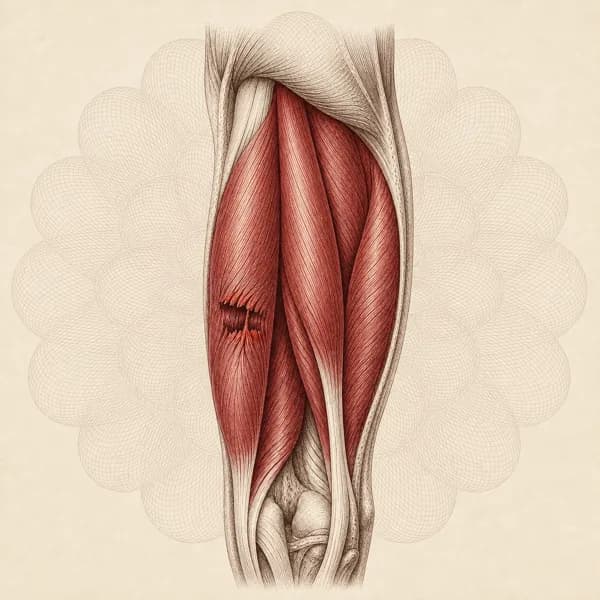
A hamstring strain injures muscle or tendon at the back of the thigh, often during sprinting or a rapid stretch. Pain is usually sudden and may come with bruising or weakness. A pop near the sitting bone with substantial bruising or difficulty walking needs prompt medical assessment: a tendon may have torn away from the bone.
Key points
- What usually helps
- Exercises that load the hamstring as it lengthens, which returned players to sport sooner in a trial.
- What you can do now
- Get walking normally first. Skip hard stretching in the early weeks.
- How long it takes
- Grade 1: 2 to 3 weeks. Grade 2: 4 to 8 weeks. A complete tear: 3 to 6 months.
- When to see a doctor first
- Some signs need medical care the same day. Check the list before you start treatment.
Symptoms
Does this sound like you?
- Sudden pain in the back of the thigh
- Difficulty walking or running
- Tenderness along the hamstring
- Possible bruising
- Pain when bending the knee
Often alongside it
- Irritation of the sciatic nerve, the large nerve at the back of the thigh
- Back pain
- Knee stiffness
- A change in the way you run
- Weakness in the leg
It starts suddenly while sprinting or stretching. The pain is sharp and forces you to stop.Book an assessment for hamstring strains
When to see a doctor first
Get seen today
Calf swelling, warmth or tenderness after the injury or a period of reduced activity
Same-day medical assessment to rule out a blood clot (DVT)
Check with your doctor
A pop or tearing feeling high up at the sit bone, often in a slip, waterskiing fall or sudden lunge, with large bruising down the back of the thigh, a gap you can feel, or difficulty walking
Possible hamstring tendon pulled off the bone at the top (proximal hamstring avulsion). Get an urgent surgical opinion within days, through your family doctor, a sports medicine physician or emergency. Not every avulsion needs surgery, but if repair is chosen it is easier when done early
Sudden sharp pain at the sit bone in a teenager during sprinting or kicking
Possible avulsion of the growth plate at the sit bone. See a doctor the same week for an X-ray
Numbness, tingling or weakness spreading down the leg or into the foot
See your family doctor before starting physiotherapy to check the sciatic nerve or lower back
Treatment
How it is treated
Main approach. In a trial of soccer players with new hamstring strains, Askling's program of exercises that load the hamstring as it lengthens (the L-protocol) returned players to play in an average of 28 days, compared with 51 days for a conventional exercise program.
Alongside it. Safe progress back to sport is guided by meeting set checks: sprinting without pain, equal strength on both sides when the hamstring is loaded as it lengthens (eccentric strength), and full range of hip bending. The 2022 clinical guideline for hamstring strains endorses this approach.
Managing it over time. Programs that include the Nordic hamstring exercise (kneeling and slowly lowering the body forward) reduce hamstring injury rates by roughly 50 percent across team sports, based on a 2019 review by Van Dyk and colleagues that pooled studies of over 8,000 athletes.
A typical rehabilitation progression
Three phases, from settling symptoms to returning to full activity.
Recovery from hamstring strains is usually staged: calm the symptoms first, then rebuild the strength and capacity of the area, then return to your full activities. The phases below show how that can progress.
Phase 1Protect the Tissue, Load Pain-Free, Walk Normally (Days 1 to 14)
The 2022 clinical guideline for hamstring strains is clear that loading the hamstring itself, including exercises that work it as it lengthens (eccentrics), should start early and be guided by how much pain you can tolerate. The first win is walking without a limp and switching on the hamstring without pain in holds that do not move the joint ( exercises). Where the injury sits also matters: injuries that extend into the tendon (intratendinous, type c in the British Athletics grading system) took longer to return from in elite track and field athletes (Pollock and colleagues, 2016), so they are progressed more cautiously in this phase.
Example exercises
- Lying on your back, pressing the heel down into a low box or the floor and holding (isometric press-down), 5 sets of 20 seconds at less than full, pain-free effort, twice daily
- Sitting with the legs out straight, pressing the heel down into a raised surface and holding (isometric contraction), 5 sets of 10 to 15 seconds
- Lying face down, bending the knee through a short pain-free range, 2 sets of 10 to 12
- Walking program building duration before speed
- Light stationary bike if tolerated, upright position rather than deep forward lean
Possible progression milestones
Walking fully pain-free, a moderate-effort hold without sharp pain, and tenderness when the hamstring is pressed clearly reduced.
Phase 2Lengthening Exercises Through the Range (Weeks 2 to 6)
Askling and colleagues (2013) randomly assigned soccer players with new hamstring injuries to a program focused on exercises that load the hamstring as it lengthens (the L-protocol) or to conventional exercises, and found a striking difference in return to play (an average of 28 days compared with 51 days). The lengthening exercises are the engine of this phase. Range is extended cautiously as symptoms allow, and stretching-type injuries (from overstretching) are progressed more cautiously than sprinting-type injuries.
Example exercises
- Single-leg Romanian deadlift (standing on one leg and hinging forward at the hip), starting with body weight and building to a light dumbbell, 3 sets of 6 to 8 per side, taking 3 seconds to lower
- The Extender exercise (from the Askling L-protocol): lying on your back with the hip bent, slowly straightening the knee into the stretch, 3 sets of 6 per side
- The Diver exercise: a single-leg hip hinge, tipping the trunk forward and lowering under control, 3 sets of 6
- , lowering only (kneeling with the ankles held and slowly lowering the body forward), starting with a very short range, 3 sets of 3 to 5
- Jogging introduced in small amounts when single-leg hops are equal on both sides and pain-free
Possible progression milestones
Pain-free lengthening exercises to a long range, single-leg hops and a single-leg bridge endurance test equal on both sides, and light jogging without a flare the next day.
Phase 3High-Speed Running, Nordic Loading, and Return to Sport (Weeks 6 to 16)
Building up high-speed running is the phase that most often gets cut short, and it is the phase where re-injuries happen. Van Dyk and colleagues (2019) pooled studies of 8,459 athletes and found that programs including the Nordic hamstring exercise roughly halved hamstring injury rates, so the Nordic is a core part of this phase. Return is based on meeting set checks, not on the calendar.
Example exercises
- Full Nordic hamstring curl, progressing from assisted to unassisted, 3 sets of 5 reps, 2 sessions per week
- Sprinting built up from 50 percent to 80 percent to 95 percent of top speed over 2 to 4 weeks
- Change-of-direction and deceleration drills layered on once straight-line running is comfortable
- Sport-specific intervals and small-sided game exposure before full training
- Maintenance dose of Nordic hamstring exercise and Romanian deadlift built into the in-season plan
Possible progression milestones
Hamstring strength equal on both sides on handheld or machine strength testing (dynamometer), a full session of the running your sport demands completed without symptoms, and a written in-season maintenance plan that keeps the Nordic in.
What you can do now
- Get walking normally first. The first goal is walking without a limp, building up how long you walk before how fast. A light stationary bike, ridden sitting upright rather than leaning far forward, is another way to keep moving if it is comfortable.If you felt a pop high up near the sitting bone with large bruising or difficulty walking, see the warning signs on this page before you start.
- Skip hard stretching in the early weeks. In the early, painful phase, hard stretching to the limit usually delays healing, particularly for stretching-type injuries. Gentle range-of-movement work and early lengthening exercises do more for long-term length than holding stretches.
- Start gentle, pain-free holds. Loading the hamstring early, guided by pain, is part of recovery. Lying on your back, press the heel down into a low box or the floor without moving the leg, and hold for 20 seconds, 5 times, twice a day.Keep the effort below full and pain-free, and ease off if you feel sharp pain.
- Return to running flat, easy and short. Running comes back once single-leg hops, hamstring strength and pain-free lengthening exercises are equal on both sides. Start on flat ground at an easy pace for short runs, and build distance before speed.Save speed work for late in rehab: returning to full pace too early is a main reason hamstring injuries come back.
- If it twinges, drop back a step. If you feel a twinge while running, stop the session that day and go back one phase in your plan for 3 to 5 days. A twinge does not mean rehab has failed: most often the last step was too big or the warm-up too short.
What I use in clinic
- Lengthening (Eccentric) Strength Work. Loading the hamstring step by step builds what it can tolerate, and warning signs along the way should not be ignored. Exercises that work the hamstring as it lengthens returned soccer players to play faster than conventional exercises in one trial, and Nordic hamstring curls are linked with fewer hamstring injuries in team sports.
- Progressive Running Program. A graded return to high-speed running prepares the hamstring for the demands that most often cause the injury.
Recovery
How long it takes
A typical grade 1 strain takes 2 to 3 weeks to return to sport, grade 2 usually takes 4 to 8 weeks, and grade 3 (a complete tear) takes 3 to 6 months.
Hamstring strains often come back, most often at or near the original spot, especially when the return to sprinting is rushed or the lengthening (eccentric) strength work stops.
What changes the timeline
- Where the tear is and how big it is
- Previous hamstring injuries
- What your sport asks of the hamstring
- The quality of the rehabilitation
How I track it. I track how much the pain gets in the way of the tasks that matter to you, how well you move when I test those tasks in clinic, and how confident you feel in daily activities
Similar conditions
Conditions that can feel similar
- Proximal Hamstring Tendinopathy
- Gradual onset rather than a sudden tear, pain in one spot at the sitting bone (ischial tuberosity), and typical pain with sitting. Bending the knee against resistance is painful, but the history is one of irritation creeping in with load, not a sudden strain.
- Proximal Hamstring Avulsion
- A sudden injury, often during sprinting, waterskiing or a sudden slip. Marked weakness when bending the knee against resistance, heavy bruising tracking down the back of the thigh, and in some cases a gap that can be felt where the tendon has pulled back. An MRI through a doctor and a surgical opinion are usually considered for a suspected complete or high-grade partial avulsion (the tendon pulled off the bone), although not every avulsion needs repair (Lempainen et al., Muscles Ligaments Tendons J 2015).
- Lumbar Radiculopathy (L5 or S1)
- Pain at the back of the thigh that goes below the knee, brought on by nerve tension tests (straight leg raise or slump) rather than by pressing on the muscle or bending the knee against resistance. There are often symptoms along the strip of skin supplied by one nerve root (a dermatome), changes in reflexes or feeling, and a history of back pain.
- Sciatic Nerve Irritation / Deep Gluteal Syndrome
- Burning or tingling pain, worse with sitting, and brought on by pressing deep in the buttock or by tests that stretch the sciatic nerve. Pressing on the middle of the hamstring and bending the knee against resistance are less painful than with a true strain (Martin et al., J Hip Preserv Surg 2015).
- Referred Pain from the Sacroiliac Joint
- Pain at the back of the pelvis that can spread down the top of the back of the thigh but rarely below the knee, brought on by a group of SI joint tests rather than by loading the hamstring against resistance.
- Ischial Apophyseal Avulsion (Adolescent Athletes)
- A young athlete whose bones are still growing, with sudden pain at the back of the thigh during sprinting, hurdling or kicking. An X-ray shows the growth area of the sitting bone (the ischial apophysis) has pulled away. On examination it looks like a severe hamstring strain, but management differs, including a possible surgical consult when the piece of bone has moved well out of place.
Questions
What patients ask me most
How long am I out?
It depends on grade and location. A typical grade 1 returns to sport in 2 to 3 weeks. Grade 2 usually takes 4 to 8 weeks. Grade 3 complete tears sit at 3 to 6 months. The British Athletics Muscle Injury Classification (Pollock et al., BJSM 2014) grades where the injury sits, and a later study in elite track and field athletes (Pollock et al., BJSM 2016) found that injuries extending into the tendon (type c) took longer to return from and came back more often, so the MRI location can change the timeline. Time frames are useful for planning, but return is determined by meeting criteria, not by the calendar.
Sprinting or stretching injury, and does it matter?
It matters a lot. Askling described two patterns that behave very differently. Sprinting-type strains happen at high speed and usually heal faster. Stretching-type strains happen when the muscle is stretched long (a high kick, a hurdler's stretch, water skiing) and take significantly longer to settle. In the Askling 2013 trial, stretching-type injuries took nearly twice as long to return as sprinting-type on the same protocol. The history decides how hard I push loading at the end of the muscle's range.
Why do hamstring injuries come back?
Two main reasons. First, returning to full pace before the tissue has rebuilt its capacity when the muscle is stretched long. Second, dropping the lengthening (eccentric) work once the early pain has gone. Most recurrences happen at or near the original site, which suggests the scarred area stays more vulnerable to strain if the surrounding tissue is not loaded properly.
Do I have to do Nordic hamstring curls?
Not necessarily, but they can be useful, particularly in sports with sprinting or kicking. Van Dyk et al. (BJSM 2019) pooled 15 studies across 8,459 athletes and found that prevention programs including the Nordic roughly halved hamstring injury rates; that is a prevention effect in athletes, not a treatment effect for an existing tear. Nordics need a tolerable starting level and are one part of a program that also rebuilds running and sport-specific capacity, and other exercises may be used when they better fit you or your stage of recovery.
When can I start running again?
When single-leg hops, hamstring strength tested without movement (isometric strength), and pain-free lengthening (eccentric) exercises are equal on both sides. Running usually returns in phase two for most grade 1 and low-grade 2 strains. Start on flat ground at an easy pace for short durations, and build distance before speed. Speed work waits until late phase three.
Is stretching a good idea?
In the early, painful phase, hard stretching to the limit usually delays healing, particularly for stretching-type injuries. Gentle range-of-movement work and early lengthening (eccentric) loading do more for long-term length than holding stretches. I rarely prescribe formal hamstring stretches in the early weeks.
Do I need an MRI?
Not for most straightforward strains. I cannot order imaging myself, so I flag it to your family doctor or a sports medicine physician and refer you when it would change the plan: a suspected tendon pulled off the bone at the top (a proximal avulsion, urgently), an in-season injury in a high-level athlete where the timeline drives selection, or recovery that is stalling. The JOSPT 2022 clinical practice guideline considers imaging useful for predicting recovery in competitive athletes but not necessary for most rehab plans.
What if I feel it twinge again while running?
Stop the session that day and drop back one phase in the loading plan for 3 to 5 days. A twinge does not mean the rehab has failed. Most often it means the next step in the progression was too big or the warm-up was too short. I reassess strength without movement (isometric testing), pain-free range and whether hops are equal on both legs before resuming at the amount you last tolerated.
The science
The Science of Hamstring Strains
Hamstring strains occur during when the muscle is lengthening under load. The biceps femoris is most commonly injured, typically at the .
Contributing factors
The hamstring muscles face their greatest mechanical challenge during the terminal swing phase of sprinting, the brief 130 millisecond interval when your hamstring must perform the seemingly contradictory task of contracting forcefully while simultaneously lengthening. This phase represents the highest injury risk moment in the entire sprinting cycle. Biomechanical research identifies this window as when muscle strain most commonly exceeds tissue capacity.
During terminal swing, your forward-swinging leg approaches maximum velocity, creating tremendous momentum that your hamstring must control and reverse. At this instant, your knee is extending rapidly (approaching 1000 degrees per second in elite sprinters) while your hip continues flexing forward. The hamstring must generate massive forces to decelerate this combined motion and prepare your leg for ground contact. Biomechanical modeling shows that during this brief phase, hamstring muscle-tendon forces can reach several times body weight in sprinters.
The specific vulnerability of the biceps femoris long head relates to its unique anatomical and mechanical characteristics. Like semitendinosus and semimembranosus, the long head of biceps femoris crosses both the hip and the knee (only the short head of biceps femoris crosses the knee alone), and it is the hamstring muscle most often strained in sprinting. During terminal swing, this muscle experiences peak length at the exact moment it must generate peak force. Studies using muscle imaging demonstrate that the biceps femoris stretches well beyond its resting length during this phase, placing extraordinary stress on the where most strains occur.
Sprint acceleration creates different but equally demanding hamstring loading patterns than maximum velocity sprinting. During the initial acceleration phase, when your body angle is more forward and ground contact time is longer, your hamstring works primarily to generate hip extension force for propulsion. As you transition to maximum velocity sprinting, the mechanics shift to the high-speed swing phase control described above. Athletes often sustain hamstring injuries during this transition, when mechanical demands change rapidly and muscle coordination must adapt quickly.
Hip flexor tightness and anterior pelvic tilt position create biomechanical predisposition to hamstring strains. When your hip flexors are chronically tight, they pull your pelvis into anterior tilt, which increases the resting length of your hamstring muscles. Starting from this already-lengthened position means your hamstrings have less available range to elongate during terminal swing before reaching their breaking point. Greater anterior pelvic tilt may contribute to this lengthened starting position, though the evidence linking it to strain risk is mixed.
Lumbopelvic control deficits amplify hamstring loading during sprinting and change-of-direction movements. When your core muscles cannot maintain stable pelvic positioning during high-speed running, excessive anterior pelvic tilt occurs dynamically at each stride. This pelvic effectively lengthens your hamstrings beyond the range they would experience with proper core control. Poor lumbopelvic control is thought to allow greater hamstring lengthening during sprinting compared to those with good core stability.
A previous hamstring strain raises the risk of another, and repeat strains often occur at or near the original site. The reasons include several factors, such as strength, exposure to high-speed running and how complete the recovery was, and changes in the healed tissue may play a part. Rehabilitation aims to address the factors that can be changed.
Strength differences between legs may also matter. When one hamstring is clearly weaker than the other, stride mechanics can change in ways that add stress to the weaker side, which is why side-to-side strength is one of the things checked before a return to sprinting. The research linking strength asymmetry to future injury is mixed, so it is one factor among several rather than a predictor on its own.
Research
What the studies show
Two rehab programs for new hamstring injuries in Swedish elite soccer (Askling et al.)
In elite soccer players with new hamstring injuries confirmed on MRI, a program focused on exercises that load the hamstring as it lengthens (the L-protocol) gave a faster return to play than conventional exercises that load it as it shortens (concentric): an average of 28 days compared with 51 days.
Guides which exercises are chosen.
Askling CM, Tengvar M, Thorstensson A (2013). Acute hamstring injuries in Swedish elite football: a prospective randomised controlled clinical trial comparing two rehabilitation protocols. Br J Sports Med. PMID: 23536466.
Related Conditions
Conditions I commonly see alongside, or confused with, this one.
Groin Strains
Both are common sports injuries with similar mechanisms and recovery approaches
Low Back Pain
Hamstring tightness can contribute to lumbar spine stress and back pain
Patellofemoral Pain (Kneecap Pain)
Hamstring dysfunction affects knee mechanics and patellofemoral joint stress
Hip Osteoarthritis
Getting back to it
Physiotherapy for hamstring strains, built around the activity you want back.