
Proximal Hamstring Tendinopathy
Proximal hamstring tendinopathy causes pain near the tendons' attachment to the sitting bone, deep in the lower buttock. Hard seats, faster or uphill running, lunges and hamstring stretching may aggravate it. Symptoms often develop gradually; a sudden pop with bruising or difficulty walking needs assessment for a different injury.
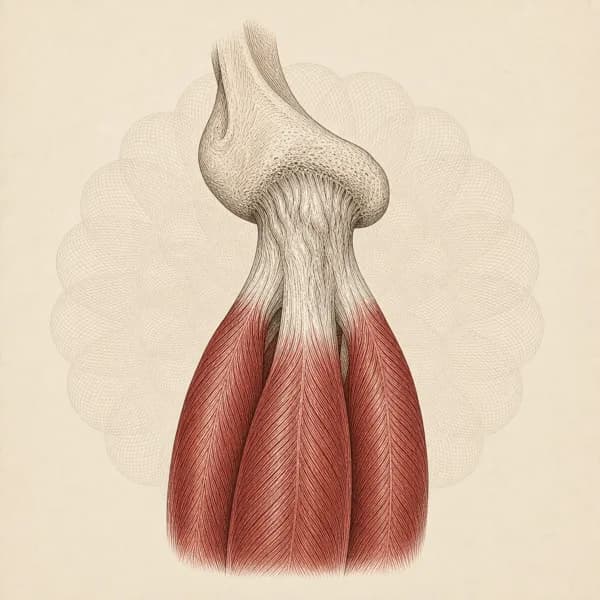
Key points
- What usually helps
- A loading program that moves from holds to heavier, slow strength work.
- What you can do now
- Change your sitting set-up. Stand up every 30 to 45 minutes.
- How long it takes
- Pain can ease in a few weeks; getting back to your activities can take 3 to 9 months.
- When to see a doctor first
- Some signs need emergency care. Check the list before you start treatment.
Symptoms
Does this sound like you?
- Deep buttock pain centered on the 'sitting bone' (ischial tuberosity)
- Pain with long periods of sitting, especially on hard surfaces
- Pain during or after activity: running (especially uphill or high speeds), lunging, or deep squatting
- Deep stiffness or tightness where the top of the hamstring meets the bottom of the buttock
- Pain with stretching: trying to stretch the hamstrings by touching your toes brings on the same deep pain in one spot
Often alongside it
- Feeling like sitting on a rock or sharp object
- Needing to shift your weight, stand up often, or perch on the edge of the seat
- Difficulty with long drives, sitting at a desk, or a meal at a restaurant
- Pain with any activity that stretches or loads the hamstring heavily
The story of proximal hamstring tendinopathy usually centres on one specific, very tender spot: the ischial tuberosity, or the 'sitting bone.' The pain is a deep ache in one spot, right in the crease of the buttock. Patients often describe it as feeling like they are sitting on a rock. It usually comes on gradually, frequently after a change in activity. It's the long-distance runner who recently added hill repeats to their training, or the office worker who started a new spin class. The most defining feature, and the source of immense frustration, is pain with sitting. Long drives, sitting at a desk, or even a meal at a restaurant become a painful ordeal, forcing them to shift their weight, stand up frequently, or perch on the edge of their seat.
Before using this comparison, check when these symptoms need a doctor first.
When to see a doctor first
Go to emergency
New trouble passing urine, loss of bladder or bowel control, or numbness around the genitals, buttocks or inner thighs
Possible cauda equina syndrome (pressure on the nerves at the base of the spine). Go to emergency now
Get seen today
New or worsening weakness in the leg or foot
Possible nerve compression. Get medical assessment today
Check with your doctor
Numbness or tingling spreading down the leg
See your family doctor before starting physiotherapy to check the lower back and sciatic nerve
A sudden pop or tearing feeling at the sit bone, with bruising down the back of the thigh or difficulty walking
Possible proximal hamstring avulsion (the tendon pulled off the bone). Get an urgent surgical opinion within days, through your family doctor, a sports medicine physician or emergency
Severe, constant pain not related to sitting or activity
Not typical of tendon pain. See your family doctor promptly to look for other causes, including a stress fracture
Treatment
How it is treated
Main approach. A loading program tailored to you, moving from holds that do not move the joint (isometrics) to heavier, slow strength work, is a reasonable way to rebuild strength and how much activity you can tolerate. Research has not established one best program for everyone, and progress is often gradual.
Alongside it. Managing load and changing how you sit ease symptoms, while exercise built up in a controlled way lets the tendon adapt.
Managing it over time. Gradual training progression and avoiding sudden increases in hill running or speed work reduces the risk of proximal hamstring tendinopathy in runners.
A typical rehabilitation progression
Three phases, from settling symptoms to returning to full activity.
Recovery from proximal hamstring tendinopathy is usually staged: calm the symptoms first, then rebuild the strength and capacity of the area, then return to your full activities. The phases below show how that can progress.
Phase 1Calm the Tendon and Take Pressure off the Sitting Bone (Weeks 1 to 4)
This mirrors stage 1 of the 2016 clinical paper on this condition by Goom and colleagues. The first job is calming the irritated tendon with holds that do not move the joint ( exercises), done away from deep hip bending, while removing the squeeze from sitting and dropping hard hamstring stretches, which load the tendon exactly where it is already sore. A dose of 5 sets of 45 seconds at about 70 percent effort is a reasonable daily starting point.
Example exercises
- Bridge hold with the heels further from the body (long-lever isometric bridge), heels on a low step and the hips bent only 0 to 20 degrees, 5 sets of 45 seconds
- Standing, pressing the heel back against a wall or fixed point with the leg fairly straight and holding (isometric leg curl), 5 sets of 30 to 45 seconds per side
- Small-range bridge (lifting the hips while lying on your back) with the back in a neutral position, 3 sets of 10, keeping the hip bend modest
- Seating review: firmer and higher chairs, a wedge cushion if useful, standing breaks every 30 to 45 minutes, no low bucket seats for now
- Drop deep forward bends, toe-touch stretches and any deep hip bending with the knee straight that brings on the sitting-bone pain
Possible progression milestones
The tendon less irritable day to day, sitting for 30 to 45 minutes manageable with the changed set-up, and 45-second holds without a flare over the next 24 hours.
Phase 2Heavy, Slow Strength Work Through the Range (Weeks 5 to 16)
Stages 2 and 3 of the Goom and colleagues paper (2016), and the wider research on tendon problems, point to heavy, slow strength work (heavy slow resistance) as the backbone of tendon adaptation. Bending the hip past 70 degrees is added cautiously, because deeper bending squeezes the tendon against the sitting bone (). The pace is slow: 3 seconds down, 3 seconds up, 2 to 3 sessions per week.
Example exercises
- Romanian deadlift (lowering a weight by hinging at the hips), going gradually deeper as tolerance builds, 3 to 4 sets of 8, taking 3 seconds down and 3 seconds up
- Single-leg Romanian deadlift with a light dumbbell and a shallow depth to start, 3 sets of 6 to 8 per side
- Hip thrust (lifting the hips with the upper back on a bench) with a moderate barbell or dumbbell, 3 sets of 8, to load the buttock muscles and the back of the thighs
- Hamstring curl machine, lying face down or seated, lowering the weight slowly (slow ), 3 sets of 10
- Walking program building duration before speed or hill work
Possible progression milestones
Sitting comfortably for 60 minutes, Romanian deadlifts at roughly half body weight for 3 sets of 8 without pain, and bending forward to pick something up no longer bringing on the deep sitting-bone pain.
Phase 3Spring-Like Loading and Return to Running or Sport (Months 4 to 9)
This is stage 4 of the Goom approach, adding fast, spring-like exercises that store and release energy in the tendon (energy storage) and the demands of your sport. Hill running and speed work are the classic flare triggers for runners with this condition, so they are built up slowly. For people who do not run, the same principles apply to lifting heavier, carrying weights, or getting back to the demands of your own activities.
Example exercises
- (kneeling with the ankles held and slowly lowering the body forward), starting with help and progressing to no help, 3 sets of 5, twice a week
- Kettlebell swing starting with a modest load, 3 sets of 10, for spring-like loading driven from the hips
- Jumping and bounding drills (): A-skips (a high-knee skipping drill), bounding and low hops, built up in weekly steps
- Easy, flat running first, then tempo runs and hill repeats brought back gradually, with a cautious increase of 10 percent a week
- Sport-specific acceleration and change-of-direction work for field sport athletes
Possible progression milestones
Back to the running or sport amounts you want without flaring overnight or the next morning, sitting confidently through long drives or flights, and a clear understanding of how to manage load for the long term.
What you can do now
- Change your sitting set-up. Sitting squeezes the top of the hamstring tendon against the sharp edge of the sitting bone, so changing your set-up often eases symptoms faster than any single exercise. Choose firmer, higher chairs, try a wedge cushion or a rolled towel under the back of the thighs, and sit upright rather than slouching.Avoid long periods on hard seats, and low bucket seats, for now.
- Stand up every 30 to 45 minutes. Regular breaks give the tendon relief from the squeeze of sitting. Long drives, desk work and long meals are common triggers, so plan breaks into them.
- Stop toe touches and deep forward bends. Hard hamstring stretching loads the tendon in the position it already cannot tolerate, and it is one of the most common things that keeps this problem stuck. To pick something up, hinge at the hips instead of bending deeply forward with straight knees.
- Keep runs easy and flat for now. Easy flat running at a shorter distance often stays in, while hills and speed work are cut back early because they sharply raise the force on the tendon. If a run leaves you worse the next morning, it was too much.Use how you feel 24 hours later to set the amount, rather than resting completely.
- Start with gentle holds. Holds that do not move the joint, such as a bridge hold with your heels on a low step and the hips only slightly bent, can help calm the tendon. A daily starting dose is 5 holds of 45 seconds at about 70 percent effort.If the holds leave a flare over the next 24 hours, ease the effort.
What I use in clinic
- Progressive Loading Exercise Program. A carefully graded program moves step by step from holds that do not move the joint (isometric exercises) to heavy, slow strength training. It helps the tendon adapt and is a reasonable way to rebuild its strength and tolerance, though research has not settled on one best program. It progresses very gradually, you stop if symptoms rise sharply, and doing it regularly matters more than doing it hard.
- Strengthening the Back of the Body (Posterior Chain). Strengthening the muscles along the back of the body, especially the buttock muscles (glutes), reduces overload on the hamstrings.
Recovery
How long it takes
This can be a stubborn condition. Meaningful pain reduction from load management can happen in a few weeks, but building tendon strength and resilience takes longer: expect 3 to 9 months to get back to desired activities without significant pain. The progression is slow and steady: some discomfort during exercise is acceptable if it settles within 24 hours, but pain that keeps climbing from session to session means the load needs adjusting.
It can be persistent. Many people improve with load management and progressive exercise, although progress is often gradual, and rest alone or aggressive stretching often does not settle it.
What changes the timeline
- How long you had symptoms before treatment
- Sticking with the changes to how you sit
- Being able to stop the stretches that flare it
- How you run, and training mistakes
- Strength along the back of the body at the start
- Understanding how to manage load
How I track it. I track how much the pain gets in the way of the tasks that matter to you, how well you move when I test those tasks in clinic, and how confident you feel in daily activities
Similar conditions
Conditions that can feel similar
- Deep Gluteal Syndrome (Sciatic Nerve Entrapment)
- Burning or tingling, with symptoms that travel below the knee. A seated piriformis stretch or a nerve tension test (slump test) brings it on, rather than pressing on the sitting bone. The sitting bone is usually not tender.
- Lumbar Radiculopathy (L5 or S1)
- A history of back symptoms, pain following the strip of skin supplied by one nerve root (a dermatome), pain on nerve tension tests (straight leg raise or slump), and possible changes in reflexes or feeling. The pain is not in one spot over the sitting bone.
- Sacroiliac Joint Pain
- Pain below the lowest lumbar vertebra (L5), centred over the SI joint at the back of the pelvis. A group of tests that stress the SI joint brings it on, rather than bending the knee against resistance or the bent-knee hamstring stretch test. The sitting bone itself is less tender.
- Ischiofemoral Impingement
- Deep buttock pain when the leg moves backward and across the body at the same time (hip extension with adduction). MRI shows swelling in a small deep hip muscle (quadratus femoris oedema) and a narrowed gap between the sitting bone and the thigh bone (the ischiofemoral space). It is worse when walking with long strides.
- Proximal Hamstring Avulsion or Partial Tear
- Usually starts suddenly with an injury during sprinting or waterskiing, sometimes with bruising, marked weakness when bending the knee against resistance, and often visible on MRI. Recent tears warrant imaging and a surgical consult in some cases (Lempainen et al., Muscles Ligaments Tendons J 2015).
- Ischial Bursitis
- Fairly rare on its own. Tenderness is spread more widely over the sitting bone rather than at one point where the tendon attaches, and symptoms often settle quickly just by adjusting activity.
Commonly confused with
Side-by-side comparisons for patterns that often get mistaken for proximal hamstring tendinopathy.
Questions
What patients ask me most
Why does sitting hurt more than running?
Because sitting squeezes the top of the hamstring tendon directly against the sharp edge of the sitting bone (ischial tuberosity). Running loads the tendon by pulling on it, which the body can eventually adapt to, but long periods of squeezing from sitting prevent normal recovery between sessions. Goom et al. (JOSPT 2016) describe compression as a key aggravating factor for proximal hamstring tendinopathy, which is why the sitting set-up often changes symptoms faster than any single exercise.
Should I stretch my hamstrings?
Not aggressively. Deep toe-touch stretching and bending forward with a weight load the tendon in the position it already cannot tolerate. This is one of the most common things that keeps proximal hamstring tendinopathy stuck. I replace stretching with progressive strengthening, particularly hinging at the hips, which restores useful hamstring length without irritating the tendon.
Is this a tear or a tendinopathy?
Two different problems. Tendinopathy is a gradual irritation and change in the tendon's structure from repeated load. A tear, particularly the tendon pulling off the bone at the top (a proximal avulsion) described by Lempainen et al. (Muscles Ligaments Tendons J 2015), is usually a sudden injury, often with a pop during sprinting or waterskiing, sometimes with bruising tracking down the back of the thigh. The history usually tells me which I am dealing with. Tears warrant imaging and sometimes a surgical consult. Tendinopathy responds to loading.
How long does proximal hamstring tendinopathy take to settle?
This is a stubborn tendon. Symptoms often start to calm within 3 to 6 weeks with holds that do not move the joint (isometrics) and changes to sitting. Really rebuilding the tendon's capacity typically takes 3 to 6 months, and for runners getting back to hill repeats or sprinting, 6 to 9 months is common. A 2023 systematic review and recent commentary on treatments for proximal hamstring tendinopathy both note that the evidence that any single treatment is best is thin, which is why I build the program around slow, progressive loading rather than chasing a quick fix.
Can I keep running while this settles?
Usually yes, at an adjusted dose. I limit uphill work and speed work early on, because both sharply raise the force on the hamstring tendon at the end of each leg swing, just before the foot lands (terminal swing). Easy flat running at a reduced distance often stays in. If a run leaves you worse the next morning, that was too much. I use how you feel 24 hours later to adjust the amount, rather than strict rest.
Do I need an MRI?
Not for most cases. The diagnosis is mainly made from your history and examination: tenderness in one spot on the sitting bone, pain on a bent-knee hamstring stretch test, and the same pain when hinging at the hips with a weight. Imaging is useful when there is a clear injury suggesting a tear, when symptoms fail to progress with appropriate loading after a reasonable trial, or when it is still unclear what else it could be.
Is injection a good idea?
Often not as a first step. Corticosteroid injections around tendons can reduce pain short-term but show inconsistent longer-term outcomes and some risk to tendon tissue. I reserve that conversation for cases where pain is stopping someone from doing the loading work, and I prefer to get to an effective loading program first. Evidence for platelet-rich plasma (PRP) injections in this condition remains mixed. The strongest consistent signal in the research is still progressive loading combined with reducing the pressure on the tendon from sitting.
The science
The Science of Proximal Hamstring Tendinopathy
Proximal hamstring is centered around one specific, exquisitely tender spot: the , or the "sitting bone." The pain is a deep, localized ache right in the crease of the buttock where the hamstring muscles originate from a thick, shared tendon. The most common mistake people make is treating this like a simple hamstring muscle strain and aggressively stretching it, which often makes it worse. A tendinopathy at the hamstring's origin is sensitive to both compressive and tensile loads. Aggressive stretching places a high tensile load on the tendon, while sitting on it directly compresses it against the ischial tuberosity. Both actions can perpetuate the pain cycle. The condition is often linked to altered running mechanics, commonly an "over-striding" gait where the foot lands too far in front of the body's center of mass, putting massive braking and tensile load on the hamstring at foot strike.
Contributing factors
The proximal hamstring tendon experiences two distinct types of mechanical stress that contribute to development: tensile loading during activities and compressive loading during sitting. Understanding both mechanisms is essential because they require different management strategies. The proximal hamstring tendons attach around the sitting bone (): the semitendinosus and biceps femoris long head share a combined tendon, and the semimembranosus attaches just beside it, so a lot of load passes through a small area.
During running, the hamstring experiences its peak tensile loading at the terminal swing phase, the moment just before your foot strikes the ground when your hip is flexed and your knee is extending. At this instant, the hamstring must eccentrically contract to decelerate the forward-swinging leg, generating very high tensile forces at the proximal tendon insertion. Runners with an over-striding pattern, where the foot lands significantly ahead of the body's center of mass, experience higher peak hamstring forces compared to runners landing closer to their center of mass.
The physics of over-striding creates a braking mechanism that dramatically amplifies hamstring load. When your foot contacts the ground ahead of your center of mass, it creates a horizontal braking force that your hamstring must resist to prevent the leg from sliding forward. Greater over-stride distance increases peak hamstring tendon force. Over a long run that load is repeated thousands of times on each leg, which is why stride length and running volume both matter for this tendon.
Hill running amplifies these forces further. When running uphill, your hip requires greater flexion range to navigate the incline, placing the hamstring in a more lengthened position at foot strike. Uphill running increases proximal hamstring tendon forces compared to level running. The combination of increased hip flexion angle and the need for more powerful hip extension to propel the body upward creates particularly high loads. This explains why proximal hamstring tendinopathy frequently develops after runners add significant hill training to their regimen without adequate progressive adaptation.
Sitting mechanics create an entirely different loading pattern involving sustained compressive forces. When you sit, particularly on hard surfaces, your body weight creates direct compression of the proximal hamstring tendon between the ischial tuberosity (sitting bone) and the seat surface. Sitting generates localized compression directly at the hamstring tendon origin that can impede blood flow and tissue recovery. This sustained compression during the hours you spend sitting prevents the normal tissue recovery and repair processes, explaining why sitting discomfort often becomes the most debilitating symptom even in athletic individuals.
Forward bending movements with straight knees, such as touching your toes or picking up objects from the floor, create extreme tensile loads on the proximal hamstring tendon. Maximal forward bending with knees extended places a high tensile load on the proximal hamstring tendon. For a tendon already by running-related microtrauma, this additional tensile stress can trigger significant pain and prevent healing. The common advice to "stretch your tight hamstrings" becomes counterproductive in proximal hamstring tendinopathy, as aggressive stretching adds tensile load to an already overloaded structure.
Gluteal muscle weakness creates compensatory hamstring overload during functional activities. When your gluteus maximus is weak or inhibited, your hamstring must contribute more to hip extension during activities like stair climbing, squatting, and running. When gluteal activation is reduced, the hamstrings tend to take on relatively more of the work during hip extension tasks. This chronic overwork contributes to progressive tendon at the proximal insertion point where mechanical stresses concentrate.
Research
What the studies show
Assessing and managing hamstring tendon pain at the sitting bone (Goom et al.)
Goom and colleagues set out a step-by-step progression: holds that do not move the joint (isometrics), then heavy, slow strength work, then fast, spring-like exercises (energy storage).
Its principles have been widely adapted for managing this condition.
Goom TS, Malliaras P, Reiman MP, et al. (2016). Proximal Hamstring Tendinopathy: Clinical Aspects of Assessment and Management. J Orthop Sports Phys Ther. PMID: 27084841.
Related Conditions
Conditions I commonly see alongside, or confused with, this one.
Getting back to it
Physiotherapy for proximal hamstring tendinopathy, built around the activity you want back.