
Tendon injury and recovery
Achilles Tendon Rupture: Treatment and Recovery
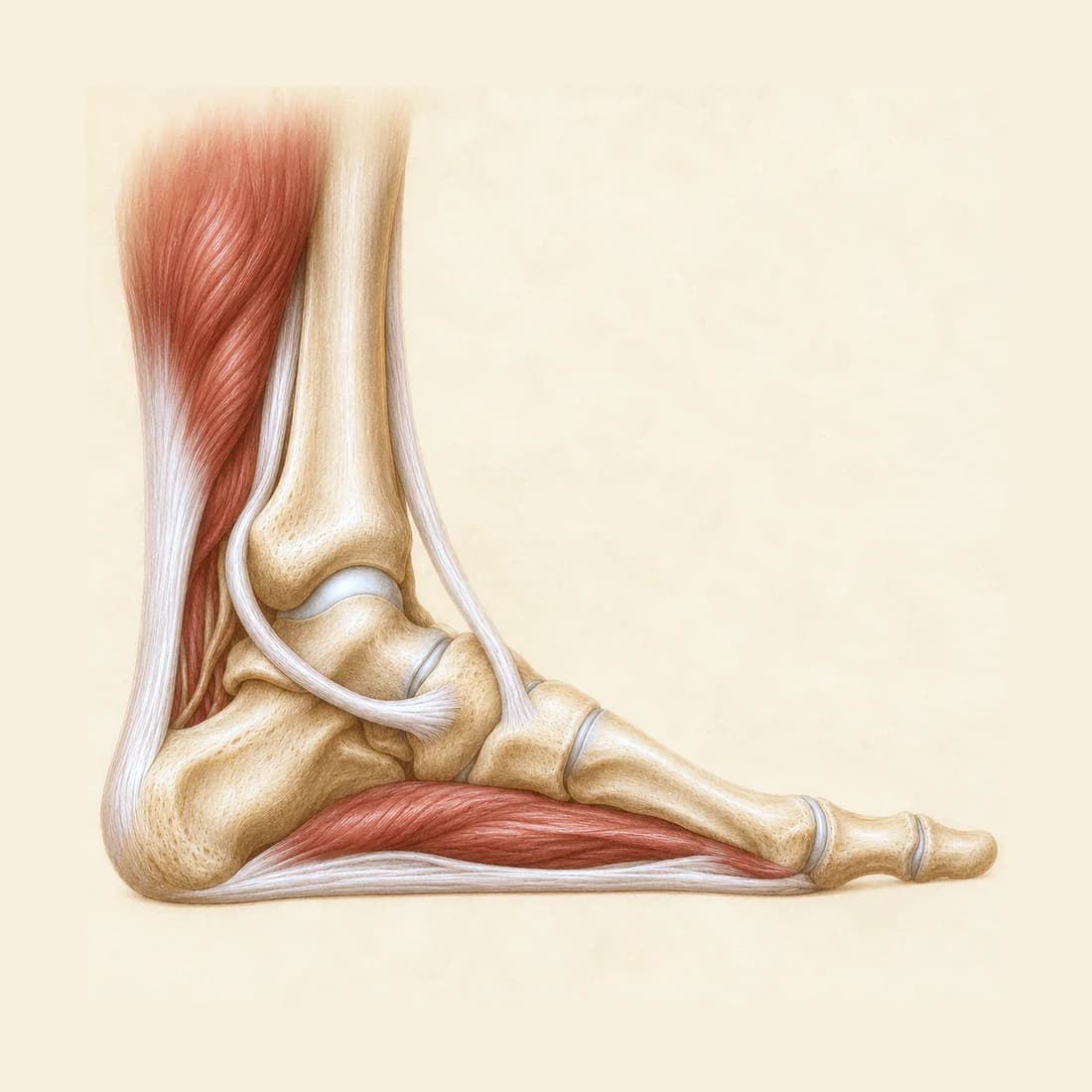
An Achilles tendon rupture is a tear in the tendon connecting the calf muscles to the heel bone. It can cause a sudden loss of push-off during a step, jump or change of direction. Prompt assessment leads to a protection plan and a discussion of surgical or non-surgical treatment. Both pathways need rehabilitation.
AAOS OrthoInfo (accessed), 2026When to see a doctor firstA sudden change in push-off needs assessment
The Achilles transmits force from the calf to the heel during walking, running and jumping. A rupture may happen during acceleration, landing or a sudden change of direction. People often turn around because it felt as though someone struck the back of the leg. AAOS OrthoInfo (accessed), 2026; Cambridge University Hospitals (accessed), 2026
The initial pain can ease, and some people can still walk with a flat-footed pattern. Those changes do not rule out a rupture. A new loss of push-off after a pop or sudden injury needs assessment even when the pain has settled. Cambridge University Hospitals (accessed), 2026
That is a different starting point from the more gradual pain and stiffness described on the Achilles tendinopathy page. A newly injured tendon needs its diagnosis and protection plan clarified before using a tendinopathy exercise program.
When to see a doctor first
Go to emergency
An open wound over the tendon, an obviously deformed ankle, or a foot that becomes cold, pale or numb after the injury
Go to emergency now.
Sudden breathlessness, chest pain, coughing up blood or feeling faint
Call 911 now. A blood clot in the lungs needs to be ruled out.
Get seen today
A sudden pop or feeling of being kicked in the calf or back of the ankle, with new difficulty pushing off
Keep weight off the injured leg and get medical assessment today through urgent care or your family doctor for a possible Achilles rupture. Pause calf stretches, heel drops and running until it has been assessed.
New or increasing calf swelling, warmth or tenderness, especially during reduced mobility or time in a boot
Get same-day medical assessment to rule out a blood clot in the leg.
The examination and imaging clarify the tear
A clinician considers how the injury happened, examines the tendon and checks calf function. The calf-squeeze or Thompson test looks at how the foot responds when the calf is compressed. It is one part of the examination, rather than a home clearance test. AAOS OrthoInfo (accessed), 2026
Ultrasound can show tendon continuity, the tear location and how the tendon ends sit as the ankle position changes. MRI can help answer remaining questions about the tendon or another injury. An X-ray mainly shows bone, so a normal X-ray does not exclude a tendon rupture. AAOS OrthoInfo (accessed), 2026
A report may describe a partial tear, a complete tear, its distance from the heel attachment or a gap between the tendon ends. Bring the report into the treatment discussion. The gap measurement depends partly on ankle position; current evidence does not support turning one measurement into a universal surgery threshold. AOFAS, 2024
Surgery and non-surgical care both have a recovery plan
Non-surgical treatment protects the tendon in a position that brings the ends closer together while it heals. It includes a prescribed boot or cast, walking instructions, review and rehabilitation. It is an active treatment pathway that needs follow-through. AAOS OrthoInfo (accessed), 2026; AOFAS, 2024
Surgery brings the torn tendon ends together with sutures, or reattaches the tendon to the heel when the injury is at that attachment. Open and minimally invasive approaches differ in how the surgeon reaches the tendon. The repaired tendon still needs protection and progressive rehabilitation. AAOS OrthoInfo (accessed), 2026
The choice considers the injury, how long ago it happened, your health, skin and wound risks, activity goals and the practical demands of the recovery plan. The discussion should cover the chance of another rupture alongside infection, wound and nerve complications. AOFAS, 2024
The randomized comparison followed symptoms and complications separately
A 2022 trial randomized 554 adults with acute Achilles ruptures to non-surgical care, open repair or minimally invasive surgery; 526 were included in the analysis. At 12 months, the groups did not clearly differ in the main patient-reported rupture score or the changes in physical performance. Myhrvold et al., 2022
Another rupture occurred in 6.2% of the non-surgical group and 0.6% of each surgical group. Nerve injuries were reported in 0.6%, 2.8% and 5.2%, respectively. These were separate outcomes in this trial. Similar average function at one year and different complication rates both belong in the treatment discussion. Myhrvold et al., 2022
Boot position and movement limits protect the healing tendon
Get written instructions for weight bearing, walking aids, boot use, heel wedges or angle settings and permitted ankle movement. Follow the schedule from the treating team for changing those settings. Different operations and non-surgical protocols can use different starting points. Marrone et al., 2024
Early functional rehabilitation introduces permitted movement and loading within a protected plan. The tendon can feel tight as walking changes. Stretching aggressively or dropping the heel below a step can lengthen the healing tendon, which may affect later calf function. Range and loading progress together under the agreed instructions. Marrone et al., 2024
Ask the medical team about your individual blood-clot risk and whether prevention is needed during reduced mobility. If you have surgery, follow the wound-care instructions too. The post-surgical rehabilitation page explains how those precautions guide exercise. AOFAS, 2024
Rebuild the calf’s work as walking becomes easier
As the plan permits, rehabilitation connects ankle movement and calf strengthening with a more comfortable walking pattern. Coming out of the boot changes the demands on the tendon again, so that transition needs its own review of support, walking and exercise. Marrone et al., 2024
Later testing considers more than whether you can lift the heel once. Heel-rise height, control and repeated work help describe calf function. A person may manage everyday walking while still struggling with repeated push-off or the demands of stairs and sport. Marrone et al., 2024
Bring examples from daily life into review: use of a walking aid, how long you were on your feet, what became difficult and the response afterward. The rehabilitation-progress guide explains how those observations can change the next step.
Running and sport add demands beyond daily walking
Running, jumping and changes of direction ask the calf and tendon to absorb and return force repeatedly. Preparation considers healing, strength, heel-rise performance, movement quality and the response to gradually introduced impact work. Marrone et al., 2024
A return-to-running review considers symptoms during daily life and rehabilitation, walking pattern, calf function, balance and confidence. Those findings join healing time and the treating team’s instructions in choosing the next activity. Marrone et al., 2024; Gaspar et al., 2026
Returning to modified practice, returning to a sport and recovering previous performance are different goals. The return-to-training guide connects exercise, testing and practice. The sports rehabilitation page explains how that work fits into a treatment plan. Ardern et al., 2016
What the running consensus proposed
In a 2026 expert consensus after surgical repair, the proposed criteria included pain-free daily activity and rehabilitation, walking without a limp, tiptoe walking, ten single-leg heel rises, good balance and psychological readiness. Calf-circumference symmetry was excluded. The authors state that these proposals need prospective validation before being used as decision rules, so the ten-raise item is not a standalone clearance test. Gaspar et al., 2026
Questions
If I can walk and the pain has eased, could it still be ruptured?
Yes. Some people can still walk with a flat-footed pattern, and the initial pain can settle considerably. A sudden injury with new loss of push-off still needs same-day assessment. Do not use pain relief or a few steps as a reason to restart running or calf exercises. Cambridge University Hospitals (accessed), 2026
Does a complete rupture always need an operation?
A complete rupture can be managed surgically or non-surgically. The choice brings together the injury, health, activity goals, complication risks and ability to follow the protection and rehabilitation plan. The randomized trial found similar average function at one year alongside different re-rupture and nerve-injury rates. AOFAS, 2024; Myhrvold et al., 2022
Can I use a heel-drop program for a partial tear?
Have the tear and permitted loading assessed first. A partial tear describes disrupted fibres, while tendinosis describes structural tissue changes. A sudden injury or a reported tear can need protection and progression that differ from the usual tendinopathy program. AAOS OrthoInfo (accessed), 2026
How long does recovery take?
Recovery is measured in months. Daily walking is an earlier goal than running, jumping and repeated sporting efforts. Calf strength and heel-rise endurance can still be reduced beyond a year after repair. Reviews combine healing time with the function needed for the next activity, so rehabilitation can continue after ordinary walking has become comfortable. Marrone et al., 2024
Sources and further reading
- AAOS OrthoInfo (accessed) · 2026 · Patient information
Achilles Tendon Rupture (Tear)
Explains anatomy, partial and complete tears, examination, imaging and treatment options. Accessed 16 November 2026; no publication year is displayed. Protection schedules are determined by the treating team.
- Cambridge University Hospitals (accessed) · 2026 · Patient information
Achilles tendon rupture: management and rehabilitation
Describes the initial pop or struck sensation, pain that can settle and difficulty pushing off despite possible flat-footed walking. Used for recognition; its local boot and exercise schedule is not prescribed here.
- AOFAS · 2024 · American Orthopaedic Foot & Ankle Society
Position Statement: Acute Achilles Tendon Ruptures
Reviews operative and nonoperative care, functional outcomes, complications, tendon elongation, ultrasound-gap measurements and blood-clot risk. Treatment selection combines the available evidence with patient and injury factors.
- Myhrvold et al. · 2022 · The New England Journal of Medicine
Nonoperative or Surgical Treatment of Acute Achilles' Tendon Rupture.
A three-group randomized trial with 526 patients in the analysis. The main patient-reported outcome did not clearly differ at 12 months. Re-rupture was more frequent after nonoperative care; nerve injuries were more frequent in the surgical groups.
- Marrone et al. · 2024 · International Journal of Sports Physical Therapy
Rehabilitation and Return to Sports after Achilles Tendon Repair.
A clinical commentary on protection, progressive loading, tendon elongation, calf function and preparation for sport after repair. Its proposed milestones are not a universal protocol.
- Gaspar et al. · 2026 · Sports Medicine
Criteria for Return to Running After Surgical Repair of Acute Achilles Tendon Rupture: A Modified Delphi Consensus Study.
An expert consensus published online in July 2026. It proposes clinical criteria for running after surgical repair and explicitly calls for prospective validation before use as decision rules.
- Ardern et al. · 2016 · British Journal of Sports Medicine
2016 Consensus statement on return to sport from the First World Congress in Sports Physical Therapy, Bern.
Distinguishes return to participation, return to sport and return to performance. It presents return as a shared process informed by the injury, the activity and the athlete’s goals.