
Everyday symptoms
Heel Pain on the First Steps in the Morning
Pain under the inner edge of your heel that eases after the first few steps often fits a plantar fascia pattern. It can return when you stand after sitting. If that pain came on gradually without an injury, you can try a gentle seated stretch before you stand.
Koc et al., 2023; Dorset NHS (accessed), 2026When to see a doctor firstWhat to try before your feet touch the floor
If a familiar ache under the inner heel came on gradually without an injury and eases after the first few steps, try this seated stretch before you stand. Rest the sore foot across your other knee if comfortable. Gently draw the toes back toward your shin until you feel a mild stretch along the arch, then release. Ease off if it makes the heel hurt more. Dorset NHS (accessed), 2026; AAOS OrthoInfo (accessed), 2026; Koc et al., 2023
Have comfortable shoes with cushioning by the bed if bare feet on a hard floor feel worse. Notice what happens over your first few steps and how the heel feels later in the day. NHS, 2025; Dorset NHS (accessed), 2026
When to see a doctor first
Go to emergency
One foot suddenly turns pale, blue or much colder than the other.
Call 911. MyHealth Alberta, 2024
Your foot or ankle looks twisted or out of place after an injury.
Go to emergency now. Keep weight off the foot. MyHealth Alberta, 2024; NHS, 2025
Your foot or ankle is newly hot, red or swollen and you have fever, shaking chills or feel generally ill.
Go to emergency now. An infection needs urgent treatment. MyHealth Alberta, 2024
Get seen today
You felt a sudden painful snap or a kicked feeling behind the ankle, or you have severe heel pain or cannot put weight on the foot after an injury.
Keep weight off the foot and get medical assessment today. A torn Achilles tendon or a fracture is possible. Pause stretching until you are seen. Cambridge University Hospitals (accessed), 2026; NHS, 2025; MyHealth Alberta, 2024
A foot or ankle becomes hot and swollen, even without a fever.
Get medical assessment today. If you have diabetes, keep weight off the foot until it is assessed. MyHealth Alberta, 2024; NICE, 2019
Check with your doctor
After an increase in running or jumping, one spot on the heel hurts sooner each time, with ordinary walking, or at rest or at night.
Stop impact activity and arrange prompt medical assessment for a possible bone stress injury. AAOS OrthoInfo (accessed), 2026; Koc et al., 2023
Where is the sore spot?
The is a strong band underneath the foot that runs from the heel toward the toes. The heel pad cushions the bone from below. The Achilles tendon attaches at the back. These areas are close together, so notice where the familiar pain begins. AAOS OrthoInfo (accessed), 2026; Yi et al., 2011; de Vos et al., 2021
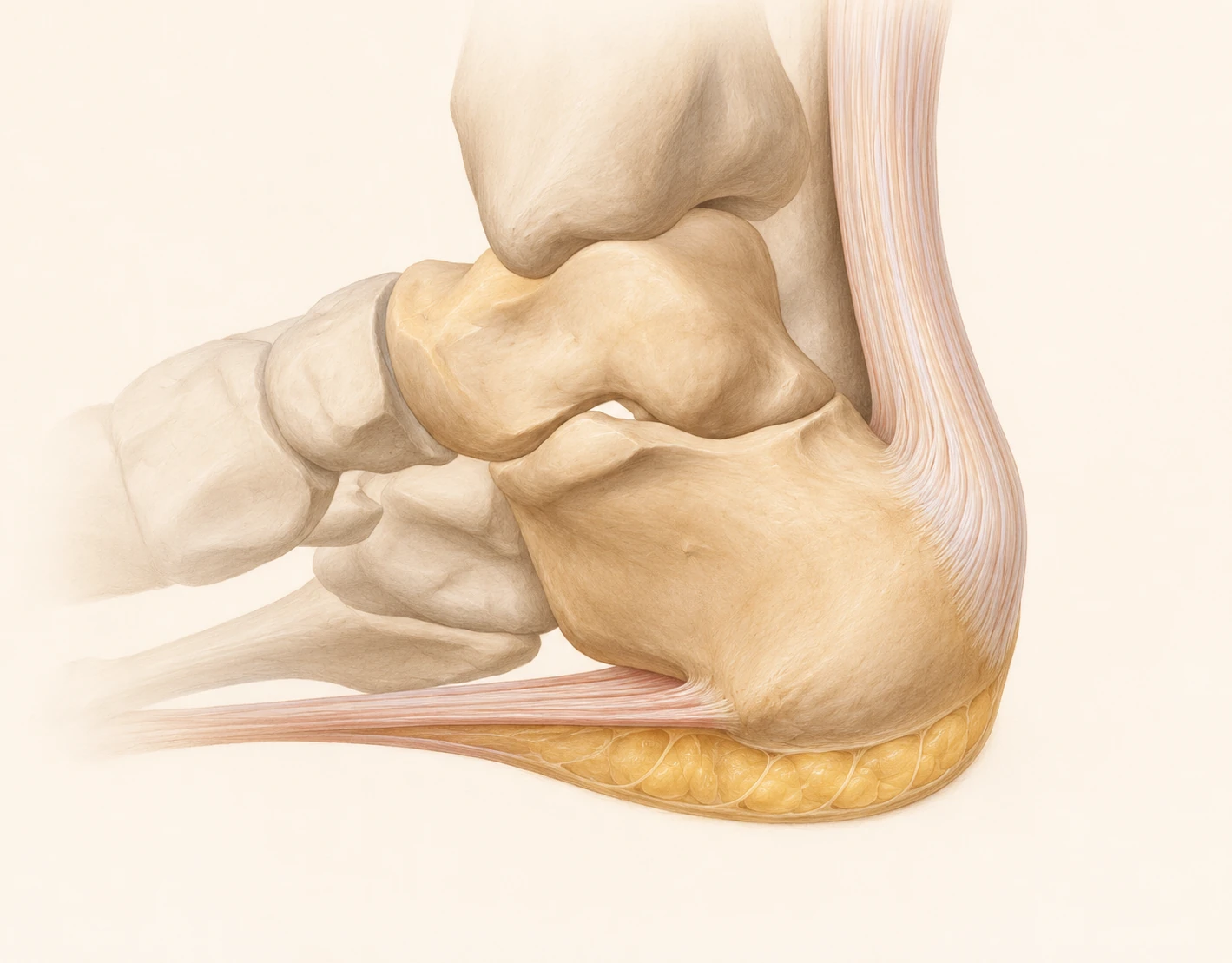
- Plantar fasciaThe band runs from the underside of the heel bone along the arch.
- Heel fat padThe gold tissue sits below the heel bone and cushions the point that meets the ground.
- Achilles tendonThe tendon joins the back of the heel bone above the sole.
- Under the inner heel, towards the arch
- Pain here on the first steps after rest often fits a plantar pattern. It can ease once you are moving, then ache again after a long walk or a shift on your feet. Koc et al., 2023; NHS, 2025
- Under the centre of the heel
- Soreness directly under the heel bone, especially while standing on a hard floor or walking barefoot, can come from the heel pad. Some people with heel-pad pain also hurt on their first steps. Yi et al., 2011
- At the back of the heel
- Gradual pain where the Achilles meets the back of the heel, especially when you push off or run, is a reason to check the tendon. A sudden painful snap at the back of the ankle needs assessment that day, even if you can still walk. de Vos et al., 2021; NHS, 2025; Cambridge University Hospitals (accessed), 2026
- Burning, tingling or numbness
- Tell your clinician if the sensation spreads along the sole or part of the foot feels numb. These symptoms give a reason to examine the nerves as well as the heel. Koc et al., 2023; NHS, 2025
How much walking feels manageable?
If your usual walk starts comfortably but the heel aches on the way home, try a shorter route. If it flares during a long shift, break up stretches of standing when you can. Pay attention to how far you can walk comfortably and how the first steps feel the next morning as you build back up. NHS, 2025; Koc et al., 2023
A heel that used to hurt only at the end of a run and now hurts on the walk to the bus deserves medical attention. Stop running or jumping and get it assessed promptly, particularly if you are limping or it aches at rest. can cause pain in one small spot and an early X-ray can look normal. AAOS OrthoInfo (accessed), 2026; Koc et al., 2023
What did the study of the seated stretch actually find?
A trial assigned 101 people whose plantar fascia pain had lasted at least ten months to a seated stretch for the sole or a standing calf stretch. Both groups also received shoe inserts, a short course of an anti-inflammatory medicine and an educational video. Of the 82 who returned at eight weeks, the seated-stretch group reported greater improvement in first-step pain and their worst pain. DiGiovanni et al., 2003
The trial assessed a stretching program over eight weeks. How much a single stretch will help on a particular morning remains uncertain. Current clinical guidance includes both plantar fascia and calf stretches for pain and function. DiGiovanni et al., 2003; Koc et al., 2023
When to have the heel examined
Book with your family doctor or a physiotherapist if pain limits normal walking, keeps returning or is worsening. For milder pain, about two weeks without improvement despite changes at home is another reason to book. Mention a recent increase in time on your feet, a change in training, any injury and what happens after the first few steps. NHS, 2025; Koc et al., 2023; AAOS OrthoInfo (accessed), 2026
Questions
If it eases during a run, can I keep my usual distance?
Consider the rest of the day and your next morning as well. If a run consistently leaves you sore later or makes walking harder the next day, shorten it or try a lower-impact activity such as swimming. Build back up as ordinary walking becomes more comfortable. NHS, 2025; Koc et al., 2023
Could a heel spur on my X-ray explain the pain?
Many people with a heel spur have no heel pain. The useful question is whether your symptoms and examination fit pain at the plantar fascia attachment or point elsewhere. A typical plantar fascia pattern can often be assessed without imaging. AAOS OrthoInfo (accessed), 2026; Koc et al., 2023
Do I need to buy custom insoles?
Comfortable shoes with some heel cushioning are a reasonable place to start. An insert can be part of a plan that also addresses activity and exercises. The clinical guideline gives little support for using either custom or ready-made inserts as the only treatment for short-term pain relief. NHS, 2025; Koc et al., 2023
What if I have diabetes and this is new foot pain?
Contact your family doctor or foot care team about new foot pain. If one foot becomes newly hot or swollen, keep weight off it and get medical assessment today, even if the pain is mild. If you also have fever or feel generally ill, go to emergency. NHS, 2025; MyHealth Alberta, 2024; NICE, 2019
Sources and further reading
- Koc et al. · 2023 · Journal of Orthopaedic & Sports Physical Therapy
Heel Pain - Plantar Fasciitis: Revision 2023.
The guideline describes plantar-medial heel pain on the first steps after inactivity and during longer periods on the feet. It recommends plantar fascia and calf stretching and discusses when to consider other diagnoses.
- Dorset NHS (accessed) · 2026 · Musculoskeletal Matters patient information
Foot pain - Plantar Fascia pain
The morning routine includes a gentle stretch along the sole before putting weight on the foot after lying down or sitting.
- MyHealth Alberta · 2024 · Patient information
Foot Pain: Care Instructions
The instructions advise emergency care if the foot turns cold or changes colour, and urgent assessment for signs of infection, significant injury or difficulty standing.
- NHS · 2025 · Patient information
Heel pain
Urgent assessment is advised for severe pain after injury, a foot that changes shape, a snap with injury or new trouble walking.
- Cambridge University Hospitals (accessed) · 2026 · Patient information
Achilles tendon rupture: management and rehabilitation
Describes the initial pop or struck sensation, pain that can settle and difficulty pushing off despite possible flat-footed walking. Used for recognition; its local boot and exercise schedule is not prescribed here.
- NICE · 2019 · NICE guideline NG19
Diabetic foot problems: prevention and management
Section 1.7 recommends prompt assessment and keeping weight off the foot when warmth, swelling or redness raises concern for Charcot arthropathy. It can occur with little pain.
- AAOS OrthoInfo (accessed) · 2026 · Patient information
Stress Fractures
Bone stress injuries can cause localized pain that builds with activity and progresses to pain with everyday walking or when resting. The guidance advises stopping painful activity and seeking assessment.
- AAOS OrthoInfo (accessed) · 2026 · Patient information
Plantar Fasciitis and Bone Spurs
The guidance illustrates a seated stretch for the plantar fascia and explains that heel spurs can appear on X-rays in people without heel pain.
- NHS · 2025 · Patient information
Plantar fasciitis
This resource describes pain under the heel and arch after rest. It suggests cushioned shoes and gentle stretches, and recommends assessment for worsening or persistent pain, altered sensation or foot pain in people with diabetes.
- Yi et al. · 2011 · Annals of Rehabilitation Medicine
Clinical characteristics of the causes of plantar heel pain.
First-step pain occurred in people diagnosed with either plantar fasciitis or fat-pad atrophy in this clinic sample. The diagnoses also considered where the heel was tender and what happened during standing.
- de Vos et al. · 2021 · British Journal of Sports Medicine
Dutch multidisciplinary guideline on Achilles tendinopathy.
The guideline describes pain at the back of the heel near the Achilles attachment that comes on when loading the tendon, with localized tenderness on examination.
- DiGiovanni et al. · 2003 · The Journal of Bone and Joint Surgery, American Volume
Tissue-specific plantar fascia-stretching exercise enhances outcomes in patients with chronic heel pain. A prospective, randomized study.
In adults with longstanding plantar fasciitis, a programme of plantar fascia stretching improved first-step and worst pain scores more than an Achilles stretching programme at eight weeks. Both groups received inserts and education.