
Understanding pain and movement
Muscle Knots and Trigger Points Explained
A muscle knot is an everyday description of a tight or tender spot. Clinicians may use the term myofascial trigger point when examination identifies a sensitive spot in a taut band, sometimes with pain felt elsewhere. Research examines these findings through clinical assessment and imaging; the description does not require muscle fibres to be tied into a literal knot.
Fernández-de-Las-Peñas and Dommerholt, 2018; Mazza et al., 2021What people mean by a muscle knot
The phrase describes a sensation or a finding under the fingers: an area that feels tender, firm or tight. A myofascial trigger point is a more specific clinical concept. An international expert panel proposed a cluster of a taut band, a hypersensitive spot and referred pain. Fernández-de-Las-Peñas and Dommerholt, 2018
A taut band describes a band-like area felt within a muscle during examination. A hypersensitive spot is more tender than the tissue around it. These observations help describe the examination; they do not show a bundle of fibres physically tangled together. Fernández-de-Las-Peñas and Dommerholt, 2018; Mazza et al., 2021
The useful clinical question is whether pressure reproduces your familiar symptoms and how that fits with your movement and health history. A tender spot deserves interpretation in the context of the problem, rather than becoming the entire diagnosis. Fernández-de-Las-Peñas and Dommerholt, 2018; Li et al., 2020
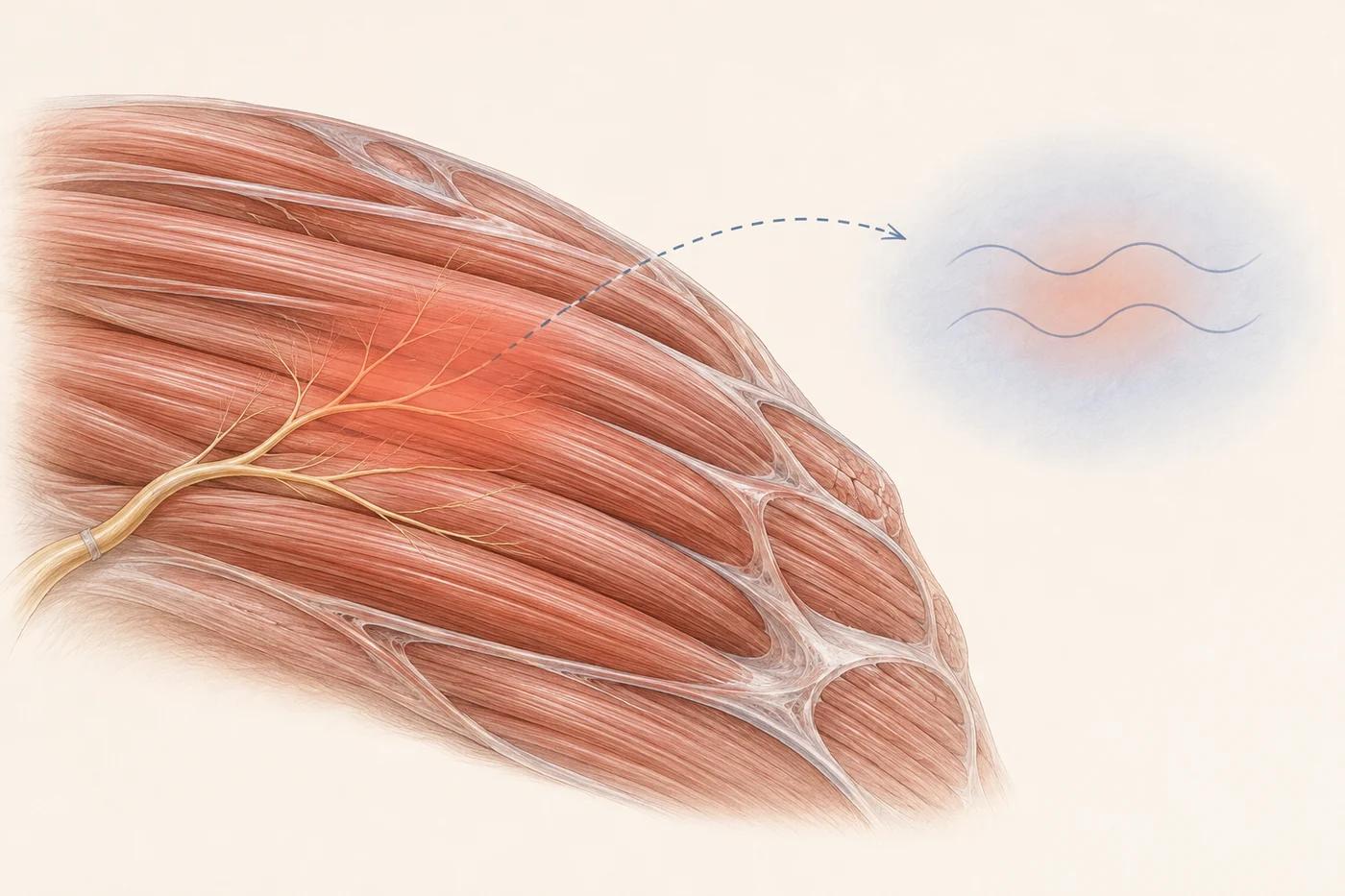
- Tender region
- Referred symptoms
The tinted regions represent sensations, not a visible lesion. Referred symptoms vary between people, so this illustration does not locate the source of an individual person’s pain.
Why pressure can hurt somewhere else
Referred pain is pain felt away from the place being stimulated. In the trigger-point consensus, the sensations could include a spreading ache and other sensory experiences. The location and feeling of the symptoms are part of what is recorded during an assessment. Fernández-de-Las-Peñas and Dommerholt, 2018
The expert panel specifically advised against expecting a fixed trigger-point location and referral area in every person. A diagram of a referral pattern is therefore an example, rather than a map that identifies the cause of your pain with certainty. Fernández-de-Las-Peñas and Dommerholt, 2018
Reproducing pain with pressure is one finding. It should not be used alone to exclude a joint, tendon or nerve-related problem. The pain mechanisms guide explains how different mechanisms can contribute to an experience of pain. Li et al., 2020; Nijs et al., 2021
What can make a muscle region sensitive
Researchers have investigated muscle electrical activity, the local chemical environment and the sensitivity of the nervous system. These lines of research connect the feeling of a tender muscle spot with both local tissue processes and the way sensory information is processed. Shah et al., 2015
Peripheral sensitisation concerns increased responsiveness near sensory nerve endings. Central sensitisation concerns processing within the central nervous system. A region can therefore be sensitive because of more than a simple change in the shape of its fibres. Shah et al., 2015; Nijs et al., 2021
The proposed contraction and energy-demand model
One proposed explanation links altered activity at the junction between nerve and muscle with sustained local contraction. The model suggests that increased energy demand and changes in local circulation and chemistry can contribute to sensitivity. It is a hypothesis investigated in trigger-point research, rather than a confirmed explanation for every muscle knot. Shah et al., 2015
The same review discusses competing explanations and evidence of sensory changes beyond the tender region. This is why treatment response, palpation and a proposed biological mechanism need to be considered separately when judging a claim about trigger points. Shah et al., 2015
How trigger points are assessed
An assessment may record a taut band, spot tenderness, whether pressure causes symptoms elsewhere and whether you recognise those symptoms. The international consensus distinguished active and latent trigger points partly through the reproduction and recognition of symptoms. Fernández-de-Las-Peñas and Dommerholt, 2018
Agreement on terminology does not automatically validate a diagnostic test. A systematic review of physical therapy trials found substantial variation in the criteria used, and many trials did not clearly report how trigger points had been identified. Li et al., 2020
That makes it helpful to describe the actual findings: which area is tender, which symptoms are reproduced and how the muscle and surrounding region function. The phrase trigger point should add detail to an assessment rather than end the investigation. Fernández-de-Las-Peñas and Dommerholt, 2018; Li et al., 2020
What imaging research has found
A systematic review examined imaging methods used to investigate myofascial pain and trigger points. Some studies found measurable differences in tissue mechanics and blood flow compared with healthy tissue. These are research observations, not proof that every palpable tender spot has one identical underlying lesion. Mazza et al., 2021
The review called for further work on diagnostic accuracy, reproducibility and methodological consistency. That is why a promising research image should not be presented as an established scan test that identifies the cause of every muscle knot. Mazza et al., 2021
What pressure and massage can change
Manual therapy studies commonly measure pain, sensitivity to pressure and movement. A network meta-analysis found improvements with several manual treatment approaches. These outcomes concern what people feel and can do; they do not directly demonstrate that a knot was physically removed. Guzmán Pavón et al., 2022
A newer review of friction massage found improvements within treatment groups, but no clear superiority over comparison groups for pain intensity and pressure sensitivity. The review also identified limitations in long-term evidence. Sadeghnia et al., 2025
This supports a practical interpretation: a hands-on treatment can be considered for its effect on comfort and movement, while the rest of the assessment and rehabilitation continue. Relief after pressure does not, by itself, establish the precise tissue mechanism. Guzmán Pavón et al., 2022; Sadeghnia et al., 2025
Approaching self-management
If you try pressure on a familiar tender area, judge it by comfort and function rather than how much pressure you can tolerate. There is no need to pursue increasingly painful pressure to prove that a knot has released. Research outcomes such as pressure sensitivity and pain are different from evidence that tissue has been untangled. Guzmán Pavón et al., 2022; Sadeghnia et al., 2025
Use changes in symptoms as information to bring to an assessment. Note where the tenderness is, whether it reproduces your usual pain and which movements are limited. Those details are more useful than treating every tender area as the same problem. Fernández-de-Las-Peñas and Dommerholt, 2018; Li et al., 2020
For a painful body region, follow the medical-help advice on the relevant condition page. A new lump, unexplained symptoms or a changing problem should be assessed rather than assumed to be a familiar muscle knot. The soft tissue therapy page explains how hands-on care fits within physiotherapy. Li et al., 2020
How to read treatment claims
Different questions require different evidence. A study can show that a treatment changes pain without establishing why it did so. It can also identify differences on imaging without showing that the finding is a reliable diagnosis in routine practice. Mazza et al., 2021; Guzmán Pavón et al., 2022
Be specific about what was studied. The friction massage review largely concerned upper trapezius trigger points and short-term outcomes. It does not establish a lasting benefit for every muscle, or show that a result applies equally to every person with a tender spot. Sadeghnia et al., 2025
The same approach applies when reading about dry needling or trigger point therapy: look at the symptom being treated, the comparator and the follow-up. Keep the proposed explanation separate from the measured result. Guzmán Pavón et al., 2022; Li et al., 2020
Questions
Is a muscle knot literally tangled muscle?
The clinical trigger-point description concerns a taut band, a hypersensitive spot and referred symptoms. It is not a description of muscle fibres tied into a knot. Imaging research investigates tissue properties rather than a literal knot. Fernández-de-Las-Peñas and Dommerholt, 2018; Mazza et al., 2021
Are muscle knots and trigger points the same?
Muscle knot is everyday language for a tight or tender spot. Trigger point is a more specific clinical description. The terms overlap in conversation, but not every area someone calls a knot has undergone a trigger-point assessment. Fernández-de-Las-Peñas and Dommerholt, 2018; Li et al., 2020
Does pain somewhere else confirm a trigger point?
Referred pain is part of the proposed clinical cluster. It is not a standalone confirmation, and the consensus does not require the same fixed referral map in everyone. Fernández-de-Las-Peñas and Dommerholt, 2018; Li et al., 2020
Does feeling better after massage prove that a knot was released?
It shows that symptoms changed. Treatment trials generally measure pain, pressure sensitivity or movement. Those measurements do not directly establish that a particular tissue structure was removed. Guzmán Pavón et al., 2022; Sadeghnia et al., 2025
Sources and further reading
- Fernández-de-Las-Peñas and Dommerholt · 2018 · Pain Medicine
International Consensus on Diagnostic Criteria and Clinical Considerations of Myofascial Trigger Points: A Delphi Study.
Experts proposed a taut band, hypersensitive spot and referred pain as a clinical cluster. The consensus did not prescribe a fixed referral map.
- Mazza et al. · 2021 · American Journal of Physical Medicine & Rehabilitation
Assessment of Myofascial Trigger Points via Imaging: A Systematic Review.
Imaging studies found measurable tissue differences, but accuracy and reproducibility needed further study.
- Li et al. · 2020 · The Clinical Journal of Pain
Criteria Used for the Diagnosis of Myofascial Trigger Points in Clinical Trials on Physical Therapy: Updated Systematic Review.
Diagnostic criteria varied across trials and many studies did not report them clearly.
- Nijs et al. · 2021 · Journal of Clinical Medicine
Nociplastic Pain Criteria or Recognition of Central Sensitization? Pain Phenotyping in the Past, Present and Future.
Explains pain mechanisms and proposed clinical criteria for nociplastic pain. Mechanisms can coexist; persistent pain alone does not establish a mechanism.
- Shah et al. · 2015 · PM&R
Myofascial Trigger Points Then and Now: A Historical and Scientific Perspective.
Reviews proposed explanations involving local muscle activity, the biochemical environment and peripheral and central sensitisation. It distinguishes hypotheses from an established account of every tender spot.
- Guzmán Pavón et al. · 2022 · The Clinical Journal of Pain
Comparative Effectiveness of Manual Therapy Interventions on Pain and Pressure Pain Threshold in Patients With Myofascial Trigger Points: A Network Meta-analysis.
Compared manual treatments using pain and pressure sensitivity outcomes. These outcomes do not demonstrate that an anatomical knot was removed.
- Sadeghnia et al. · 2025 · BMC Musculoskeletal Disorders
The effect of friction massage on pain intensity, PPT, and ROM in individuals with myofascial trigger points: a systematic review.
Improvements within massage groups did not establish superiority over controls for pain or pressure sensitivity. Long-term evidence was limited.