
Understanding pain and movement
Pain, Tissue Damage and Scan Results
Pain is an unpleasant sensory and emotional experience. Tissue injury can contribute to it, but pain is also influenced by how your nervous system processes information and by your wider circumstances. A scan describes structures; understanding why you hurt requires your symptoms, health history and examination as well.
Raja et al., 2020; Brinjikji et al., 2015How pain and tissue signals differ
Nociception is the nervous system’s response to potentially harmful stimulation. Pain is the experience you feel. The two are related, but they are different processes. A tissue signal does not arrive with a fixed amount of pain attached to it. Raja et al., 2020
The International Association for the Study of Pain describes pain as a personal experience influenced by biological, psychological and social factors. That includes the condition of your tissues and nervous system, alongside influences such as previous experiences and the circumstances in which symptoms occur. These influences are part of the biology and context of pain. Raja et al., 2020
Your description matters. Where pain is felt, when it began, what changes it and what it stops you doing are clinical information. A test result adds to that account rather than replacing it. The IASP definition explicitly recognises the person’s experience of pain. Raja et al., 2020
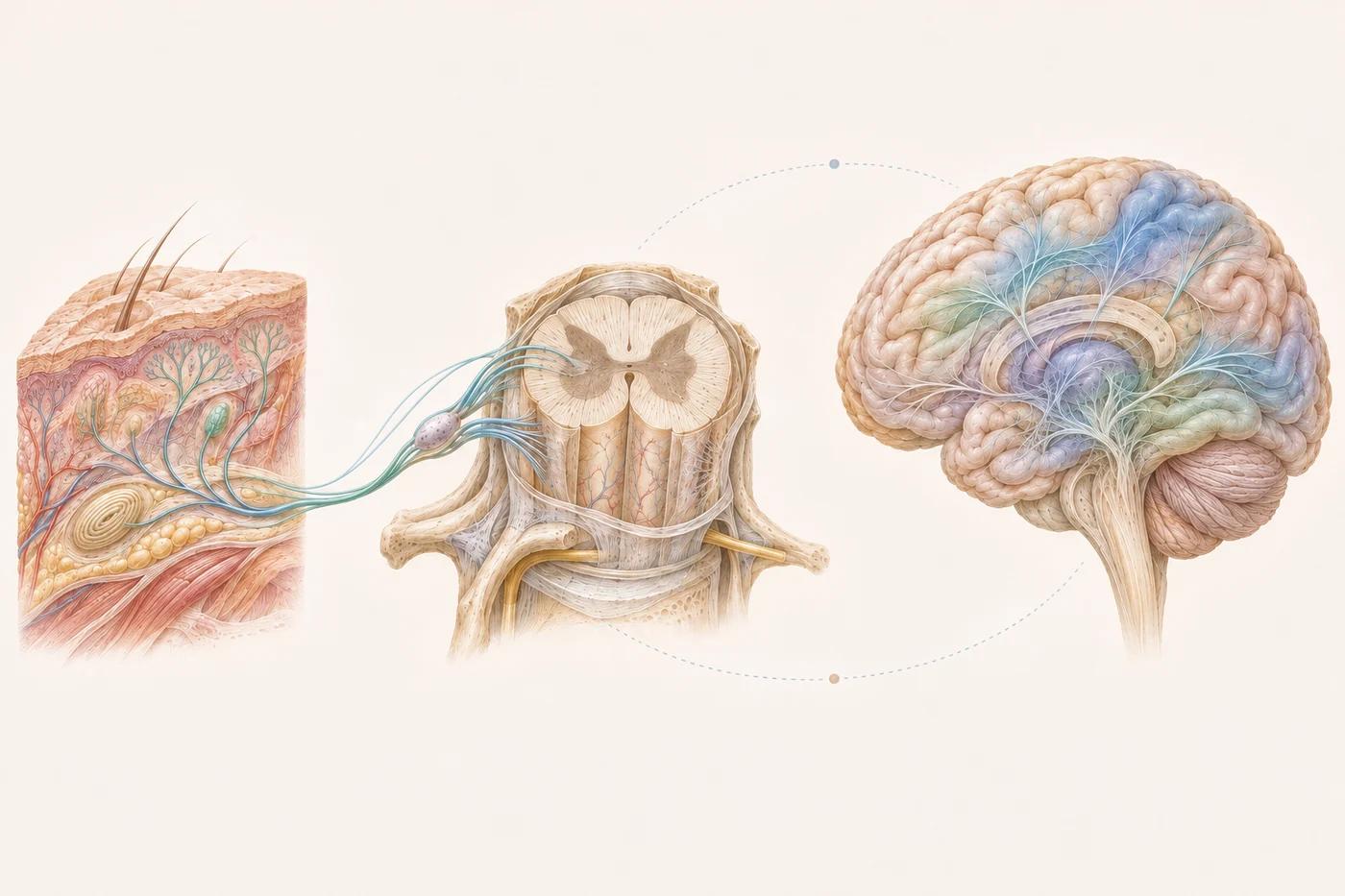
- Peripheral tissue input
- Spinal processing
- Brain networks
A conceptual view of tissue input, spinal processing and brain networks. The dotted connections represent interacting influences; the illustration simplifies the pathways involved in pain.
The relationship with tissue damage
An injury or disease can activate nociceptive pathways and produce pain. Pain can also arise when the sensory nervous system itself is affected, or when nociceptive processing changes. This helps explain why the amount of visible tissue change cannot serve as a universal pain scale. Raja et al., 2020; Nijs et al., 2021
A painful knee and a knee MRI answer different questions. MRI can show cartilage, meniscus and bone changes. It does not directly measure the pain experience. A review of painless, uninjured knees found several of these same changes, particularly in older adults. Culvenor et al., 2019
That evidence helps interpret a finding; it does not prove that your finding is irrelevant. The useful question is how well the structure, location and history fit your symptoms and examination. The knee and spine imaging reviews both emphasise clinical context. Culvenor et al., 2019; Brinjikji et al., 2015
Making sense of a scan result
A report may use words such as degeneration, bulge or tear. In spinal imaging studies, degenerative findings were common among people without pain and became more common with age. Their presence alone does not identify which structure is responsible for symptoms. Brinjikji et al., 2015
It is equally important to avoid the opposite shortcut: a reassuring scan does not mean that pain has been disproved. The experience of pain cannot be reduced to a picture of tissue structure. Some pain mechanisms concern nerve function or altered processing, which need a broader clinical assessment. Raja et al., 2020; Nijs et al., 2021
Read a report alongside a description of your symptoms. Ask what the finding means, whether it fits the examination, and whether it changes management. The knee MRI, hip MRI and lumbar MRI guides explain the report language in more detail. Brinjikji et al., 2015; Culvenor et al., 2019
Three ways clinicians describe pain mechanisms
Nociceptive, neuropathic and nociplastic describe mechanisms, rather than how severe or believable pain is. More than one can contribute at the same time. These terms help organise an assessment; a symptom questionnaire or scan alone does not establish the full explanation. Raja et al., 2020; Nijs et al., 2021
- Nociceptive pain
- Pain related to actual or threatened injury in tissue outside the nervous system, with activation of nociceptive pathways. Joint, muscle and tendon problems can involve this mechanism. Raja et al., 2020; Nijs et al., 2021
- Neuropathic pain
- Pain caused by a lesion or disease of the somatosensory nervous system. Its assessment considers the affected nerve pathways and relevant sensory and neurological findings. Raja et al., 2020; Nijs et al., 2021
- Nociplastic pain
- Pain involving altered nociception when tissue injury or a lesion of the sensory nervous system does not fully explain it. The proposed clinical criteria include more than pain duration alone. Raja et al., 2020; Nijs et al., 2021
A closer look at sensitisation
Sensitisation refers to increased responsiveness within nociceptive processing. Central sensitisation concerns processing within the central nervous system. It is related to the discussion of nociplastic pain, but the terms describe different concepts and should not be treated as interchangeable diagnoses. Nijs et al., 2021
The proposed musculoskeletal nociplastic pain criteria consider the duration and distribution of pain, whether other mechanisms fully explain it, and clinical evidence of hypersensitivity. Nociceptive or neuropathic mechanisms can coexist with a nociplastic contribution. A long history of pain does not settle the question by itself. Nijs et al., 2021
When pain persists
Persistent pain may involve ongoing nociceptive input, a nerve-related problem, altered nociceptive processing or a combination. Reassessment should consider the current pattern and function rather than assuming that every new symptom has the same explanation as an old one. Nijs et al., 2021
The distinction between pain and tissue injury can help make sense of symptoms that fluctuate. It does not require you to disregard pain. The explanation should leave room for both the tissue condition and the nervous system, and should lead to a practical plan you understand. Raja et al., 2020; Nijs et al., 2021
Education and movement in rehabilitation
Pain education aims to make the experience more understandable and support rehabilitation. In trials of chronic low back pain, adding pain neuroscience education to exercise or physiotherapy improved short-term pain and disability outcomes compared with the physical treatment alone. Ma et al., 2024
Those trials studied treatment programmes delivered to people with chronic low back pain. They do not establish that reading an article treats pain or that the same effect applies to every diagnosis. Education is most useful when it helps you understand your own assessment and the purpose of your rehabilitation. Ma et al., 2024
A practical discussion can cover what has been found, what activity is appropriate, how symptoms will be monitored and what would prompt a review. The rehabilitation-progress guide works through that review using walking and stair examples. The pain education and self-management page describes how education fits within physiotherapy. Ma et al., 2024
Questions to bring to an assessment
Ask which findings fit your symptoms, what the proposed pain mechanism explains and how it changes the plan. Ask how progress will be judged in the activities that matter to you. A useful explanation should connect the clinical findings to your experience rather than simply restating a scan report. Raja et al., 2020; Brinjikji et al., 2015
For symptoms in a particular area, use the medical-help guidance on the relevant condition page. The low back, knee and shoulder pages include the warning signs and actions appropriate to those regions. Raja et al., 2020
Questions
Can pain be real when a scan is reassuring?
Yes. Pain is an experience, while imaging assesses particular structures. A reassuring scan can be useful clinical information without explaining every symptom. Your history and examination still matter. Raja et al., 2020; Nijs et al., 2021
Does a tear or degenerative change always cause pain?
No. Studies have found meniscus, cartilage and spinal changes in people without pain. A finding still needs to be considered in the context of your symptoms; being common without pain does not make it irrelevant in every case. Culvenor et al., 2019; Brinjikji et al., 2015
Does persistent pain mean that I have nociplastic pain?
Duration alone is insufficient. The proposed clinical criteria consider pain distribution, hypersensitivity and whether nociceptive or neuropathic mechanisms fully explain the presentation. Different mechanisms can coexist. Nijs et al., 2021
Can understanding pain help with rehabilitation?
It can support treatment. Trials in chronic low back pain found short-term benefits when pain education was added to exercise or physiotherapy. The education should be connected to your own assessment and rehabilitation. Ma et al., 2024
Sources and further reading
- Raja et al. · 2020 · Pain
The revised International Association for the Study of Pain definition of pain: concepts, challenges, and compromises.
Defines pain as an experience and distinguishes it from nociception. Biological, psychological and social factors influence that experience.
- Brinjikji et al. · 2015 · AJNR
Systematic literature review of imaging features of spinal degeneration in asymptomatic populations.
Spinal imaging changes were common in people without symptoms and became more common with age. Findings need clinical context.
- Nijs et al. · 2021 · Journal of Clinical Medicine
Nociplastic Pain Criteria or Recognition of Central Sensitization? Pain Phenotyping in the Past, Present and Future.
Explains pain mechanisms and proposed clinical criteria for nociplastic pain. Mechanisms can coexist; persistent pain alone does not establish a mechanism.
- Culvenor et al. · 2019 · British Journal of Sports Medicine
Prevalence of knee osteoarthritis features on magnetic resonance imaging in asymptomatic uninjured adults: a systematic review and meta-analysis.
Cartilage, meniscus and other MRI findings occurred in adults with uninjured, painless knees. The results describe prevalence, not the cause of an individual person’s pain.
- Ma et al. · 2024 · Physiotherapy Theory and Practice
A systematic review and meta-analysis of pain neuroscience education for chronic low back pain: short-term outcomes of pain and disability.
Adding pain education to exercise or physiotherapy improved short-term outcomes in chronic low back pain. This does not establish the effect of reading a webpage.