
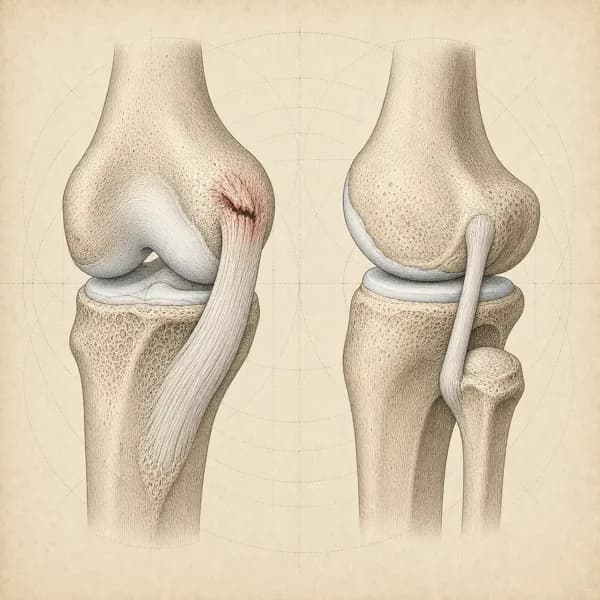
Is it the MCL or the LCL?

Both are ligaments on the side of the knee, both are sprained by a sideways force, and both are graded 1 to 3. The MCL runs down the inner side of the knee and resists the knee being pushed inward. The LCL is a thinner cord on the outer side and resists the knee being pushed outward. Where it hurts and how the injury happened help tell them apart. The exam then checks which ligament is injured and whether anything else is involved. The MCL is the knee ligament injured most often. An LCL injury is less common and can be part of a larger injury to the outer and back corner of the knee, so the exam checks for that as well.

The MCL is the medial collateral ligament. The LCL is the lateral collateral ligament, also called the fibular collateral ligament.

Written by Kareem Hassanein, Registered Physiotherapist. Burlington, Ontario. This is a guide, not a diagnosis. An in-person exam usually narrows it down, though the two can overlap and some cases need imaging or a second look.

When to see a doctor firstOther Comparisons

Side by side

The patterns that separate MCL sprain from LCL sprain in clinic. Read across each row and compare.

AspectMCL sprainLCL sprain
Where it hurtsAlong the inner side of the knee, often tender at one spot near the thigh-bone or shin-bone end of the ligament.Along the outer side of the knee, often tender over a cord you can feel when the leg is crossed in a figure-four position.
How it usually happensA blow to the outside of the knee, or the knee collapsing inward during a cut, a ski fall or a tackle.A blow to the inside of the knee, or the knee being forced outward, often with the knee close to straight.
SwellingOften local, along the inner side. A large swelling inside the joint suggests something else may be injured as well.Often local, on the outer side. Marked swelling or bruising toward the back of the knee raises the question of a larger injury.
The test that stresses itGentle inward stress on the knee (valgus stress) at about 30 degrees of bend.Gentle outward stress on the knee (varus stress) at about 30 degrees of bend.
What can be injured with itThe ACL, either meniscus and, in more severe injuries, other knee ligaments.The outer and back corner of the knee, the cruciate ligaments, and the nerve that runs around the outside of the knee.
Usual managementGrade 1 and 2 sprains, and many grade 3 sprains without other injuries, are managed without surgery. Rehabilitation includes protection from sideways stress, movement as tolerated and progressive strengthening exercises.Lower-grade sprains of the LCL alone are usually managed without surgery. Marked looseness or a suspected combined injury needs prompt medical assessment. A complete injury to the outer and back corner of the knee is most often treated surgically.
Where it hurts
MCL sprain

Along the inner side of the knee, often tender at one spot near the thigh-bone or shin-bone end of the ligament.

LCL sprain

Along the outer side of the knee, often tender over a cord you can feel when the leg is crossed in a figure-four position.

How it usually happens
MCL sprain

A blow to the outside of the knee, or the knee collapsing inward during a cut, a ski fall or a tackle.

LCL sprain

A blow to the inside of the knee, or the knee being forced outward, often with the knee close to straight.

Swelling
MCL sprain

Often local, along the inner side. A large swelling inside the joint suggests something else may be injured as well.

LCL sprain

Often local, on the outer side. Marked swelling or bruising toward the back of the knee raises the question of a larger injury.

The test that stresses it
MCL sprain

Gentle inward stress on the knee (valgus stress) at about 30 degrees of bend.

LCL sprain

Gentle outward stress on the knee (varus stress) at about 30 degrees of bend.

What can be injured with it
MCL sprain

The ACL, either meniscus and, in more severe injuries, other knee ligaments.

LCL sprain

The outer and back corner of the knee, the cruciate ligaments, and the nerve that runs around the outside of the knee.

Usual management
MCL sprain

Grade 1 and 2 sprains, and many grade 3 sprains without other injuries, are managed without surgery. Rehabilitation includes protection from sideways stress, movement as tolerated and progressive strengthening exercises.

LCL sprain

Lower-grade sprains of the LCL alone are usually managed without surgery. Marked looseness or a suspected combined injury needs prompt medical assessment. A complete injury to the outer and back corner of the knee is most often treated surgically.

What I check in person to separate them

These are the tests I use at the first visit. You cannot do them all on yourself reliably, but knowing what each one looks for helps explain how an in-person exam narrows things down.

  • Palpation along each ligament

    I press along each ligament from end to end. A single sore spot on one side of the knee is a useful pointer to which ligament is involved.

  • Valgus and varus stress at 30 degrees

    With your knee bent to about 30 degrees, I apply a gentle sideways stress in each direction and compare it with the other knee. I am looking at how far the joint opens and whether it comes to a firm stop.

  • The same stress with the knee straight

    Increased opening compared with the other knee when the leg is fully straight suggests a more extensive injury. If I find that, I refer you on.

  • Cruciate ligament and meniscus checks

    A side ligament sprain after a bigger injury can come with other injuries, so I also screen the cruciate ligaments and the menisci.

  • Foot strength and feeling on the outer shin

    With an injury on the outer side of the knee, I check the nerve that lifts the foot and supplies feeling to the outer shin and the top of the foot.

Which pattern fits you better?

This is not a diagnosis. Symptoms can overlap, and the descriptions below are a starting point.

More likely

MCL sprain

Your pattern more closely matches an MCL sprain if the pain is on the inner side, the knee was struck from the outside or collapsed inward, and it is tender along the inner ligament. Turning and cutting often feel worse than walking in a straight line.

Read the MCL sprain page
More likely

LCL sprain

Your pattern more closely matches an LCL sprain if the pain is on the outer side, the knee was forced outward or struck from the inside, and it is tender over the cord on the outer side.

Read the LCL sprain page

If you still cannot tell

Location alone can mislead. The outer side of the knee also holds the IT band, the outer meniscus and a hamstring tendon, and the inner side holds the inner meniscus and a group of tendons just below the joint. An in-person exam usually narrows it down. Either injury can make the knee feel unstable, and pain and swelling can limit some tests in the first days, so I may repeat them at a later visit. If I find marked looseness, increased opening with the knee straight, or signs that more than one structure is injured, I flag it to your family doctor or a sports medicine doctor and refer you. Imaging can be arranged there when it would change the plan.

When both are going on

A single sideways blow opens one side of the knee and compresses the other, so it is unusual for one blow to sprain both. Both can be injured in a higher-energy injury, usually together with a cruciate ligament, and that knee needs a medical assessment.

When to see a doctor first

  • Unable to take four steps on the leg after the injury, unable to bend the knee to a right angle, or tenderness on the kneecap or the bony point on the outside of the knee. Go to urgent care or emergency to check for a fracture. Clinicians use the Ottawa Knee Rules for this. Under those rules, being 55 or older is also a reason for an X-ray after a knee injury.
  • After an injury, the knee looked dislocated or feels loose in more than one direction. Go to emergency now, even if the knee has moved back into place. A knee dislocation can damage the blood vessels and nerves behind the knee.
  • Numbness, coldness, or colour change in the foot after a major knee injury. Go to emergency now. A severe ligament injury can damage the blood supply to the leg.
  • Difficulty lifting the foot, or numbness on the outer shin or the top of the foot, after an injury to the outer side of the knee. Seek same-day medical assessment. The nerve on the outer side of the knee may be involved.
  • A knee that is locked and will not straighten. Possible displaced meniscus tear. Get it assessed the same day by your family doctor, urgent care or emergency; it needs an urgent orthopaedic referral.
  • Calf pain, swelling, or warmth in the days after the injury. Seek same-day medical assessment to rule out a blood clot.
  • Sudden shortness of breath or chest pain, coughing up blood or feeling faint, especially with a painful or swollen calf. Go to emergency now, or call 911. A clot that has travelled to the lungs (pulmonary embolism) needs to be ruled out.
  • A hot, red and swollen knee together with fever, chills or feeling generally unwell. Go to emergency now.

Questions patients ask about telling these apart

Which is worse, an MCL or an LCL sprain?

Neither is worse by name; the grade and what else is injured matter more. Many MCL sprains recover without surgery. An LCL injury with marked looseness, or with damage to the outer and back corner of the knee, needs prompt medical assessment.

How long does each take to recover?

It depends on the grade, on what else is injured, and on what you are returning to. A mild sprain of either ligament often settles in weeks, while a higher-grade sprain can take months. I set expectations after the exam. Return to sport depends on how the knee tests and feels, alongside the time the ligament needs to heal.

Do I need an MRI?

Not always. Many lower-grade sprains are assessed and managed on the exam alone. I cannot order imaging. When imaging would change the plan, I flag it to your family doctor or specialist and refer you.

Should I wear a brace?

A hinged brace is sometimes used to limit sideways stress while the ligament heals, particularly when the knee is less stable. Studies of MCL rehabilitation vary in whether a brace is used and for how long. Whether a brace makes sense for you, and for how long, depends on the injury and the exam.

Can I keep training?

Often, in a modified way. Straight-line work is usually tolerated before cutting, pivoting and contact. I set the progression from how the knee responds.

Evidence this page draws on

The main sources behind this comparison.

Describes the medial collateral ligament as the most commonly injured ligament in the knee, and reports that isolated grade I and II tears and most grade III tears can be treated without surgery with a supervised, functional rehabilitation program.

Giannotti BF, Rudy T, Graziano J. "The non-surgical management of isolated medial collateral ligament injuries of the knee." Sports Medicine and Arthroscopy Review 2006; 14(2): 74-77.

A systematic review of 26 reports on non-operative treatment of isolated MCL injuries found that rehabilitation used strengthening exercises with poorly reported details, and that the use of a brace and how long it was worn were reported inconsistently.

Svantesson J, Piussi R, Weissglas E, et al. "Shedding light on the non-operative treatment of the forgotten side of the knee: rehabilitation of medial collateral ligament injuries, a systematic review." BMJ Open Sport & Exercise Medicine 2024; 10(2): e001750.

A review of injuries to the outer and back corner of the knee, which includes the lateral collateral ligament, reports that complete injuries rarely heal with non-operative treatment and are most often treated surgically, and that these injuries can be missed without a careful exam.

Chahla J, Moatshe G, Dean CS, LaPrade RF. "Posterolateral Corner of the Knee: Current Concepts." Archives of Bone and Joint Surgery 2016; 4(2): 97-103.

Book an assessment

I assess and treat these conditions at Endorphins Health & Wellness Centre in Burlington. Direct insurance billing is available, and a physician referral is not required.

  • 4631 Palladium Way, Unit 6Burlington, ON L7M 0W9
  • (905) 634-6000Direct billing. No referral needed.

Burlington hours

Endorphins Health & Wellness Centre
4631 Palladium Way
Monday
1:30 to 7:00 PM
Tuesday
3:30 to 8:00 PM
Thursday
1:30 to 8:00 PM
Headon Physio
1387 Walkers Line
Wednesday
2:00 to 7:00 PM
Friday
1:00 to 7:00 PM
PhysioMax Wellness
1035 Brant Street
Tuesday
11:00 AM to 2:30 PM
Saturday
12:00 to 3:00 PM