
Understanding pain and movement
Sarcopenia: Muscle Strength, Ageing and Exercise
Sarcopenia is a muscle disorder involving reduced muscle strength and muscle quantity or quality. It becomes more common with age and can also develop in the context of illness or other contributors. Assessment looks beyond the size of a muscle to strength, physical performance and the effect on daily life.
Cruz-Jentoft et al., 2019; Kirk et al., 2024Muscle size, strength and function
Muscle quantity describes how much muscle tissue is present. Strength describes the force you can produce. Physical performance describes tasks involving the body as a whole, such as walking or standing from a chair. These measurements are related, but they are not interchangeable. Cruz-Jentoft et al., 2019; Kirk et al., 2024
This distinction matters when someone notices difficulty on stairs or getting out of a chair. Looking at the size of the thigh alone cannot explain all of the change. Assessment may examine force, movement and the wider health picture as well as muscle quantity. Cruz-Jentoft et al., 2019
The global conceptual consensus includes muscle mass, strength and muscle-specific strength, which relates force to muscle size. It treats impaired physical performance as an outcome. Clinical frameworks use these ideas in somewhat different ways, so the framework should be named when a result is interpreted. Kirk et al., 2024
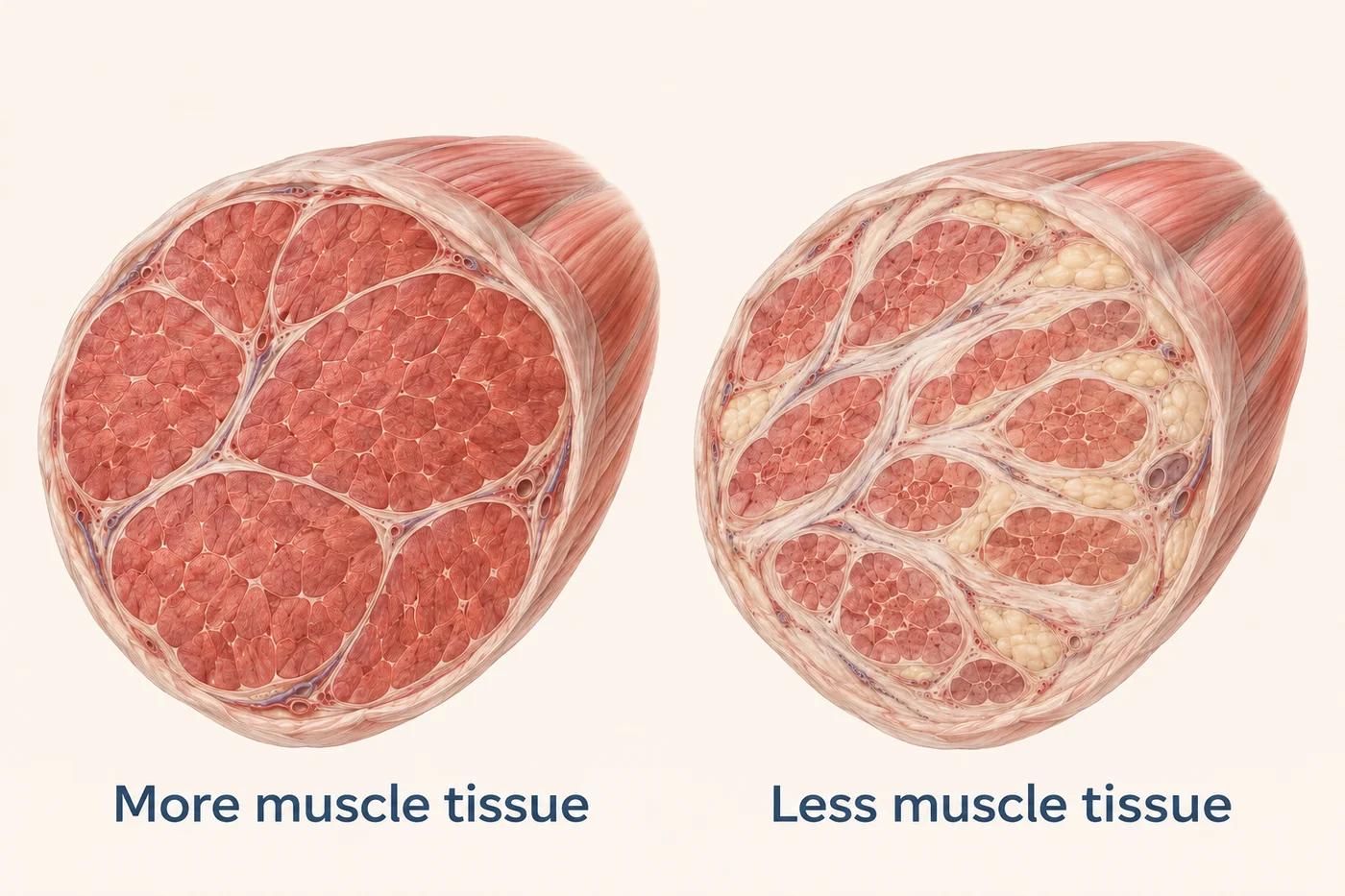
Illustrative cross-sections, not scans or diagnostic thresholds. Muscle quantity, strength and physical performance require different measurements.
Ageing and other contributors
Sarcopenia becomes more common with older age, but the European consensus recognises that it can occur earlier in life. It distinguishes age-related sarcopenia from secondary sarcopenia associated with other contributors, including disease, inactivity and inadequate nutrition. Cruz-Jentoft et al., 2019
Temporary disuse after an injury and sarcopenia are related discussions, but the words do not automatically describe the same diagnosis. Weakness needs an assessment of its pattern and context. A person recovering from surgery, for example, has different considerations from someone with a broader decline in muscle health. Cruz-Jentoft et al., 2019
A gradual change in function is worth bringing to a healthcare appointment. Explain what has changed in walking, rising, carrying or other everyday tasks. These observations connect the assessment to the activities you want to maintain or recover. Cruz-Jentoft et al., 2019; Beaudart et al., 2025
How sarcopenia is assessed
Screening identifies people who need further assessment. It does not by itself confirm sarcopenia. The SARC-F questionnaire asks about functional difficulties, and the European framework describes measurements of strength, muscle quantity or quality, and physical performance. Cruz-Jentoft et al., 2019
In the EWGSOP2 European framework, low muscle strength identifies probable sarcopenia. Evidence of low muscle quantity or quality confirms the diagnosis. Poor physical performance indicates greater severity within that framework. Cruz-Jentoft et al., 2019
A clinician may use grip strength or a chair-rise test to assess strength, body-composition methods to assess muscle quantity, and gait or other performance tests to assess function. The tests have different purposes, and the results need to be interpreted using the relevant measurement method and framework. Cruz-Jentoft et al., 2019
- Screening
- A way to identify who may benefit from further assessment. A positive screening result is a starting point. Cruz-Jentoft et al., 2019
- Strength
- Assessed using an appropriate strength measure, such as grip or chair-rise performance within the European framework. Cruz-Jentoft et al., 2019
- Muscle quantity or quality
- Adds information about the muscle tissue itself. In EWGSOP2, this contributes to confirming a diagnosis after low strength is identified. Cruz-Jentoft et al., 2019
- Physical performance
- Describes function such as walking. Its role depends on the framework: a severity measure in EWGSOP2 and an outcome in the global conceptual definition. Cruz-Jentoft et al., 2019; Kirk et al., 2024
Why diagnostic frameworks differ
A conceptual definition describes what a condition is. An operational definition sets out how to identify it in practice or research. The global GLIS consensus was developed to establish a shared conceptual definition; its publication explicitly distinguished this from the subsequent work of creating an operational definition. Kirk et al., 2024
The EWGSOP2 algorithm is one widely used operational framework. Its thresholds and test choices should be described as belonging to that framework, rather than presented as universal rules for every population. Mixing parts of different algorithms can change what a test result means. Cruz-Jentoft et al., 2019; Kirk et al., 2024
Exercise and rehabilitation
Resistance-based physical activity is recommended in the international clinical practice guideline for sarcopenia. Resistance exercise asks muscles to work against an external load. In a clinical programme, exercise choice and progression need to fit the person’s strength, function and health. Dent et al., 2018
A systematic review comparing exercise approaches in older adults with sarcopenia found benefits across several outcomes. Resistance exercise, sometimes combined with balance, aerobic activity or nutrition, improved aspects of strength, physical performance or quality of life compared with usual care. Shen et al., 2023
The exercise programme should connect to daily function. Chair rising, walking and carrying describe different demands, so an assessment can identify which capacities need attention. The objective is to judge progress in strength and meaningful activity alongside any change in muscle quantity. Cruz-Jentoft et al., 2019; Shen et al., 2023
Measured improvement and meaningful change
A newer resistance-training review found improvements in several strength and function measures but did not find significant increases in the reported measures of muscle mass. Its authors also noted that changes in several outcomes did not exceed the thresholds they used for a meaningful benefit. Yan et al., 2025
This is useful when reading exercise claims. A statistically detectable change is not automatically a noticeable change in everyday life. The evidence supports considering resistance exercise while tracking outcomes that matter to the person, rather than promising that a programme will rebuild a certain amount of muscle. Yan et al., 2025; Dent et al., 2018
Nutrition alongside exercise
The international guideline conditionally recommends a protein-rich diet or protein supplementation for sarcopenia. This is a different recommendation strength from its strong recommendation for resistance-based activity. Nutrition and exercise should be considered together rather than treating a supplement as a complete programme. Dent et al., 2018
In the exercise review, adding nutritional interventions had a larger effect on grip strength than exercise alone, while effects on other physical performance measures were similar. That result should not be translated into a claim that every supplement improves every outcome. Shen et al., 2023
The guideline also highlights adequate calorie and protein intake. When food intake is difficult or the diet needs to account for a medical condition, nutrition advice should be individualised. A dietitian can help turn that assessment into an eating plan. Dent et al., 2018
Following progress over time
Strength, physical performance and muscle quantity provide different information. Following the same appropriate measures over time helps show whether a programme is changing the capacities it targets. A change in body weight or appearance alone does not describe every aspect of muscle health. Cruz-Jentoft et al., 2019; Yan et al., 2025
Daily-life outcomes matter too. A global evidence review found associations between sarcopenia and reduced quality of life, falls and fractures. These describe patterns across populations; they are not predictions of what will happen to an individual. Beaudart et al., 2025
Bring a specific goal to an assessment, such as rising from your usual chair or managing the stairs at home. Sudden weakness or an unexpected rapid change needs medical assessment rather than being attributed to ageing. The exercise therapy page explains how a programme can be planned and progressed. Cruz-Jentoft et al., 2019
Questions
Is sarcopenia just having small muscles?
No. Modern definitions include strength and other aspects of muscle health. In EWGSOP2, low strength identifies probable sarcopenia and low muscle quantity or quality helps confirm it. Cruz-Jentoft et al., 2019; Kirk et al., 2024
Can a chair-rise test diagnose sarcopenia on its own?
It contributes information about strength and function, but a complete diagnosis depends on the framework and the additional assessment. A screening or single test result should not be treated as the entire diagnosis. Cruz-Jentoft et al., 2019
Can exercise improve sarcopenia?
Resistance-based activity is recommended in the clinical guideline, and reviews have found improvements in strength and several functional outcomes. The size and practical importance of changes vary, so progress should be measured against your own goals. Dent et al., 2018; Shen et al., 2023; Yan et al., 2025
Do I need a protein supplement?
The guideline conditionally recommends a protein-rich diet or supplementation. Which approach is appropriate depends on your intake and health. A supplement is one possible nutritional tool, not a substitute for assessment and exercise. Dent et al., 2018
Sources and further reading
- Cruz-Jentoft et al. · 2019 · Age and Ageing
Sarcopenia: revised European consensus on definition and diagnosis.
EWGSOP2 identifies probable sarcopenia through low strength, confirms it with low muscle quantity or quality and uses physical performance to describe severity.
- Kirk et al. · 2024 · Age and Ageing
The Conceptual Definition of Sarcopenia: Delphi Consensus from the Global Leadership Initiative in Sarcopenia (GLIS).
Identifies muscle mass, strength and strength relative to muscle size as components. Physical performance is an outcome in this conceptual framework.
- Beaudart et al. · 2025 · Aging Clinical and Experimental Research
Health outcomes of sarcopenia: a consensus report by the outcome working group of the Global Leadership Initiative in Sarcopenia (GLIS).
Reviews associations with quality of life, falls, fractures and mortality. These population associations are not predictions for an individual.
- Dent et al. · 2018 · The Journal of Nutrition, Health & Aging
International Clinical Practice Guidelines for Sarcopenia (ICFSR): Screening, Diagnosis and Management.
Strongly recommends resistance-based activity and conditionally recommends a protein-rich diet or protein supplementation.
- Shen et al. · 2023 · Journal of Cachexia, Sarcopenia and Muscle
Exercise for sarcopenia in older people: A systematic review and network meta-analysis.
Resistance exercise and combinations with balance or aerobic exercise improved several outcomes compared with usual care. Added nutrition had different effects on different outcomes.
- Yan et al. · 2025 · Aging Clinical and Experimental Research
Optimal resistance training prescriptions to improve muscle strength, physical function, and muscle mass in older adults diagnosed with sarcopenia: a systematic review and meta-analysis.
Found improvements in several strength and function measures, but not muscle mass. The authors noted that measured changes did not exceed their thresholds for meaningful benefit.