
Understanding pain and movement
Tendinitis, Tendinosis and Tendinopathy
Tendinopathy is the broad term used for a tendon problem. Tendinitis refers to inflammation, while tendinosis describes structural tissue changes. These words emphasise different aspects of tendon health. Modern research considers mechanical loading, inflammation and tissue changes together rather than dividing every painful tendon into a single category.
Goerl, 2020; Gehwolf et al., 2025What a tendon does
A tendon connects muscle to bone and transmits force as you move. Its collagen-rich tissue contains living cells and an extracellular matrix. Tendon biology changes in response to its mechanical and chemical environment; it is more than a passive cord. Gehwolf et al., 2025; La Rose et al., 2026
Different tendons have different jobs and surroundings. The rotator cuff contributes to shoulder movement and stability. The Achilles and patellar tendons experience different loading demands in the lower limb. A treatment plan needs to account for the particular tendon and the activity you want to do. La Rose et al., 2026; Gehwolf et al., 2025
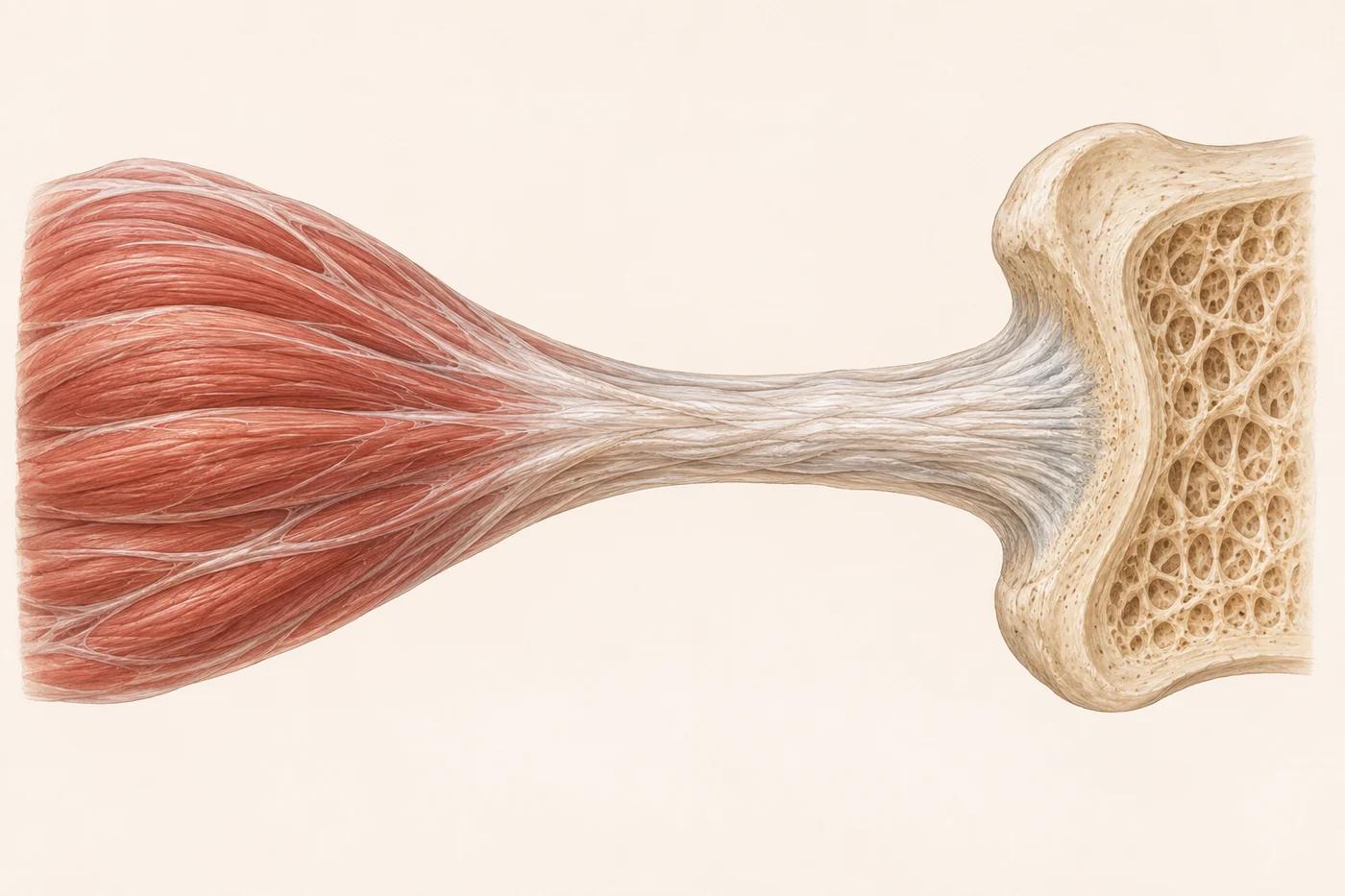
- Muscle
- Tendon
- Bone
A simplified view of the connection from muscle to tendon to bone. It shows how tissues connect, rather than a particular injury or a sequence of disease stages.
Inside the tendon tissue
Tendon cells, including tenocytes, sit within the tissue’s extracellular matrix. Researchers study changes in these cells, matrix proteins, blood vessels and immune activity to understand tendon disease. This helps explain why a structural label is only one part of the biology. Gehwolf et al., 2025
The review describes an interacting network of mechanical stress, inflammation and vascular changes. It also identifies metabolic influences as an area of research. This is more informative than treating a tendon as a worn rope whose condition can be judged entirely by its appearance. Gehwolf et al., 2025
What each term means
Reports and clinical conversations sometimes use these terms loosely. It helps to distinguish a description of tissue biology or appearance from the broader clinical problem. The words are related, but they are not exact synonyms. Goerl, 2020; Gehwolf et al., 2025
- Tendinitis or tendonitis
- A term referring to tendon inflammation. The two spellings refer to the same word. It does not mean that every painful tendon problem is caused only by inflammation. Goerl, 2020; Gehwolf et al., 2025
- Tendinosis
- A term describing structural changes in tendon tissue. Radiology reports may use it when a tendon’s thickness, texture or signal looks altered. The description alone does not establish pain severity. Goerl, 2020; Gehwolf et al., 2025
- Tendinopathy
- A broader term for tendon pathology, commonly used clinically for a painful tendon problem. It avoids reducing the explanation to inflammation or degeneration alone. Goerl, 2020; Gehwolf et al., 2025
Why tendon terminology changed
The language has shifted as research methods have changed. Earlier descriptions emphasised inflammation. Later studies highlighted structural degeneration and used the word tendinosis. More recent methods have identified immune cells and inflammatory mediators in tendon disease, bringing inflammatory processes back into the explanation. Gehwolf et al., 2025
This history does not establish a fixed sequence from tendinitis to tendinosis to a tear. The contemporary review describes interacting mechanical, inflammatory and vascular processes. The terms should not be presented as three inevitable stages through which your tendon must pass. Gehwolf et al., 2025
Inflammation is part of a wider picture
Mechanical stress, inflammatory signalling and vascular changes can interact in tendinopathy. Research into tendon disease includes changes in cells and the surrounding matrix, as well as changes in blood vessels. A single label cannot capture all of that biology. Gehwolf et al., 2025
It is inaccurate to explain persistent tendinopathy as a condition in which inflammation never has a role. It is also too simple to treat inflammation as the whole problem. The relevant question for rehabilitation is how the tendon behaves under load and what the clinical assessment finds. Gehwolf et al., 2025
What a scan can tell you
Ultrasound and MRI can describe tendon structure. A scan may show thickening, altered internal appearance, vascularity, calcification or a tear. These findings need to be interpreted alongside where you hurt and what you can do. Gehwolf et al., 2025; Rabello et al., 2020
Structural change and pain do not have a simple one-to-one relationship. Tendons with marked changes can be painless, while pain does not always correspond to marked structural change. That makes the history and clinical examination essential to interpretation. Gehwolf et al., 2025
A painless abnormality is not necessarily meaningless. In a review of mostly sporting populations, Achilles and patellar ultrasound abnormalities were associated with a higher risk of future symptoms. That is a population-level association, not a prediction that a particular person will develop pain. McAuliffe et al., 2016
Do improvements have to show on a scan?
A systematic review of Achilles and patellar rehabilitation found that some improvements in symptoms accompanied changes in tendon thickness or vascularity. The findings differed with the tendon, type of exercise and follow-up period. This supports using imaging as complementary information rather than treating every scan change as a direct measure of recovery. Rabello et al., 2020
Clinical progress includes symptoms and function. A scan can contribute information when it answers a specific question, but the report wording alone cannot tell you which activities are appropriate or how rehabilitation should progress. Rabello et al., 2020; Gehwolf et al., 2025
Loading and rehabilitation
Tendons transmit force, so their mechanical environment matters. Rehabilitation considers the demands of work, exercise and daily movement alongside the tendon’s response. The biological review describes loading as one influence within a wider process, not a single explanation for every tendon problem. Gehwolf et al., 2025
Therapeutic loading has been studied in Achilles and patellar tendinopathy. The imaging review found clinical improvement across the included exercise studies, although changes on scans were inconsistent. This does not establish one loading programme as suitable for every tendon or every stage of a problem. Rabello et al., 2020
Use the guide for the specific site when you need a plan: Achilles, patellar, gluteal, hamstring or rotator cuff. Those pages address the clinical pattern and the differences that matter to treatment. Gehwolf et al., 2025
Reading the wording with your clinician
Ask whether the report describes a structural finding, a tear or a clinical diagnosis. Ask how well it fits the location and behaviour of your symptoms, and what the examination suggests about strength and function. This keeps the language connected to the problem you are experiencing. Gehwolf et al., 2025; Rabello et al., 2020
A tear requires its own assessment and should not be assumed from the word tendinosis. The supraspinatus scan guide explains tendinosis and tear wording in the shoulder. For help with sudden injuries or new symptoms, follow the medical-help guidance on the relevant tendon’s condition page. Goerl, 2020; Desmeules et al., 2025
Questions
Are tendinitis and tendonitis different?
They are different spellings of the same term. The word refers to inflammation. Tendinopathy is broader, and tendinosis describes structural tissue changes. Goerl, 2020; Gehwolf et al., 2025
Does tendinosis mean a tendon is torn?
No. Tendinosis and a tear describe different findings. A report may describe both, so each part of the wording needs to be read rather than treating one word as a substitute for the other. Goerl, 2020; Desmeules et al., 2025
Can a tendon look abnormal without hurting?
Yes. Structural abnormalities can occur in painless tendons. In athletes, some ultrasound changes were associated with future symptoms, so their significance still depends on the clinical context. Gehwolf et al., 2025; McAuliffe et al., 2016
Does chronic tendinopathy involve inflammation?
Inflammatory processes can contribute alongside mechanical stress, tissue and vascular changes. The older explanation that persistent tendinopathy contains no inflammation is too absolute. Gehwolf et al., 2025
Sources and further reading
- Goerl · 2020 · The Journal of Family Practice
Getting tendinopathy treatment (and terminology) right.
Tendinopathy, tendinitis, tendinosis and paratenonitis describe different concepts rather than interchangeable tissue diagnoses.
- Gehwolf et al. · 2025 · Advanced Science
Tendinopathy: The Interplay between Mechanical Stress, Inflammation, and Vascularity.
Reviews interacting mechanical, inflammatory and vascular processes. Structural changes and pain do not have a simple one-to-one relationship.
- La Rose et al. · 2026 · StatPearls
Anatomy, Rotator Cuff.
Describes the four cuff muscles and their role among the shoulder’s static and dynamic stabilisers.
- Rabello et al. · 2020 · Clinical Journal of Sport Medicine
Association Between Clinical and Imaging Outcomes After Therapeutic Loading Exercise in Patients Diagnosed With Achilles or Patellar Tendinopathy at Short- and Long-Term Follow-up: A Systematic Review.
Some clinical improvements accompanied imaging changes, with results differing by tendon, exercise and follow-up. Imaging complements clinical assessment.
- McAuliffe et al. · 2016 · British Journal of Sports Medicine
Can ultrasound imaging predict the development of Achilles and patellar tendinopathy? A systematic review and meta-analysis.
In predominantly sporting populations, painless tendon abnormalities were associated with future symptoms. Other factors also contribute.
- Desmeules et al. · 2025 · JOSPT
Rotator Cuff Tendinopathy Diagnosis, Nonsurgical Medical Care, and Rehabilitation: A Clinical Practice Guideline.
Covers assessment, nonsurgical care and rehabilitation of adults with rotator cuff tendinopathy, including calcific tendinopathy and partial-thickness tears.