
Everyday symptoms
Shin Pain When Running
A broad ache along the inner shin can follow a longer run or a new hill session. Pause the run that brings it on. If the pain keeps returning to one small spot, starts earlier each time or hurts when you walk, stop running and jumping and arrange prompt medical assessment for a possible bone stress injury.
AAOS OrthoInfo (accessed), 2026; AAOS OrthoInfo (accessed), 2026When to see a doctor firstWhat to do on this run
If shin pain is building or changing your stride, stop. Notice how ordinary walking feels. If the same spot hurts with walking or you are limping, limit painful walking while you arrange assessment. Early pain can ease as you warm up, then return as you cool down. AAOS OrthoInfo (accessed), 2026; Blackman, 2010; AAOS OrthoInfo (accessed), 2026
When to see a doctor first
Go to emergency
Lower-leg pain is suddenly severe, or it rapidly worsens after a blow, fracture or crush injury. The leg may feel tight or swollen.
Go to emergency now. Pressure building inside the leg can damage muscle and nerves. AAOS OrthoInfo (accessed), 2026
You suddenly cannot move your foot or lose all feeling in it.
Go to emergency now. AAOS OrthoInfo (accessed), 2026
One foot suddenly turns pale, blue or much colder than the other.
Call 911. MyHealth Alberta, 2024
You develop sudden unexplained shortness of breath, sharp chest pain when breathing or cough up blood.
Call 911. These can be signs of a blood clot in the lung. MyHealth Alberta (accessed), 2026
Get seen today
One calf develops new, unexplained swelling, warmth, redness or tenderness.
Get medical assessment today for a possible blood clot. MyHealth Alberta (accessed), 2026
Numbness or weakness in the lower leg or foot fails to clear with rest after a run.
Get medical assessment today. AAOS OrthoInfo (accessed), 2026; Vogels et al., 2022
Where does it hurt, and when does it settle?
The tibia is the larger bone at the front of the lower leg. Being able to describe a stretch of soreness or one particular spot helps, especially if you can also say how the area feels later that day. The location is one clue a clinician uses alongside your running history and an examination. AAOS OrthoInfo (accessed), 2026; AAOS OrthoInfo (accessed), 2026; Winters et al., 2018
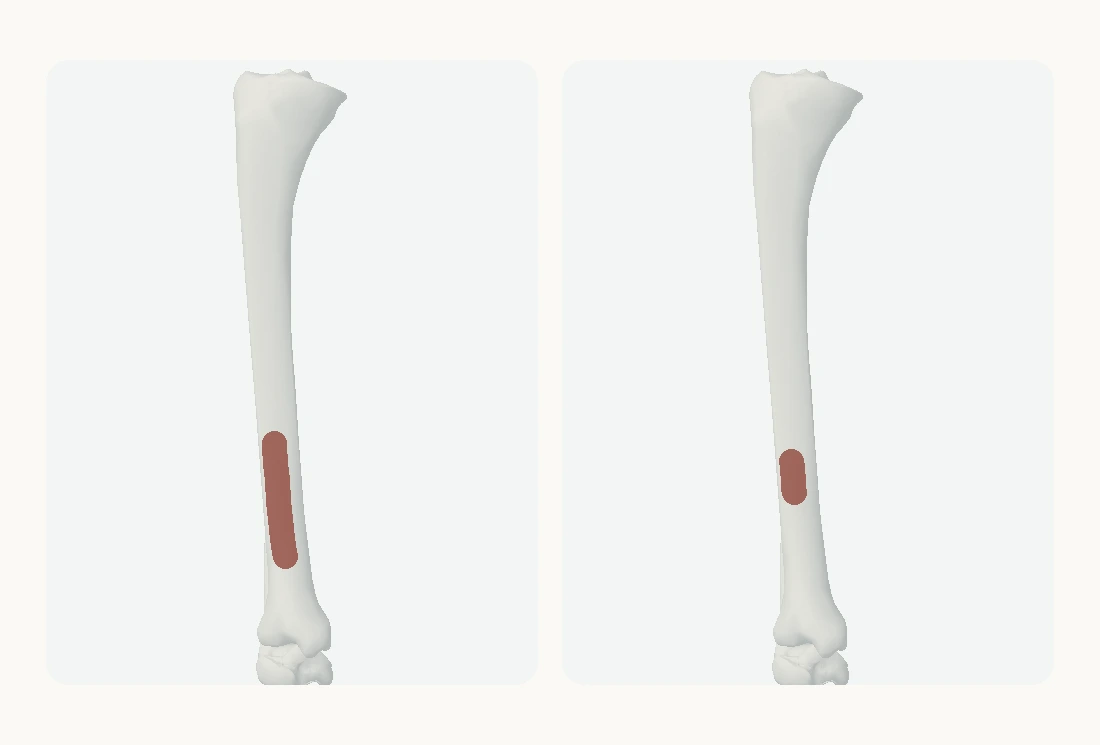
- Along a stretch of the inner shinSoreness is spread along the shin.
- A smaller areaThe red patch shows one example. The exact location of pain can vary.
- A broad ache along the inside edge
- Soreness spread along the inner edge of the shin during or after running can fit medial tibial stress syndrome, often called shin splints. Think about any recent change in weekly distance, number of runs or hills. AAOS OrthoInfo (accessed), 2026; Winters et al., 2018
- One spot on the bone that keeps hurting
- An early bone stress injury can first ache at the end of a run. If the same spot later hurts on shorter runs, during a trip to the store or in bed, tell your clinician how the pattern has changed. Get it checked before another run, even if it settles between sessions. AAOS OrthoInfo (accessed), 2026; Blackman, 2010
- Tightness or pressure at a similar point in each run
- If the lower leg repeatedly feels full or cramped after a similar effort and settles within minutes of stopping, book an assessment. Some runners also notice tingling or temporary weakness in the foot. Chronic exertional compartment syndrome is one possibility a clinician can assess. AAOS OrthoInfo (accessed), 2026; Vogels et al., 2022
What to change after a training increase
Suppose you added hill repeats and a longer weekend run in the same week. If the ache is spread along the inner shin and walking is comfortable, pause the runs that bring it on. Swimming or an easy stationary bike ride can keep you active if it feels comfortable. Book an assessment if the pain is worsening, persists despite taking pressure off it or returns when you try to run again. AAOS OrthoInfo (accessed), 2026; AAOS OrthoInfo (accessed), 2026
Once the diffuse shin symptoms have settled, start with a shorter, easier outing on a flat route and leave more recovery between runs. Notice how you feel on the way home and the next day. If the same pain returns, stop that session. If it becomes concentrated in one spot, get it assessed. AAOS OrthoInfo (accessed), 2026; AAOS OrthoInfo (accessed), 2026
Returning after a diagnosed bone stress injury
A clinician helping you back after a tibial bone stress injury considers whether walking is pain-free, where the injury is, and how much load the leg can tolerate. Some sites need evidence of bone healing before running resumes. Once your clinician clears a return, short intervals of walking and easy running can build comfortable distance before you add speed or hills. George et al., 2024
How strong is the evidence for a return schedule?
A 2024 review found 50 publications on starting running after a tibial bone stress injury. Most were reviews or clinical commentaries. Walk-run intervals and building distance before speed appeared across the literature, but the evidence gives limited guidance on the best rate of progression for an individual runner. George et al., 2024
Questions
Can it still be a bone stress injury if the pain is dull or warms up?
Yes. In an early stress reaction the ache can ease during a run and reappear after stopping. A spot that keeps returning, starts hurting earlier or begins to affect walking deserves prompt assessment. Waiting for sharp pain or pain at night can delay that check. Blackman, 2010; AAOS OrthoInfo (accessed), 2026
What if the tightness is gone by the time I see someone?
Describe the runs on which it happened. Mention roughly when the tightness began, where it was, whether the foot tingled or felt weak and how soon normal movement returned after stopping. These details help a clinician assess exertional compartment symptoms and consider other causes. Vogels et al., 2022; AAOS OrthoInfo (accessed), 2026
Will compression socks or extra calf exercises get me back sooner?
A trial assigned 74 athletes with shin splints to a graded running program alone, the same program plus calf stretching and strengthening, or the program plus a compression stocking. The groups showed no clear difference in time to complete the program. Everyone followed graded running, so the trial could not tell whether it was better than resting. Moen et al., 2012
Can an early X-ray miss a tibial stress injury?
Yes. Bone stress can cause pain before a change is visible on an X-ray. If focal pain continues or walking is getting harder, tell your clinician even if an early X-ray looked normal. They can decide whether further assessment or imaging would change your plan. AAOS OrthoInfo (accessed), 2026; George et al., 2024
Sources and further reading
- AAOS OrthoInfo (accessed) · 2026 · Patient information
Shin Splints
The overview describes pain along the inner edge of the shin bone after exercise or an increase in training. It covers assessment for other causes and a gradual return as symptoms allow.
- AAOS OrthoInfo (accessed) · 2026 · Patient information
Stress Fractures
Bone stress injuries can cause localized pain that builds with activity and progresses to pain with everyday walking or when resting. The guidance advises stopping painful activity and seeking assessment.
- AAOS OrthoInfo (accessed) · 2026 · Patient information
Compartment Syndrome
Severe pain developing after an injury can be a medical emergency. The resource also describes a separate exertional pattern where cramping or tightness comes on during activity and eases after stopping.
- MyHealth Alberta · 2024 · Patient information
Foot Pain: Care Instructions
The instructions advise emergency care if the foot turns cold or changes colour, and urgent assessment for signs of infection, significant injury or difficulty standing.
- MyHealth Alberta (accessed) · 2026 · Patient information
Deep Vein Thrombosis
The guidance calls for prompt assessment of new leg swelling, warmth or tenderness. It advises calling 911 for possible signs of a clot in the lung, such as sudden shortness of breath or chest pain.
- Vogels et al. · 2022 · Sports Medicine
Clinical Consensus on Diagnosis and Treatment of Patients with Chronic Exertional Compartment Syndrome of the Leg: A Delphi Analysis.
Clinicians agreed on several symptoms that prompt assessment, including exertional pain and tightness that can be reproduced with activity. The panel had differing views about how to use pressure measurements.
- Blackman · 2010 · Australian Family Physician
Shin pain in athletes - assessment and management.
The clinical review describes an early bone stress reaction that can ease during warm-up and return after stopping. It describes the different history of shin splints, bone stress injury and exertional compartment symptoms.
- Winters et al. · 2018 · British Journal of Sports Medicine
Medial tibial stress syndrome can be diagnosed reliably using history and physical examination.
Two clinicians agreed well on whether athletes with lower-leg complaints had shin splints. Some athletes also had another lower-leg injury. The study evaluated a history and clinician examination.
- George et al. · 2024 · Sports Medicine
Criteria and Guidelines for Returning to Running Following a Tibial Bone Stress Injury: A Scoping Review.
The review describes criteria clinicians consider before a return, such as pain-free walking. After assessment and clearance, walk-run intervals can be used to rebuild gradually. Much of the available evidence comes from lower-level studies and expert opinion.
- Moen et al. · 2012 · Sports Medicine, Arthroscopy, Rehabilitation, Therapy & Technology
The treatment of medial tibial stress syndrome in athletes; a randomized clinical trial.
All 74 randomized athletes followed a graded running plan. Additional calf exercises or a compression stocking did not clearly change the time to complete that plan. The trial compared those additions and did not test continuing the athlete’s usual running.