Full-Thickness Rotator Cuff Tear on MRI

A full-thickness rotator cuff tear means one of the tendons that hold the ball of the shoulder in its socket is torn right through. The tear runs from the tendon’s top surface to its underside, in at least one place. The report then says which tendon, how big the tear is, how far the torn edge has pulled back (retraction) and how the muscle behind it looks (atrophy and fatty infiltration). These tears become more common with each decade, and in population studies most were in shoulders that were not painful at the time. A sudden loss of strength after a fall or a heavy pull, in a shoulder that worked well before, needs a prompt surgical opinion.

Assessing and treating shoulder pain in Burlington, Ontario.

When to see a doctor firstBroader Shoulder Pain Guide
Rotator cuff

What “full-thickness rotator cuff tear” means on a scan report

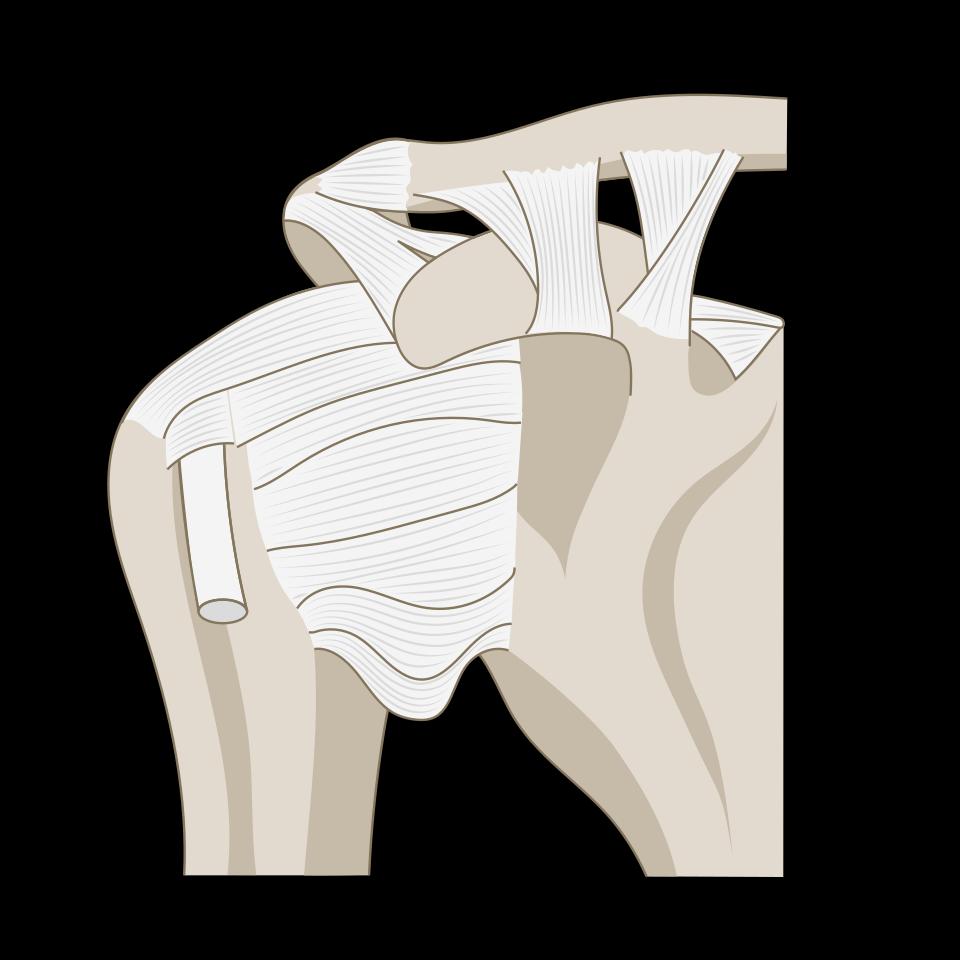
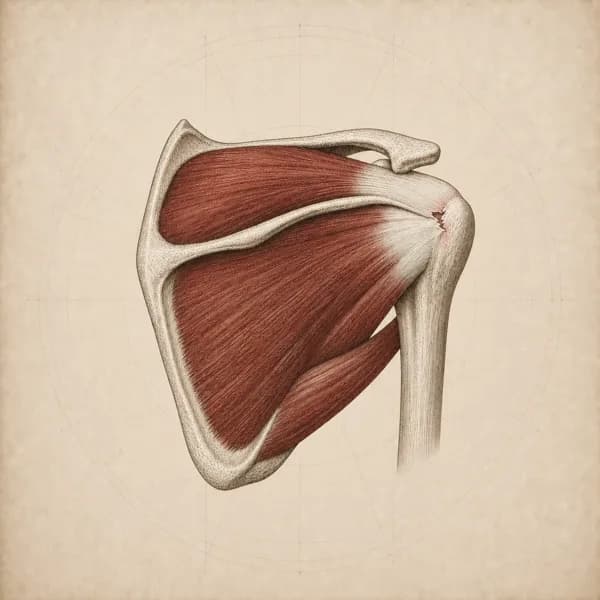
Four tendons form the cuff, and the supraspinatus is the one most often torn. Four muscles run from the shoulder blade to the top of the arm bone. Their tendons form a cuff around the ball of the joint: the supraspinatus over the top, the infraspinatus and the small teres minor behind, and the subscapularis in front. These muscles lift and turn the arm and keep the ball centred in its socket. In 393 people with a painful full-thickness tear that came on without an injury, the supraspinatus was the only torn tendon in 72 percent (Dunn et al., 2014). Tendinosis and partial-thickness tears are covered in the supraspinatus tendinosis guide.

“Full-thickness” describes depth, not width. It means the tear goes right through the tendon, from the surface facing the bursa above it to the surface facing the joint below. A full-thickness tear can be a few millimetres across. Reports use “complete” in two ways: as another word for full-thickness, or to say the whole width of that tendon has come away from the bone. Read it with the measurements.

The words that come with it. These are the terms you are most likely to see.

On the reportWhat it means
Supraspinatus, infraspinatus, subscapularis, teres minorWhich tendon is torn. Posterosuperior means the supraspinatus and infraspinatus; anterosuperior means the supraspinatus with the top of the subscapularis.
Tear size in millimetres or centimetres, AP and MLFront to back (anteroposterior, AP) is how much of the tendon’s attachment has come away. Side to side (mediolateral, ML) is the gap between the bone and the torn edge.
Small, medium, large, massiveSize bands, used in more than one way. A common set calls a tear small under about 1 cm, medium at 1 to 3 cm, large at 3 to 5 cm and massive above 5 cm; other reports call a tear massive when two or more tendons are torn through.
Retraction, tendon stump, tendon qualityHow far the torn end (the stump) has pulled back: still near its attachment, to the middle of the ball of the joint (the humeral head), or to the socket (the glenoid). It was minimal in 48 percent of the 393 people above (Dunn et al., 2014). Tendon quality describes the stump itself: thin, frayed or split into layers.
Muscle atrophy, tangent signThe muscle behind the torn tendon looks smaller than it should. A positive tangent sign records that the supraspinatus muscle no longer fills its hollow on top of the shoulder blade.
Fatty infiltration or fatty degeneration, Goutallier grade 0 to 4Fat within the muscle: 0 is normal, 1 some fatty streaks, 2 less fat than muscle, 3 as much fat as muscle, 4 more fat than muscle. Across studies of repairs, more fatty infiltration was linked with more re-tears (Wang et al., 2026).
High-riding humeral head, superior (upward) migration, reduced acromiohumeral distanceThe ball of the joint has moved up toward the bony point of the shoulder (the acromion), because the cuff no longer holds it down. A gap under about 7 mm is commonly called narrowed.
Rotator cuff tear arthropathy, Hamada gradeArthritis of the shoulder joint that can develop with a large, long-standing tear and a high-riding ball. The Hamada grades describe its stages on X-ray.
Long head of biceps: subluxed, dislocated, ruptured, empty grooveThe biceps tendon runs through the front of the joint beside the cuff. Subluxed or dislocated means it has slipped partly or fully out of its groove; ruptured, or an empty groove, means it has torn through. See the biceps tendon page.
Fluid in the subacromial-subdeltoid bursa, joint effusionJoint fluid can pass through a full-thickness tear into the thin sac above the tendon, so bursal fluid often appears on the same report. See the subacromial bursitis guide.
After a repair: intact, re-tear, recurrent tear, Sugaya typeWhether the repaired tendon is in one piece. A re-tear means there is a gap, because the repair did not heal or tore again; on the Sugaya scale of 1 to 5, types 4 and 5 mean a gap. Pooled across 273 studies, the re-tear rate was 17 percent (Wang et al., 2026).
Supraspinatus, infraspinatus, subscapularis, teres minor
Which tendon is torn. Posterosuperior means the supraspinatus and infraspinatus; anterosuperior means the supraspinatus with the top of the subscapularis.
Tear size in millimetres or centimetres, AP and ML
Front to back (anteroposterior, AP) is how much of the tendon’s attachment has come away. Side to side (mediolateral, ML) is the gap between the bone and the torn edge.
Small, medium, large, massive
Size bands, used in more than one way. A common set calls a tear small under about 1 cm, medium at 1 to 3 cm, large at 3 to 5 cm and massive above 5 cm; other reports call a tear massive when two or more tendons are torn through.
Retraction, tendon stump, tendon quality
How far the torn end (the stump) has pulled back: still near its attachment, to the middle of the ball of the joint (the humeral head), or to the socket (the glenoid). It was minimal in 48 percent of the 393 people above (Dunn et al., 2014). Tendon quality describes the stump itself: thin, frayed or split into layers.
Muscle atrophy, tangent sign
The muscle behind the torn tendon looks smaller than it should. A positive tangent sign records that the supraspinatus muscle no longer fills its hollow on top of the shoulder blade.
Fatty infiltration or fatty degeneration, Goutallier grade 0 to 4
Fat within the muscle: 0 is normal, 1 some fatty streaks, 2 less fat than muscle, 3 as much fat as muscle, 4 more fat than muscle. Across studies of repairs, more fatty infiltration was linked with more re-tears (Wang et al., 2026).
High-riding humeral head, superior (upward) migration, reduced acromiohumeral distance
The ball of the joint has moved up toward the bony point of the shoulder (the acromion), because the cuff no longer holds it down. A gap under about 7 mm is commonly called narrowed.
Rotator cuff tear arthropathy, Hamada grade
Arthritis of the shoulder joint that can develop with a large, long-standing tear and a high-riding ball. The Hamada grades describe its stages on X-ray.
Long head of biceps: subluxed, dislocated, ruptured, empty groove
The biceps tendon runs through the front of the joint beside the cuff. Subluxed or dislocated means it has slipped partly or fully out of its groove; ruptured, or an empty groove, means it has torn through. See the biceps tendon page.
Fluid in the subacromial-subdeltoid bursa, joint effusion
Joint fluid can pass through a full-thickness tear into the thin sac above the tendon, so bursal fluid often appears on the same report. See the subacromial bursitis guide.
After a repair: intact, re-tear, recurrent tear, Sugaya type
Whether the repaired tendon is in one piece. A re-tear means there is a gap, because the repair did not heal or tore again; on the Sugaya scale of 1 to 5, types 4 and 5 mean a gap. Pooled across 273 studies, the re-tear rate was 17 percent (Wang et al., 2026).
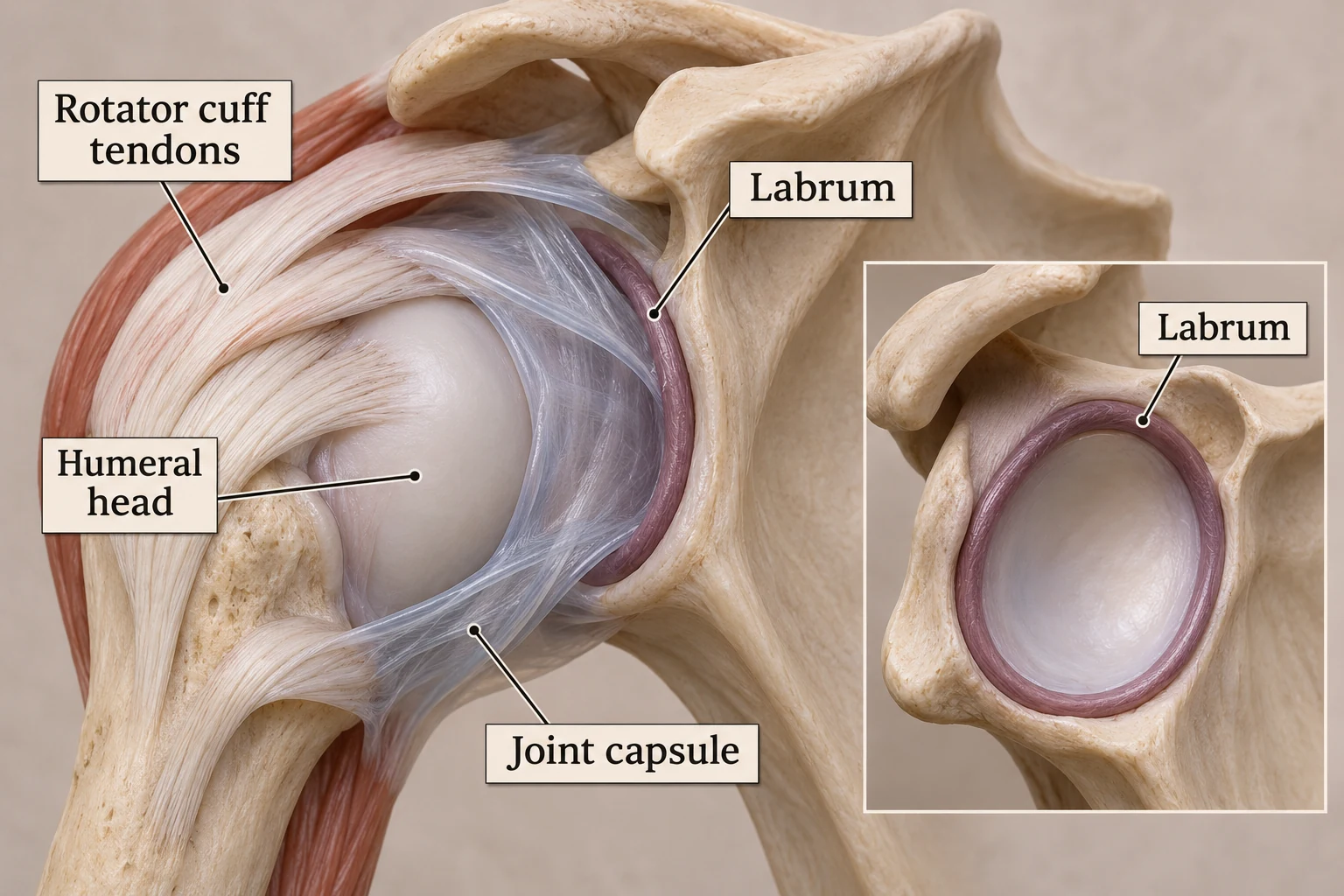
A shoulder cutaway labels rotator cuff tendons over the humeral head, the joint capsule and the labrum around the socket. An inset shows the labral rim around the socket.
Cuff tendons, joint capsule and labrumThe cuff tendons connect muscle to the upper arm bone. The capsule surrounds the joint, and the labrum forms a rim around the socket. A cuff tear, a capsular problem and a labral tear involve different tissues.Enlarge illustration

When to see a doctor first

Go to emergency

  • Shoulder or arm pain with chest pain, shortness of breath, sweating or nausea, or pain that comes on with exertion and eases with rest

    Call 911. Heart problems can show up as shoulder pain.

  • Pain at the tip of the shoulder that does not change when you move or press on the shoulder, together with pain in the abdomen or lower chest, pain on breathing in, or feeling faint

    Go to emergency now. A problem in the chest or abdomen can be felt at the shoulder.

  • A shoulder that has changed shape or looks out of place after a fall, blow or sudden pull, or you think it is dislocated

    Go to emergency now. Avoid lifting or exercising the arm until it has been assessed.

  • Shoulder pain or a hot, red or swollen shoulder, together with fever, chills or feeling generally unwell

    Go to emergency now. This can be a joint infection.

  • After a shoulder operation, a wound that is leaking or becoming more red, swollen or painful, together with fever, chills or feeling generally unwell

    Go to emergency now. This can be an infection of the wound or the joint.

  • Sudden unexplained weakness or numbness in an arm or leg, even if it improves

    Call 911 now; it can be a stroke.

Get seen today

  • A fall, blow or sudden pull followed by severe pain, or sudden weakness so you cannot lift the arm

    Go to emergency or urgent care today to rule out a fracture or dislocation. If a fracture or dislocation is excluded but you still cannot lift the arm, ask the assessing clinician or your family doctor to arrange urgent assessment for a rotator cuff tear, ideally at the next available orthopaedic clinic. Avoid lifting or exercising the injured arm until it has been assessed.

  • A newly hot, red or swollen shoulder without fever, chills or feeling unwell

    Get medical assessment the same day to rule out a joint infection. Infection is possible even without a fever.

  • After a shoulder operation, a wound that is leaking or becoming more red, swollen or painful, without fever, chills or feeling unwell

    Get medical assessment the same day, through your surgeon’s office if it can see you that day. Infection is possible even without a fever.

  • New weakness in the hand or grip, or weakness down the arm that keeps getting worse

    Same-day medical assessment; this can come from a nerve in the neck.

Check with your doctor

  • Weakness lifting the arm that keeps getting worse over weeks

    See your family doctor. With a known tear this can mean the tear has grown, and I flag it to them so repeat imaging and an orthopaedic opinion can be arranged.

  • Numbness or tingling spreading down the arm into the hand, without weakness

    This can come from the neck or a nerve rather than the shoulder. Can be checked at your physiotherapy assessment; see your family doctor if it is spreading or getting worse.

  • Shoulder pain with a history of cancer, unexplained weight loss, or constant pain at night that does not ease with position

    See your family doctor before starting physiotherapy.

What it does and does not tell you

Full-thickness tears become common with age. In a Japanese study, 664 adults who came to a health check in one village had both shoulders scanned with ultrasound. Of those, 22.1 percent had a full-thickness tear: none in their 20s to 40s, 10.7 percent in their 50s and 36.6 percent in their 80s (Minagawa et al., 2013). On MRI of 602 randomly sampled Finnish adults aged 41 to 76, 11 percent had one. The figure was 4 percent at 45 to 49 and 28 percent at 70 and older (Ibounig et al., 2026).

Most are in shoulders that are not painful. About two in three of the tears in the village study caused no symptoms (Minagawa et al., 2013). In the Finnish study, 75 of the 96 tears were in shoulders with no symptoms that week. Even so, in that study tears were more common in shoulders with symptoms, 14.6 against 6.5 percent. That gap disappeared after adjusting for other scan and examination findings, and large tears were too few to study (Ibounig et al., 2026).

Among painful tears, a bigger tear does not mean more pain. One study looked at 393 people with a painful full-thickness tear that came on without an injury. No measure of how severe the tear was (its size, retraction, upward shift of the ball or muscle wasting) was linked with how much it hurt (Dunn et al., 2014). Whether a tear is painful at all is a different question. Another study compared 50 painful and 50 painless full-thickness tears on MRI. Three findings were each linked with having symptoms: a gap of more than 3 cm between the bone and the torn edge, a positive tangent sign, and fatty infiltration above grade 1. The authors could not say which came first (Moosmayer et al., 2010).

Many tears grow over the years. A review of eight studies looked at 411 unrepaired full-thickness tears. Growth of 5 mm or more was found in 40.6 percent of painless tears after about four years and 34.1 percent of painful tears after about three. Its authors concluded that most tears do not grow much over that span (Kwong et al., 2019). In a cohort followed for a median of 5.1 years, 61 percent of the full-thickness tears grew and 50 percent of the shoulders with one became painful. Growth was linked with new pain. Everyone in that cohort also had a painful cuff problem in the other shoulder (Keener et al., 2015). Over 15 years in one trial, the 26 tears treated with physiotherapy alone roughly doubled in size on average (Moosmayer et al., 2024).

Retraction, atrophy and fatty infiltration bear on whether a repair is possible and likely to heal. Across 35 studies, re-tears after repair were linked with more fatty infiltration and larger tears, and with smoking and diabetes (Wang et al., 2026). The muscle can worsen as a tear grows. In the cohort above, the supraspinatus muscle worsened in 30 percent of shoulders whose tear grew and 4 percent of those whose tear did not (Keener et al., 2015). The grades are judged by eye. When three shoulder surgeons graded the same 31 MRI scans, none of the three grading systems reached high agreement. For muscle atrophy, the surgeons agreed only 28 percent of the time (Lippe et al., 2012).

The story changes the urgency. A sudden loss of strength after a fall or a heavy pull, in a shoulder that worked well before, needs a prompt surgical opinion (see the warning signs above). The trials of starting with exercise mostly enrolled people with small tears that came on gradually. Their results may not apply to tears after an injury, large tears involving the subscapularis or younger people (Karjalainen et al., 2019).

The usual stories behind the report

  • Gradually, with no clear injury. This is a common story. The tendon wears over years, and pain tends to start, or return, when overhead work or lifting increases faster than the shoulder is used to. The rotator cuff page covers this pattern and its rehabilitation.
  • After a fall or a heavy pull. A fall onto the arm, a dislocation or a sudden heavy lift, followed straight away by weakness lifting the arm or turning it outward. This story follows the warning signs on this page. Surgeons who favour early repair argue that it leaves less time for the tendon to pull back and for fat to build in the muscle (Lara et al., 2026).
  • A new injury on top of an older tear. A minor fall or jolt brings on pain, and the scan shows changes that take time to develop, such as retraction or fatty infiltration. In the 15-year trial, 59 of the 103 people had a tear whose pain began suddenly after a minor injury (Moosmayer et al., 2024).
  • Found by chance, or on the other side. A tear reported in a shoulder that does not hurt. In the Finnish MRI study, 26 of the 70 people with a full-thickness tear had one in both shoulders. Of those 26, 17 had no symptoms in either shoulder (Ibounig et al., 2026). The treatment trials enrolled people with symptoms, so they do not cover a painless tear.

What the trials say about treatment

For small and medium tears that came on gradually or after a minor injury, the trials compared starting with physiotherapy and having a repair. Over the first one to six years they found small or no differences. In the longest trial the advantage for repair widened between 2 and 15 years. After an injury with a sudden loss of strength, and for large tears, there is far less trial evidence, and the usual advice is an early surgical opinion.

  • The Canadian guideline recommends rehabilitation and sees a place for surgery. For adults with rotator cuff disorders, the 2022 guideline recommends an active, task-based rehabilitation program of exercise and education. It sees surgery as appropriate for selected people with a full-thickness tear (Lafrance et al., 2022).
  • In the largest cohort, scores improved and did not decline over 10 years in people who did not have surgery. The 452 people in it had a painful full-thickness tear with no injury behind it, and all started with 6 to 12 weeks of physiotherapy. Over 10 years, 115 people had surgery, more than half of them in the first six months. In the rest, pain and function scores improved and did not decline (Kuhn et al., 2024). There was no comparison group, only 47 percent of eligible people enrolled, 77 died or were lost to follow-up, and the tears were not scanned again.
  • For small tears in people over 55, physiotherapy alone and repair gave similar results. A trial included 180 shoulders with a supraspinatus tear averaging 10 mm and no injury behind it. It compared physiotherapy alone, shaving bone from the underside of the acromion (acromioplasty) with physiotherapy, and repair with both. In the 150 shoulders followed for about six years, all three gave similar function, pain and satisfaction. Ten shoulders that were not repaired at first had a repair later (Kukkonen et al., 2021).
  • For tears up to 3 cm, repair did better at 15 years. In a trial of 103 people with a full-thickness tear up to 3 cm, small early differences in favour of repair grew over time. At 15 years repair gave better shoulder function, less pain and more pain-free movement than starting with physiotherapy, with no difference in general health scores. Fifteen of the 51 people who started with physiotherapy had a repair later (Moosmayer et al., 2024).
  • When rehabilitation had not settled the pain, repair did somewhat better at two years. In a Finnish trial, 417 people with shoulder pain did three months of rehabilitation. The 190 shoulders still painful were then randomised to surgery or continued non-surgical care. Among the 98 shoulders with a full-thickness tear, both groups improved, and repair gave somewhat more pain relief and better function at two years. People knew which treatment they had. Across the whole trial, 38 percent of the shoulders assigned to surgery improved first and did not have the operation (Cederqvist et al., 2021).
  • At one year, repair probably gave little or no more pain relief than exercise-based care. This comes from a Cochrane review of three trials with 339 people. None of the trials used a placebo operation. The review’s main results were at one year, before the 10 and 15-year results above (Karjalainen et al., 2019).
  • For tears after an injury, the evidence is thin. One small trial has tested this. In 58 people with a small tear after an injury (median 9.7 mm), repair and physiotherapy gave similar results at 12 months. However, 29.2 percent of the unrepaired tears had grown by more than 5 mm (Ranebo et al., 2020). That trial does not speak for large tears. In surgical series, most tears after an injury were over 3 cm and most involved the subscapularis (Mall et al., 2013). The studies on timing are weak. A review of 33 studies with 8,118 people relied on retrospective data. It found no clear penalty when repair was delayed by 3 to 6 months, and more re-tears when it was delayed by a year or longer. In the same review, people whose repair had healed had been operated on about four months sooner, on average, than those with a re-tear (van der List et al., 2023). A 2026 review for a Brazilian surgical society found only three cohort studies, of very low certainty. It counted repair within 3 months of the injury as early. It still recommended repair as early as possible, because of the risk that the tear becomes unrepairable (Lara et al., 2026).
  • Re-tears are common, but pain and function can still improve. Pooled across 273 studies, the re-tear rate was 17 percent (Wang et al., 2026). The rate varies widely. One UK trial randomised 273 people with tears that came on gradually. On scans a year after surgery, there was a re-tear in 46.4 percent after keyhole repair and 38.6 percent after open repair. The healed repairs improved the most (Carr et al., 2017). A re-tear on a scan is not the same as a failed operation. Across 14 studies and 861 people, pain and function improved whether or not the repair was intact. Scores and strength were somewhat better when it had healed, by a margin the authors judged too small to matter for pain and function (Russell et al., 2014). A later pooled analysis found lower function scores and less strength with a full-thickness re-tear (Yang et al., 2017).
  • For massive tears that cannot be repaired, most of the evidence is weak. Sometimes the tendon has pulled back too far, or the muscle has changed too much, for a repair to hold. The options then include rehabilitation, repair of part of the tear, a graft, a tendon transfer and a reverse shoulder replacement. A 2020 review found no randomised trials or other high-level comparative studies. In the studies it did find, physiotherapy was counted as failing in 30 percent of people, and another 30 percent went on to surgery. On that weak evidence, the review concluded that physiotherapy was associated with less improvement than surgery. Reverse replacement had a 10 percent implant failure rate and an 8 percent reoperation rate (Kovacevic et al., 2020). A randomised trial published since that review, in 117 people in the UK, tested adding a balloon spacer to a keyhole clean-out operation. Shoulder scores at 12 months were worse with the balloon than with the clean-out alone (Metcalfe et al., 2022).
  • The first step depends on the tear and how it started. For a small or medium tear that came on gradually, a full course of rehabilitation is the usual first step. Asking for a surgical opinion early is also reasonable, because the longest trial favoured repair at 10 and 15 years and tears can grow in the meantime. The case for an early opinion is stronger when the tear followed an injury or strength is clearly down. It is stronger, too, when the tear is larger, involves the subscapularis or shows retraction or muscle change. Being younger, or doing work or sport that is heavy on the shoulder, also strengthens the case.

How I assess and treat a shoulder with this on the report

The story sets the urgency. A sudden loss of strength after a fall or a heavy pull follows the warning signs on this page before anything else. For a tear that came on gradually, what the shoulder stops you doing and what your work and sport ask of it shape the plan.

On examination, a shoulder that is stiff both when you lift the arm and when someone else lifts it for you points to a stiff joint, such as a frozen shoulder, rather than to the tear alone. Strength is tested for each part of the cuff: lifting the arm out to the side, turning it outward, and pressing the hand toward the stomach, which tests the subscapularis. The biceps, the AC joint and the neck are checked too, and the report is read alongside those findings. I cannot order imaging; when further imaging would change the plan, I flag it to your family doctor and refer you.

When rehabilitation is the starting point, the plan is strengthening for the intact parts of the cuff, the deltoid and the shoulder blade muscles, starting with supported positions and static holds if lifting the arm is painful. The guideline lists pain medication and injections, which go through your doctor, as options that may ease pain in the short term (Lafrance et al., 2022). If a repair is a possibility in the coming months, raise the timing of any steroid injection with your doctor or surgeon first: in two systematic reviews, an injection in the year before a repair was linked with more repeat operations, most of all in the last 6 months (Puzzitiello et al., 2020), and more so after two or more injections (Cimino et al., 2020). I judge progress by strength and by what you can do, over about 6 to 12 weeks, the length of program in the largest cohort study (Kuhn et al., 2024). If the shoulder is not improving, strength is falling, or the story or the scan points to a tear better repaired early, I refer you through your family doctor for a surgical opinion. After a repair, your surgeon’s protocol leads: it sets how long the arm stays in a sling and when movement and strengthening begin, and I provide the rehabilitation within it.

Rotator cuff tear questions I hear most

Does a full-thickness rotator cuff tear need surgery?

Not in every case. In one cohort, 452 people with a painful tear that came on without an injury all started with physiotherapy, and 432 stayed in the study. Of those, 115 had surgery within 10 years, more than half of them in the first six months. Over the same period, 77 died or were lost to follow-up. In a trial of tears up to 3 cm, repair did better at 10 and 15 years. A sudden loss of strength after an injury, a larger tear, or being younger and active are reasons to get a surgical opinion early.

Can a full-thickness rotator cuff tear heal on its own?

Not reliably. A tendon torn right through does not usually grow back onto the bone, and some tears get bigger. In a review of 411 unrepaired tears, 34.1 to 40.6 percent had grown by 5 mm or more after three to four years. The shoulder can still improve, because the rest of the cuff and the muscles around it can be strengthened. In the largest cohort, pain and function scores improved with physiotherapy. In the people who did not go on to surgery, the scores did not decline over 10 years. In the 15-year trial, shoulder function in the tears that were never repaired fell between 2 and 15 years as the tears grew.

What do retraction and fatty infiltration (Goutallier grade) mean?

Retraction is how far the torn end of the tendon has pulled back from the bone. It may still be near its attachment, or have pulled back to the middle of the ball of the joint or to the socket (the glenoid). Fatty infiltration means some of the muscle behind the tendon has been replaced by fat, graded from 0 (none) to 4 (more fat than muscle). Neither measures pain. A surgeon weighs both when advising whether and when to repair. Across studies, more fatty infiltration and larger tears were linked with more re-tears.

How quickly does a tear after a fall need to be looked at?

Promptly. If you cannot lift the arm or the pain is severe, go to emergency or urgent care today to rule out a fracture or dislocation. If those are excluded and you still cannot lift the arm, ask for urgent assessment for a rotator cuff tear, ideally at the next available orthopaedic clinic. The studies on timing are weak. A review that relied on retrospective studies found more re-tears when repair was delayed by a year or longer, and no clear difference at 3 to 6 months. In the same review, repairs that had healed had been done about four months sooner on average. A 2026 surgical society review still advised repair as early as possible, counting the first 3 months as early.

What does a massive or irreparable rotator cuff tear mean?

Massive describes size: commonly a tear over about 5 cm, or one that involves two or more tendons. Irreparable means a surgeon judges that the tendon cannot be brought back to the bone and held there. That is usually because it has pulled back a long way and much of the muscle has been replaced by fat. Most of the evidence for the options comes from weaker kinds of study, so the choice is made with a surgeon. In one review, physiotherapy was counted as failing in 30 percent of people with these tears, and another 30 percent went on to surgery. Its authors concluded, on weak evidence, that physiotherapy was associated with less improvement than surgery.

My scan after surgery shows a re-tear. Does it need to be repaired again?

Not necessarily. Re-tears on scans are common after rotator cuff repair: 17 percent when 273 studies were pooled. Across 14 studies, pain and function had improved whether or not the repair was intact, with somewhat better scores and strength when it had healed. What counts is how the shoulder is doing. Your surgeon should review a re-tear. A new injury, a sudden loss of strength or rising pain are reasons to be seen sooner.

I have a full-thickness tear but no pain. Do I need to do anything?

Usually nothing urgent. Painless full-thickness tears are common: among 420 people aged 50 to 79 with no shoulder symptoms, 7.6 percent had one. Some become painful. In a cohort followed for a median of 5.1 years, 50 percent of the shoulders with a full-thickness tear developed pain. Everyone in that study already had a painful cuff problem in the other shoulder. New pain or a loss of strength is the reason to have it assessed.

Evidence this page is built on

The main sources behind this guide. Other studies are named in the text where they are used.

2013 Minagawa H et al., Journal of Orthopaedics

Prevalence of symptomatic and asymptomatic rotator cuff tears in the general population: From mass-screening in one village

Ultrasound of both shoulders in 664 residents of one village who came to a health check, 21.3 percent of its population. Full-thickness tears in 22.1 percent: none in people in their 20s to 40s, 36.6 percent in their 80s. 65.3 percent of the tears caused no symptoms.

2026 Ibounig T et al., JAMA Internal Medicine

Incidental Rotator Cuff Abnormalities on Magnetic Resonance Imaging

MRI of both shoulders in 602 randomly sampled Finnish adults aged 41 to 76. Full-thickness tears in 11 percent of people: in 6.5 percent of shoulders without symptoms that week and 14.6 percent with, a difference not seen after adjustment.

2009 Moosmayer S et al., Journal of Bone and Joint Surgery (British Volume)

Prevalence and characteristics of asymptomatic tears of the rotator cuff: an ultrasonographic and clinical study

420 volunteers aged 50 to 79 with no shoulder symptoms. Full-thickness tears in 7.6 percent: 2.1 percent at 50 to 59, 5.7 percent at 60 to 69 and 15 percent at 70 to 79.

2014 Dunn WR et al., Journal of Bone and Joint Surgery

Symptoms of pain do not correlate with rotator cuff tear severity: a cross-sectional study of 393 patients with a symptomatic atraumatic full-thickness rotator cuff tear

393 people with a painful full-thickness tear that came on without an injury. Tear size, retraction, upward shift of the ball of the joint and muscle wasting were not linked with how much it hurt.

Show all 27 sources

2010 Moosmayer S et al., Acta Orthopaedica

MRI of symptomatic and asymptomatic full-thickness rotator cuff tears. A comparison of findings in 100 subjects

50 people with a painful and 50 with a painless full-thickness tear, compared on MRI. Symptoms were linked with a tear over 3 cm from bone to torn edge, a positive tangent sign and fatty degeneration above grade 1; the authors called the causal relationships unclear.

2019 Kwong CA et al., Arthroscopy

Full-Thickness Rotator Cuff Tears: What Is the Rate of Tear Progression? A Systematic Review

Eight studies, 411 unrepaired full-thickness tears. Growth of 5 mm or more in 40.6 percent of asymptomatic tears at 46.8 months and 34.1 percent of symptomatic tears at 37.8 months.

2015 Keener JD et al., Journal of Bone and Joint Surgery

A prospective evaluation of survivorship of asymptomatic degenerative rotator cuff tears

224 people with a painful cuff problem in one shoulder; the other, painless shoulder was followed for a median of 5.1 years. 61 percent of full-thickness tears grew and 50 percent of shoulders with one became painful.

2023 Torchia MT et al., Journal of Shoulder and Elbow Surgery

Evaluation of survivorship of asymptomatic degenerative rotator cuff tears in patients 65 years and younger: a prospective analysis with long-term follow-up

229 people aged 65 or younger with a painful cuff tear in one shoulder; the other, painless shoulder was followed for a median of 7.1 years. Full-thickness tears free of enlargement: 74 percent at 2 years, 42 percent at 5 and 20 percent at 8. Pain developed in 57 percent of the shoulders followed and was linked with enlargement.

2012 Lippe J et al., Arthroscopy

Inter-rater agreement of the Goutallier, Patte, and Warner classification scores using preoperative magnetic resonance imaging in patients with rotator cuff tears

Three shoulder surgeons graded the MRI scans of 31 people before a repair, for retraction, muscle atrophy and fatty infiltration. None of the three grading systems reached high agreement; for muscle atrophy the surgeons agreed 28 percent of the time.

2022 Lafrance S et al., Journal of Orthopaedic & Sports Physical Therapy

Diagnosing, Managing, and Supporting Return to Work of Adults With Rotator Cuff Disorders: A Clinical Practice Guideline

Canadian guideline with 73 recommendations. An active, task-based rehabilitation program of exercise and education; pain medication and injections may ease pain in the short term; surgery appropriate for selected people with a full-thickness tear.

2024 Kuhn JE et al., Journal of Bone and Joint Surgery

The Predictors of Surgery for Symptomatic, Atraumatic Full-Thickness Rotator Cuff Tears Change Over Time: Ten-Year Outcomes of the MOON Shoulder Prospective Cohort

452 people with a painful full-thickness tear and no injury, all starting with 6 to 12 weeks of physiotherapy; 432 stayed in the study. 115 had surgery within 10 years and 77 died or were lost to follow-up; scores did not decline in those who did not have surgery. No comparison group or repeat scans.

2021 Kukkonen J et al., Journal of Shoulder and Elbow Surgery

Operative versus conservative treatment of small, nontraumatic supraspinatus tears in patients older than 55 years: over 5-year follow-up of a randomized controlled trial

180 shoulders in people over 55 with small supraspinatus tears and no injury, 150 followed for a mean of 6.2 years. Physiotherapy alone, acromioplasty with physiotherapy, and repair with both gave similar results; 10 shoulders crossed over to repair.

2024 Moosmayer S et al., Journal of Bone and Joint Surgery

Fifteen-Year Results of a Comparative Analysis of Tendon Repair Versus Physiotherapy for Small-to-Medium-Sized Rotator Cuff Tears: A Concise Follow-up of Previous Reports

103 people with full-thickness tears up to 3 cm, 83 seen at 15 years. Open or mini-open repair gave better function and less pain than physiotherapy with optional later repair, which 15 of 51 had, and the gap widened from 2 to 15 years. The 26 tears left unrepaired grew from 16.2 to 31.6 mm on average, and function in that group fell.

2021 Cederqvist S et al., Annals of the Rheumatic Diseases

Non-surgical and surgical treatments for rotator cuff disease: a pragmatic randomised clinical trial with 2-year follow-up after initial rehabilitation

417 people with shoulder pain did three months of rehabilitation; 190 shoulders still painful were randomised, unblinded, to surgery or non-surgical care. Both groups improved; with a full-thickness tear, repair gave more pain relief and better function at two years. 38 percent of the shoulders assigned to surgery did not have the operation.

2019 Karjalainen TV et al., Cochrane Database of Systematic Reviews

Surgery for rotator cuff tears

Nine trials, 1,007 people; three trials with 339 people compared repair with exercise-based care. At one year surgery probably gave little or no improvement in pain. No placebo-controlled trials, and mostly small tears that came on gradually.

2020 Ranebo MC et al., Journal of Shoulder and Elbow Surgery

Surgery and physiotherapy were both successful in the treatment of small, acute, traumatic rotator cuff tears: a prospective randomized trial

58 people, mean age 59.7, with small tears after an injury. No difference between repair and physiotherapy at 12 months. Re-tear in 6.5 percent of repairs; growth of more than 5 mm in 29.2 percent of unrepaired tears.

2013 Mall NA et al., Arthroscopy

An evidenced-based examination of the epidemiology and outcomes of traumatic rotator cuff tears

Review of nine studies of tears after an injury that were repaired; average age 54.7. The subscapularis was torn in 78 percent; tears were under 3 cm in 22 percent, 3 to 5 cm in 36 percent and over 5 cm in 42 percent. The authors found too little data for a firm recommendation on early repair.

2023 van der List JP et al., American Journal of Sports Medicine

Role of Delay Between Injury and Surgery on the Outcomes of Rotator Cuff Repair: A Systematic Review and Meta-analysis

33 studies, 8,118 people with tears after an injury. Delaying repair by 3 to 6 months did not lead to significantly more re-tears or worse scores; delaying by a year or more went with more re-tears, and healed repairs had been done a mean 3.9 months sooner than those that re-tore. The review relied on retrospective studies.

2026 Lara PHS et al., Acta Ortopedica Brasileira

Evidence-Based Reviews & Recommendations from the Brazilian Society of Shoulder and Elbow Surgery: Early Versus Late Repair for Traumatic Rotator Cuff Tears

Review for a surgical society: three cohort studies, very low certainty. Functional results were similar after early and late repair; counting repair within 3 months of the injury as early, the society still recommends repair as early as possible, citing the risk of irreparability.

2026 Wang H et al., BMC Musculoskeletal Disorders

Incidence and risk factors for rotator cuff retear after arthroscopic rotator cuff repair in middle-aged and older patients: a systematic review and meta-analysis

273 studies, 147,042 people: pooled re-tear rate 17 percent. In 35 studies of risk factors, re-tears were linked with more fatty infiltration, larger tears, smoking and diabetes.

2014 Russell RD et al., Journal of Bone and Joint Surgery

Structural integrity after rotator cuff repair does not correlate with patient function and pain: a meta-analysis

14 studies, 861 people; 78.3 percent had an intact repair. Scores improved whether or not the repair was intact, with differences too small to matter clinically; strength was greater with an intact repair.

2017 Yang J Jr et al., American Journal of Sports Medicine

The Clinical Effect of a Rotator Cuff Retear: A Meta-analysis of Arthroscopic Single-Row and Double-Row Repairs

Pooled analysis of studies that compared intact repairs with full-thickness re-tears at least a year after keyhole repair. With a re-tear, function scores and strength were lower; pain was not significantly higher when all repairs were pooled.

2017 Carr A et al., Bone & Joint Journal

Effectiveness of open and arthroscopic rotator cuff repair (UKUFF): a randomised controlled trial

273 people with degenerative tears randomised to keyhole or open repair in 19 UK hospitals. No difference in shoulder scores at two years. On scans a year after surgery, re-tear in 46.4 and 38.6 percent; healed repairs improved the most.

2020 Kovacevic D et al., Journal of Shoulder and Elbow Surgery

Management of irreparable massive rotator cuff tears: a systematic review and meta-analysis of patient-reported outcomes, reoperation rates, and treatment response

Review of treatments for massive tears that cannot be repaired. No level I or II studies. Physiotherapy: 30 percent failure, and another 30 percent went on to surgery. Reverse replacement: 10 percent implant failure, 8 percent reoperation. The authors concluded that physiotherapy was associated with less improvement than surgery, and that high-quality comparative studies are lacking.

2022 Metcalfe A et al., The Lancet

Subacromial balloon spacer for irreparable rotator cuff tears of the shoulder (START:REACTS): a group-sequential, double-blind, multicentre randomised controlled trial

117 people in 24 UK hospitals with a tear that could not be repaired had a keyhole clean-out with biceps release, with or without a balloon spacer; neither they nor their assessors knew which. Shoulder scores at 12 months were worse with the balloon, and recruitment stopped early.

2020 Puzzitiello RN et al., Arthroscopy

Adverse Impact of Corticosteroid Injection on Rotator Cuff Tendon Health and Repair: A Systematic Review

Review of 8 studies (level III and IV) of steroid injection for rotator cuff tendinosis. An injection up to a year before a repair was linked with more revision repairs, most of all within 6 months of surgery or with two or more injections in the year. The authors advise withholding it if a repair is planned within 6 months.

2020 Cimino AM et al., Arthroscopy

Corticosteroid Injections May Increase Retear and Revision Rates of Rotator Cuff Repair: A Systematic Review

Review of 11 studies. In 3 of them an injection within 6 months, and up to 1 year, before a repair was linked with more revision surgery, most of all after 2 or more injections. Injections given some weeks after a repair eased pain without more re-tears in most studies.

Access, hours, and how to book

I see patients for shoulder pain at Endorphins Health & Wellness Centre in Burlington. The clinic serves people coming in from Burlington, Waterdown, Oakville, Hamilton, Flamborough, and Carlisle, with free parking on site and a ground-floor entrance.

  • 4631 Palladium Way, Unit 6Burlington, ON L7M 0W9
  • (905) 634-6000Direct insurance billing available. No physician referral needed.

Burlington hours

Endorphins Health & Wellness Centre
4631 Palladium Way
Monday
1:30 to 7:00 PM
Tuesday
3:30 to 8:00 PM
Thursday
1:30 to 8:00 PM
Headon Physio
1387 Walkers Line
Wednesday
2:00 to 7:00 PM
Friday
1:00 to 7:00 PM
PhysioMax Wellness
1035 Brant Street
Tuesday
11:00 AM to 2:30 PM
Saturday
12:00 to 3:00 PM